[NC] My father is very ill. Since my parents have joint accounts, is it enough to have my mother sign a durable power of attorney?
Since this DPOA is for your mother, she is the principal and you are the agent. For it to be valid in South Carolina, she must sign it in front of a notary and two qualified witnesses. (SC Code § 62-8-105(1))
Because your parents have joint accounts, your mother may already have authority to access those funds. However, a DPOA is still helpful for other assets and legal matters.
You should contact the bank to confirm exactly what authority your mother has under the joint account and what they require from you.
0
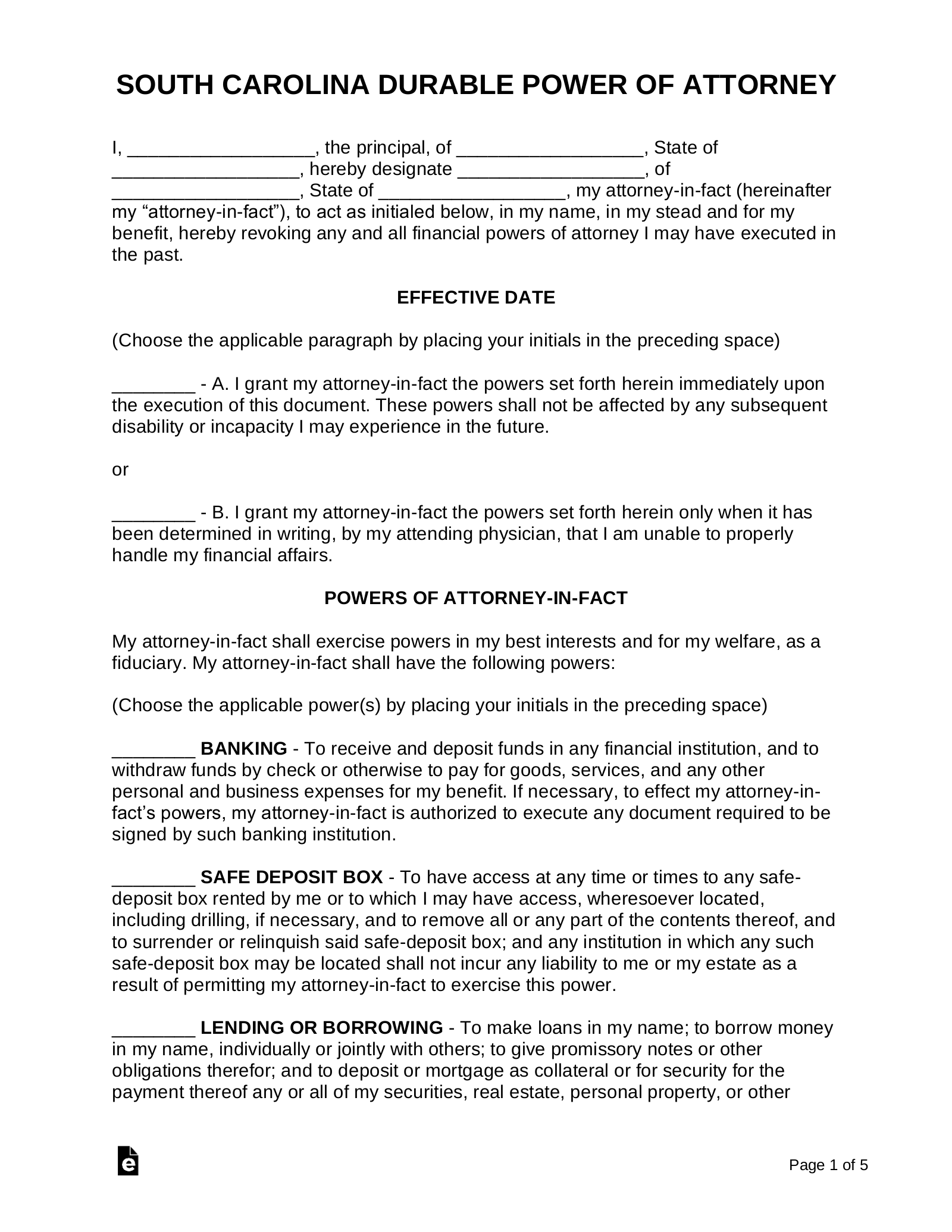
South Carolina Durable Financial Power of Attorney Form
Full Conversation
With my father being very ill, is there a way to still have him sign a durable power of attorney in the hospital, or are there other things we have to do in this type of situation?
Lexi, Chatbot
I’m sorry to hear that your loved one is very ill. Are you looking to have him sign a legal document while he is in the hospital?
I have let the hospital know that we’re going to go the hospice route, if that gives you any idea.
Lexi, Chatbot
Is there anything else the lawyer should know before I connect you? Rest assured they’ll be able to help with your durable power of attorney.
I’ve set up the form for my mother, and she can sign that in the presence of two people so that I can at least become legally the person who can look after their banking accounts and such and make sure that their bills are paid on her behalf.
Their accounts are joint accounts.
TJ, Esq.
Hello! My name is TJ, and I’m an attorney. Thanks so much for the opportunity to assist you! I’ve gone over the details you shared and I’ll post my initial response shortly. I’ll also post a few quick questions to better understand your situation.
TJ, Esq.
Generally, a durable power of attorney must be signed by the principal (the person granting authority) in the presence of a notary public and often one or two witnesses, depending on state law. The principal must have the mental capacity to understand what they are signing.
If your mother has a joint bank account with your loved one, she may already have authority to handle the accounts.
Let me ask a few questions so I can give you a clearer answer:
- Is your mother the person you want to have the DPOA for, or is it your loved one?
- When you say you’ve set up the form, do you mean you filled it out or just found it?
- What state is this taking place in?
South Carolina.
On the form site, I filled in the information for the South Carolina durable power of attorney to take care of all things — financial. Pretty much every box that it asked me, I said yes.
TJ, Esq.
Thanks for getting back to me. A durable power of attorney for financial matters must be signed by the principal, acknowledged before a notary public, and signed by two witnesses who are not the agent.
South Carolina law also requires that the person signing has contractual capacity — meaning they understand what they are signing and its effect.
I’m a little confused about whether your mother or your loved one is signing this document. Could you clarify who the principal is?
That would be my mother.
She and my dad are on most everything together — from the house they are selling, to cars, and everything.
What I have to do right now is get their bills paid, and that’s the worst thing.
My dad at the hospital marked me as the person to make all health decisions.
He can talk, but he’s very weak. His heart is failing and his kidneys are failing.
At this moment, I need to get access to maintain their checking account basically.
Later on, it would be to move my mother. Of course she can sign her own checks, but I’m going to be the one filling out everything and making sure everything stays paid. She never has done this.
A durable power of attorney is a private document and is not automatically filed with the state. If documents already existed, they may be with an attorney, a bank, a safe deposit box, or personal files.
My dad said these legal documents existed, but I cannot find them.
Is this something that is filed with the state that I could request a lookup on?
I know I can do this on her behalf without legal documents, but I prefer to have it legal and straightforward in case I need to show that.
TJ, Esq.
Since this DPOA is for your mother, she is the principal and you are the agent. For it to be valid in South Carolina, she must sign it in front of a notary and two qualified witnesses. (SC Code § 62-8-105(1))
Because your parents have joint accounts, your mother may already have authority to access those funds. However, a DPOA is still helpful for other assets and legal matters.
You should contact the bank to confirm exactly what authority your mother has under the joint account and what they require from you.
Yes, it says I need a durable power of attorney in order to maintain their accounts, so that’s why I’m going there.
One other question: once I get this DPOA, what is the process of filing it with the state?
TJ, Esq.
Once the DPOA is properly signed and notarized, it is generally effective immediately.
In South Carolina, there is no single state office where a DPOA must be filed. However, it is strongly recommended that you record it with the Register of Deeds in the county where your mother lives. This is especially important if real estate is involved, but it is also helpful for banks and other institutions.
Recording it makes it part of the public record and helps avoid disputes about your authority later.
22
8
Answered 2 weeks ago
12
3
Answered 2 weeks ago
Disclaimer
By messaging AskaLawyer.com, you agree to our Terms and have read our Privacy Policy.
The information provided on AskaLawyer.com is for general informational purposes only and does not constitute legal advice. While we strive to ensure the accuracy and timeliness of the information presented, we make no guarantees regarding its completeness or applicability to your specific circumstances.
Use of this website does not create an attorney-client relationship between you and AskaLawyer.com or any of its attorneys. Communications through this website, including any responses from attorneys, are not privileged or confidential. For advice tailored to your individual situation, we recommend consulting a licensed attorney in your jurisdiction.
AskaLawyer.com disclaims any liability for actions taken or not taken based on the content of this site. We are not responsible for any third-party content that may be accessed through this website. Reliance on any information provided herein is solely at your own risk.