Does signing a deed with a spousal waiver mean I give up ownership or inheritance rights to the property if my spouse dies?

Andres Sanchez
Andres Sanchez

23,565 satisfied customers

View context
Solved

If your goal is to transfer ownership efficiently and avoid probate, the correct legal tool depends heavily on the state where the property is located, because real estate transfers are governed by state statute.

Common probate-avoidance tools include:

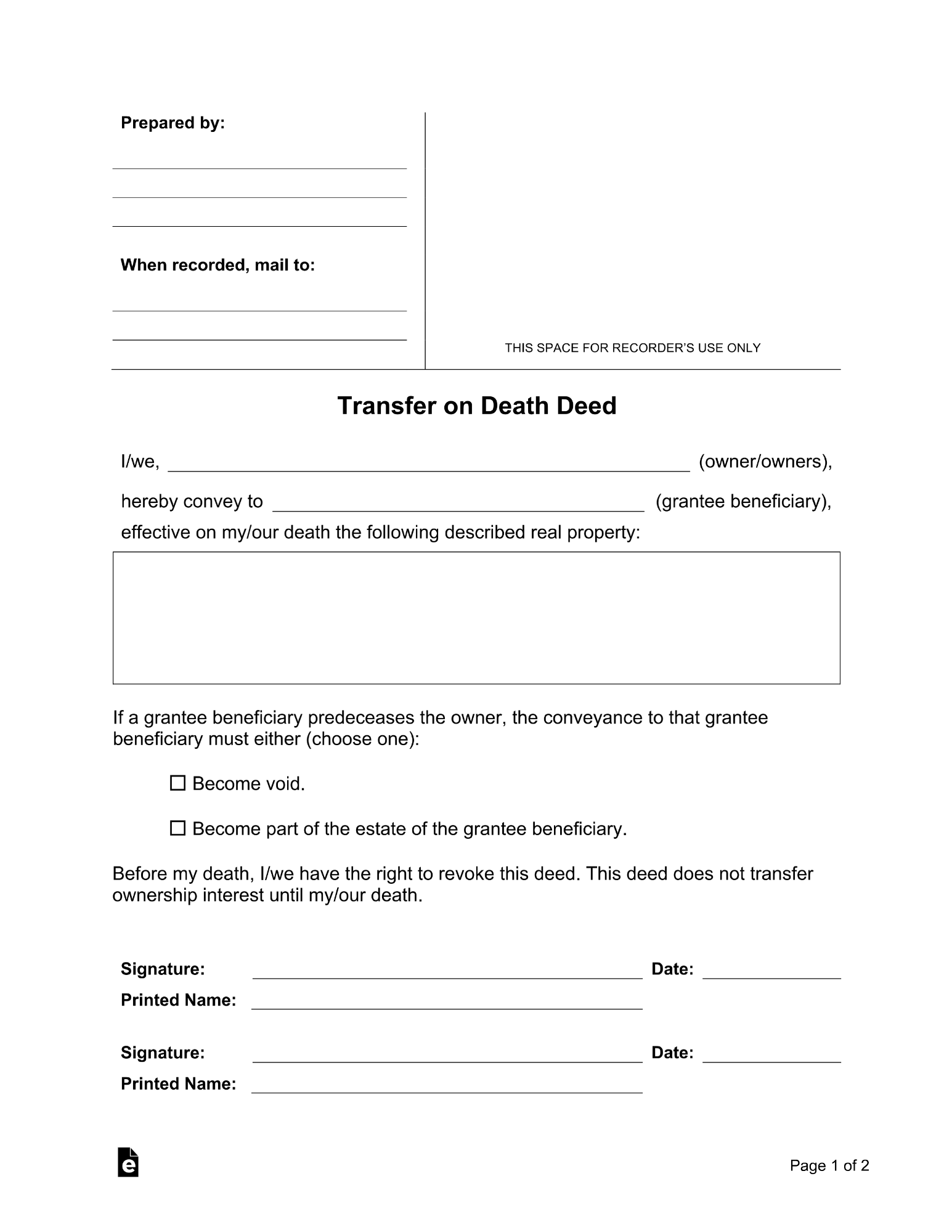
  • Transfer-on-Death (TOD) Deed – Authorized in many states under versions of the Uniform Real Property Transfer on Death Act. A TOD deed allows the owner to retain full control during life and automatically transfer the property at death without probate. It does not transfer ownership immediately.
  • Joint Tenancy with Right of Survivorship (JTWROS) – When properly created by deed language, this allows property to pass automatically to the surviving joint tenant upon death. The survivorship language must be explicit; it is not presumed in most states.
  • Revocable Living Trust – The property is deeded into the trust during lifetime, and the successor trustee distributes it according to the trust terms without probate. This provides the most control and flexibility but requires proper drafting and retitling.

The language you described sounds like a spousal waiver, which is typically used when one spouse relinquishes marital or inheritance rights (for example, elective share rights under many state probate codes). That type of document does not transfer ownership and can actually eliminate protections rather than create them.

Before signing anything, you should verify:

  • Who is listed as grantor (the person conveying title)
  • Who is listed as grantee (the person receiving title)
  • Whether the deed language actually adds you as a current co-owner
  • Whether the document references a TOD statute
  • The state where the property is located

If your name is not being added as a grantee, then ownership is not being transferred to you. If the document contains waiver language, you could be giving up statutory marital rights such as elective share, homestead, or community property rights, depending on the state.

Because real estate rights and spousal protections are highly state-specific, the safest next step is to confirm the property’s state and the exact title language before signing.

0

Transfer on Death Deed

Full Conversation


Hi, completing a transfer of deed document and it appears that as the primary beneficiary and spouse I am giving consent to relinquish ownership upon death. in accordance with this Deed, and in consideration of good and value consideration, do hereby waive all my rights in and to the above-described real property, including any rights of dower, homestead, curtesy, community property, and any other applicable right, title, or interest.

Lexi

Lexi, Chatbot

I understand that dealing with deed documents can be quite complex and concerning. Can you please share if this transfer of deed is part of a larger estate planning process?

Not at this time. The house we live in is only in his name. We do have a living will.

Lexi

Lexi, Chatbot

Have you consulted with any legal professionals regarding the implications of relinquishing ownership in this manner?

Not yet. I was told by someone that we should do a transfer of deed to secure the house for me even if we have a living will. Is this not correct?

Andres Sanchez

Andres Sanchez

Hi there! I'm Andres Sanchez, and I'm here to help you with your concerns about the transfer of deed document. Please note this is general legal information only and does not create an attorney-client relationship.

Trying to figure out if you need a transfer of deed — and whether this language protects you — makes sense.

Trying to figure out if I need a transfer of deed. As this reads it doesn’t make sense.

Andres Sanchez

Andres Sanchez

Let’s break this down clearly.

The language you quoted — where you “waive all rights” including homestead, dower, curtesy, community property, and any other interest — typically means you are giving up rights, not securing them.

If the house is only in his name, you currently do not hold title ownership. However, as a spouse, you may still have certain marital or inheritance rights depending on your state.

A living will does not transfer property. A living will only handles medical decisions if someone becomes incapacitated. It does not control real estate ownership after death.

Ensure immediate ownership transfer, thus avoiding probate.

Andres Sanchez

Andres Sanchez

If your goal is to transfer ownership efficiently and avoid probate, the correct legal tool depends heavily on the state where the property is located, because real estate transfers are governed by state statute.

Common probate-avoidance tools include:

  • Transfer-on-Death (TOD) Deed – Authorized in many states under versions of the Uniform Real Property Transfer on Death Act. A TOD deed allows the owner to retain full control during life and automatically transfer the property at death without probate. It does not transfer ownership immediately.
  • Joint Tenancy with Right of Survivorship (JTWROS) – When properly created by deed language, this allows property to pass automatically to the surviving joint tenant upon death. The survivorship language must be explicit; it is not presumed in most states.
  • Revocable Living Trust – The property is deeded into the trust during lifetime, and the successor trustee distributes it according to the trust terms without probate. This provides the most control and flexibility but requires proper drafting and retitling.

The language you described sounds like a spousal waiver, which is typically used when one spouse relinquishes marital or inheritance rights (for example, elective share rights under many state probate codes). That type of document does not transfer ownership and can actually eliminate protections rather than create them.

Before signing anything, you should verify:

  • Who is listed as grantor (the person conveying title)
  • Who is listed as grantee (the person receiving title)
  • Whether the deed language actually adds you as a current co-owner
  • Whether the document references a TOD statute
  • The state where the property is located

If your name is not being added as a grantee, then ownership is not being transferred to you. If the document contains waiver language, you could be giving up statutory marital rights such as elective share, homestead, or community property rights, depending on the state.

Because real estate rights and spousal protections are highly state-specific, the safest next step is to confirm the property’s state and the exact title language before signing.

Thanks.

Andres Sanchez

Andres Sanchez

You’re welcome. If you’d like, tell me what state the property is located in, and I can explain what the correct probate-avoidance method usually looks like there.

Andres Sanchez

Andres Sanchez

23,565 satisfied customers

Andres Sanchez
Welcome! Have a similar question?

12 lawyers online now

0:00

By messaging AskALawyer, you agree to our Terms and Privacy Policy.

Disclaimer


By messaging AskaLawyer.com, you agree to our Terms and have read our Privacy Policy.

The information provided on AskaLawyer.com is for general informational purposes only and does not constitute legal advice. While we strive to ensure the accuracy and timeliness of the information presented, we make no guarantees regarding its completeness or applicability to your specific circumstances.

Use of this website does not create an attorney-client relationship between you and AskaLawyer.com or any of its attorneys. Communications through this website, including any responses from attorneys, are not privileged or confidential. For advice tailored to your individual situation, we recommend consulting a licensed attorney in your jurisdiction.

AskaLawyer.com disclaims any liability for actions taken or not taken based on the content of this site. We are not responsible for any third-party content that may be accessed through this website. Reliance on any information provided herein is solely at your own risk.

Ask a Lawyer Logo
Ask a Lawyer Logo
Intake Questions
Step  of 3
Loading...

Lexi, Chatbot

How would you like your legal question to be answered?

Online

Legal AI

Using ChatGPT 4o

Loading...

How do you like to pay?

By proceeding with payment, you agree to our Terms and Privacy Policy. You authorize us to charge $ today and $ thereafter until canceled. You may cancel anytime in the My Account section to stop future charges.

Total Due:

After purchasing, your chat will begin with an attorney.

By proceeding with payment, you agree to our Terms and Privacy Policy. You authorize us to charge $ today and $ thereafter until canceled. You may cancel anytime in the My Account section to stop future charges.

Total Due:

After purchasing, your chat will begin with an attorney.

After connecting, your chat will begin with an attorney.

After choosing, your chat will continue with Legal AI.

It looks like you already have an account with Ask a Lawyer.

We have sent you a magic link to . Click the link in your email to sign in and continue your chat.

spin

Step of 6 •

You'll receive an email at as soon as the lawyer joins the conversation 🙏🏻😊

Over 90% of lawyers connect within 5 minutes. If you're not online at that moment, don't worry — the lawyer will reply to your message while you're away.

You're also welcome to stay in the chat while waiting to be connected 💬✨

Waiting for lawyer

0:00