Does a small estate affidavit only apply to assets without beneficiaries, and exclude an annuity with no named beneficiary?

Legal Eagle
Legal Eagle

133,377 satisfied customers

View context
Solved

You are correct in your understanding of how a Small Estate Affidavit generally works. In most states, including those that follow the Uniform Probate Code, this affidavit is used to collect assets that do not pass automatically to a named beneficiary or joint owner.

When an account has a designated beneficiary, that asset typically transfers outside of probate by operation of contract, meaning the financial institution pays directly to the beneficiary listed on the account. The same applies to jointly held accounts with rights of survivorship — they are not part of the probate estate and do not need to be included in the affidavit.

Therefore, the annuity without a beneficiary is the asset that would require probate or a small estate procedure, while the other accounts with beneficiaries or joint ownership do not.

The question on the affidavit asking whether the decedent had “any other assets” is intended to ensure full disclosure of probate assets, not non-probate transfers. You should list only those assets that do not have a beneficiary designation and are not jointly owned with survivorship rights.

If the annuity is the only such asset, then that is the focus of the affidavit. However, it is important to confirm whether the annuity contract allows for a default beneficiary provision — some annuities name the estate as the beneficiary if no individual is listed. If that is the case, the funds become part of the probate estate and can be collected through the affidavit process.

The checking account, since you are a joint owner, passes to you by law and does not need to be included unless the account was structured differently (for example, “tenants in common” rather than “joint tenants with right of survivorship”).

0

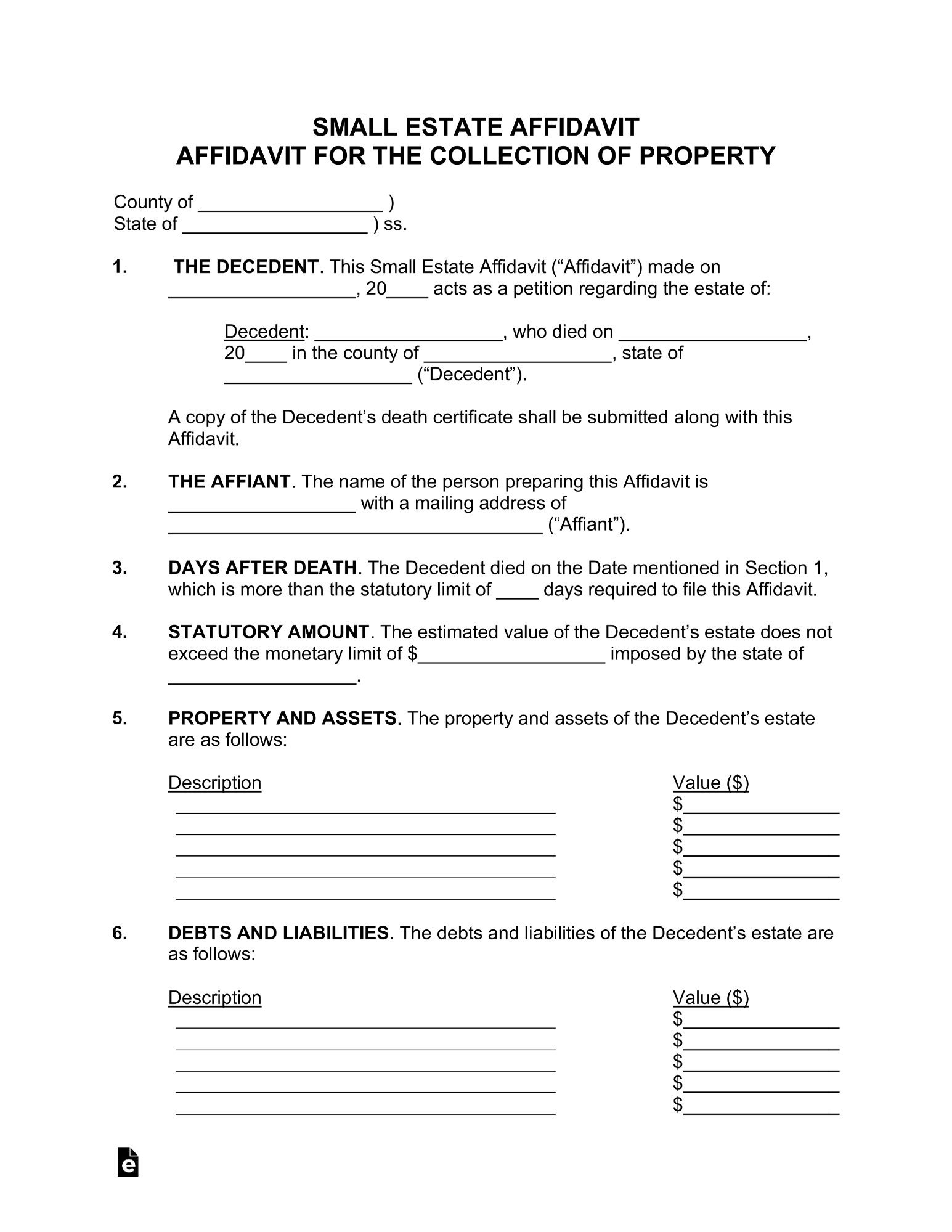
Small Estate Affidavit Form

Full Conversation


Morning, I am working on my sister's investment accounts. All her accounts have beneficiaries listed except for one, that is an annuity for $30K.

When filling out a Small Estate Affidavit, which is needed to get the money to the beneficiaries on her will, the question is asked: does she have any other assets? My understanding is that this Small Estate Affidavit is only for accounts that don't have any beneficiaries listed. Is that correct?

She had no house. Her other investments have been disbursed to the beneficiaries listed on her will. Her checking account is still open, as I am a joint owner on it, and that has beneficiaries listed as well. Is that the correct assumption?

Lexi

Lexi, Chatbot

I understand that dealing with your sister's investments can be quite complex. Can you confirm if the annuity is the only asset without a beneficiary listed?

Yes.

Lexi

Lexi, Chatbot

Have you already started the process of filling out the Small Estate Affidavit, or are you still gathering information?

Starting the process.

Legal Eagle

Legal Eagle

Good day and welcome. Please give me a moment to review your question. Note that I am a hearing-impaired expert and so phone calls are difficult for me. Thank you for understanding.

Just so you are aware, this is a legal information only site. I do not provide representation and no attorney-client relationship is formed. My answers and comments should not be considered legal advice. It is always best to hire a local attorney to review the specifics of your particular case to ensure that a proper review is conducted.

Can you share a little more about your situation?

I am working on my sister's investment accounts. All her accounts have beneficiaries listed except for one, that is an annuity for $30K.

When filling out a Small Estate Affidavit, which is needed to get the money to the beneficiaries on her will, the question is asked does she have any other assets? My understanding is that this Small Estate Affidavit is only for accounts that don't have any beneficiaries listed. Is that correct?

She had no house. Her other investments have been disbursed to the beneficiaries listed on her will. Her checking account is still open, as I am a joint owner on it, and that has beneficiaries listed as well. Is that the correct assumption? For her checking account, there are two joint owners. My other sister & I. But it also has beneficiaries listed on that account. So we would want the money to be disbursed to them.

Legal Eagle

Legal Eagle

You are correct in your understanding of how a Small Estate Affidavit generally works. In most states, including those that follow the Uniform Probate Code, this affidavit is used to collect assets that do not pass automatically to a named beneficiary or joint owner.

When an account has a designated beneficiary, that asset typically transfers outside of probate by operation of contract, meaning the financial institution pays directly to the beneficiary listed on the account. The same applies to jointly held accounts with rights of survivorship — they are not part of the probate estate and do not need to be included in the affidavit.

Therefore, the annuity without a beneficiary is the asset that would require probate or a small estate procedure, while the other accounts with beneficiaries or joint ownership do not.

The question on the affidavit asking whether the decedent had “any other assets” is intended to ensure full disclosure of probate assets, not non-probate transfers. You should list only those assets that do not have a beneficiary designation and are not jointly owned with survivorship rights.

If the annuity is the only such asset, then that is the focus of the affidavit. However, it is important to confirm whether the annuity contract allows for a default beneficiary provision — some annuities name the estate as the beneficiary if no individual is listed. If that is the case, the funds become part of the probate estate and can be collected through the affidavit process.

The checking account, since you are a joint owner, passes to you by law and does not need to be included unless the account was structured differently (for example, “tenants in common” rather than “joint tenants with right of survivorship”).

For her checking account, there are two joint owners. My other sister & I. But it also has beneficiaries listed on that account. So we would want the money to be disbursed to them.

Legal Eagle

Legal Eagle

Makes total sense.

Thanks for your help.

Legal Eagle

Legal Eagle

You're very welcome.

Legal Eagle

Legal Eagle

133,377 satisfied customers

Criminal law, employment law, family law, landlord-tenant, and real estate law.

Legal Eagle
Welcome! Have a similar question?

12 lawyers online now

0:00

By messaging AskALawyer, you agree to our Terms and Privacy Policy.

Jessica B
Jessica B

Attorney

4.73 (30,891)

[FL] Does the agent need to sign a power of attorney?

17

7

Answered 2 hours ago

Liz
Liz

Lawyer

4.75 (43,836)

[IN] Can I create a power of attorney with only witnesses and a notary?

20

8

Answered 2 hours ago

Disclaimer


By messaging AskaLawyer.com, you agree to our Terms and have read our Privacy Policy.

The information provided on AskaLawyer.com is for general informational purposes only and does not constitute legal advice. While we strive to ensure the accuracy and timeliness of the information presented, we make no guarantees regarding its completeness or applicability to your specific circumstances.

Use of this website does not create an attorney-client relationship between you and AskaLawyer.com or any of its attorneys. Communications through this website, including any responses from attorneys, are not privileged or confidential. For advice tailored to your individual situation, we recommend consulting a licensed attorney in your jurisdiction.

AskaLawyer.com disclaims any liability for actions taken or not taken based on the content of this site. We are not responsible for any third-party content that may be accessed through this website. Reliance on any information provided herein is solely at your own risk.

Ask a Lawyer Logo
Ask a Lawyer Logo
Intake Questions
Step  of 3
Loading...

Lexi, Chatbot

How would you like your legal question to be answered?

Online

Legal AI

Using ChatGPT 4o

Loading...

How do you like to pay?

By proceeding with payment, you agree to our Terms and Privacy Policy. You authorize us to charge $ today and $ thereafter until canceled. You may cancel anytime in the My Account section to stop future charges.

Total Due:

After purchasing, your chat will begin with an attorney.

By proceeding with payment, you agree to our Terms and Privacy Policy. You authorize us to charge $ today and $ thereafter until canceled. You may cancel anytime in the My Account section to stop future charges.

Total Due:

After purchasing, your chat will begin with an attorney.

After connecting, your chat will begin with an attorney.

After choosing, your chat will continue with Legal AI.

It looks like you already have an account with Ask a Lawyer.

We have sent you a magic link to . Click the link in your email to sign in and continue your chat.

spin

Step of 6 •

You'll receive an email at as soon as the lawyer joins the conversation 🙏🏻😊

Over 90% of lawyers connect within 5 minutes. If you're not online at that moment, don't worry — the lawyer will reply to your message while you're away.

You're also welcome to stay in the chat while waiting to be connected 💬✨

Waiting for lawyer

0:00