How does a transfer on death deed for a house work to avoid probate?

Legal Eagle
Legal Eagle

133,377 satisfied customers

View context
Solved

Using a Transfer on Death Deed (TODD)—sometimes called a Beneficiary Deed—is a common and effective estate planning tool to help assets pass directly to heirs while avoiding the time and expense of probate.

However, because real estate laws vary significantly by state, you need to ensure this is done correctly for the specific jurisdiction where the property is located.

Important Considerations for a TODD

State Specifics: Not every state allows Transfer on Death Deeds. You must verify if the state where the house is located recognizes them. If it does, you must use that specific state's required form.

Recording Requirements: A TODD is not effective just because it is signed and notarized. It must be filed and recorded with the County Recorder of Deeds or the appropriate land records office in the county where the property is located before the owner passes away.

The "Executor" Role: You mentioned being the executor of your father's will. It is important to understand that a TODD supersedes a will. If the house has a properly recorded TODD, the house will pass directly to the named beneficiary (you) automatically upon your father's death, bypassing the probate process entirely. Your authority as executor under the will does not apply to property that has been transferred via a TODD.

Existing Mortgages/Liens: If there is a mortgage on the house, the property usually passes to the beneficiary subject to that mortgage. The mortgage does not disappear upon death; the beneficiary will generally be responsible for continuing the payments or refinancing the loan.

Medicaid/Estate Recovery: In some states, if your father received state-funded long-term care (like Medicaid), the state may have the right to place a claim against the property even if a TODD is in place. An attorney can help you determine if this is a risk in your specific situation.

Steps to Take

  • Verify state law allows TODDs
  • Obtain the correct state-specific form
  • Ensure the legal description of the property is accurate
  • Have your father sign in front of a notary
  • Record the deed with the county before death
  • Keep copies with estate documents

A Note on "Savings"

You mentioned wanting to avoid probate for both the house and the savings.

TODDs are for real estate only.

For bank accounts, you should use a Payable on Death (POD) or Transfer on Death (TOD) designation through the bank. This allows funds to pass directly to you without probate.

0

Transfer on Death (Beneficiary) Deed Form
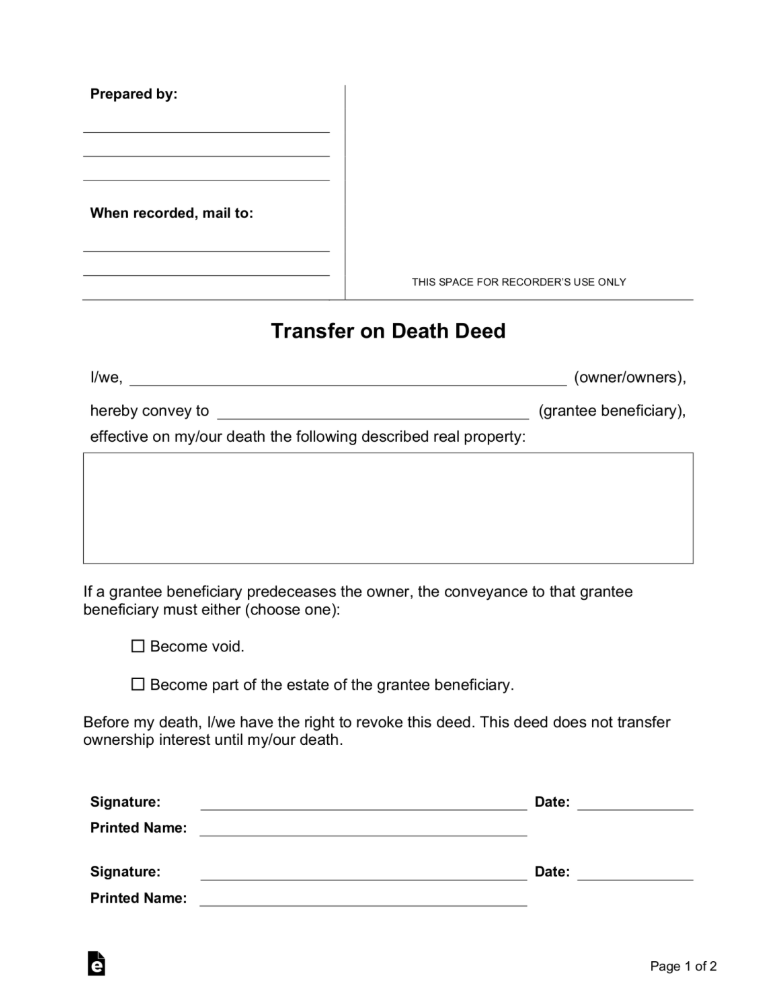
Full Conversation


Simple basic transfer from father to son, paid for house and savings. Looking to do the TODD on house to avoid probate. Dad’s will clearly has me as executor of will.

Lexi

Lexi, Chatbot

I understand that you're looking to simplify the transfer of assets from your father to you. Have you already discussed the Transfer on Death Deed (TODD) with your father?

Yes.

Lexi

Lexi, Chatbot

Is there any specific timeline you are working with for this transfer?

Now.

Legal Eagle

Legal Eagle

Thanks for reaching out to our service. I'm an attorney with many years of experience. I understand you're looking to do a Transfer on Death Deed (TODD) for your father's house to avoid probate, with you as the executor of the will.

Legal Eagle

Legal Eagle

Using a Transfer on Death Deed (TODD)—sometimes called a Beneficiary Deed—is a common and effective estate planning tool to help assets pass directly to heirs while avoiding the time and expense of probate.

However, because real estate laws vary significantly by state, you need to ensure this is done correctly for the specific jurisdiction where the property is located.

Important Considerations for a TODD

State Specifics: Not every state allows Transfer on Death Deeds. You must verify if the state where the house is located recognizes them. If it does, you must use that specific state's required form.

Recording Requirements: A TODD is not effective just because it is signed and notarized. It must be filed and recorded with the County Recorder of Deeds or the appropriate land records office in the county where the property is located before the owner passes away.

The "Executor" Role: You mentioned being the executor of your father's will. It is important to understand that a TODD supersedes a will. If the house has a properly recorded TODD, the house will pass directly to the named beneficiary (you) automatically upon your father's death, bypassing the probate process entirely. Your authority as executor under the will does not apply to property that has been transferred via a TODD.

Existing Mortgages/Liens: If there is a mortgage on the house, the property usually passes to the beneficiary subject to that mortgage. The mortgage does not disappear upon death; the beneficiary will generally be responsible for continuing the payments or refinancing the loan.

Medicaid/Estate Recovery: In some states, if your father received state-funded long-term care (like Medicaid), the state may have the right to place a claim against the property even if a TODD is in place. An attorney can help you determine if this is a risk in your specific situation.

Steps to Take

  • Verify state law allows TODDs
  • Obtain the correct state-specific form
  • Ensure the legal description of the property is accurate
  • Have your father sign in front of a notary
  • Record the deed with the county before death
  • Keep copies with estate documents

A Note on "Savings"

You mentioned wanting to avoid probate for both the house and the savings.

TODDs are for real estate only.

For bank accounts, you should use a Payable on Death (POD) or Transfer on Death (TOD) designation through the bank. This allows funds to pass directly to you without probate.

Legal Eagle

Legal Eagle

133,377 satisfied customers

Criminal law, employment law, family law, landlord-tenant, and real estate law.

Legal Eagle
Welcome! Have a similar question?

12 lawyers online now

0:00

By messaging AskALawyer, you agree to our Terms and Privacy Policy.

Disclaimer


By messaging AskaLawyer.com, you agree to our Terms and have read our Privacy Policy.

The information provided on AskaLawyer.com is for general informational purposes only and does not constitute legal advice. While we strive to ensure the accuracy and timeliness of the information presented, we make no guarantees regarding its completeness or applicability to your specific circumstances.

Use of this website does not create an attorney-client relationship between you and AskaLawyer.com or any of its attorneys. Communications through this website, including any responses from attorneys, are not privileged or confidential. For advice tailored to your individual situation, we recommend consulting a licensed attorney in your jurisdiction.

AskaLawyer.com disclaims any liability for actions taken or not taken based on the content of this site. We are not responsible for any third-party content that may be accessed through this website. Reliance on any information provided herein is solely at your own risk.

Ask a Lawyer Logo
Ask a Lawyer Logo
Intake Questions
Step  of 3
Loading...

Lexi, Chatbot

How would you like your legal question to be answered?

Online

Legal AI

Using ChatGPT 4o

Loading...

How do you like to pay?

By proceeding with payment, you agree to our Terms and Privacy Policy. You authorize us to charge $ today and $ thereafter until canceled. You may cancel anytime in the My Account section to stop future charges.

Total Due:

After purchasing, your chat will begin with an attorney.

By proceeding with payment, you agree to our Terms and Privacy Policy. You authorize us to charge $ today and $ thereafter until canceled. You may cancel anytime in the My Account section to stop future charges.

Total Due:

After purchasing, your chat will begin with an attorney.

After connecting, your chat will begin with an attorney.

After choosing, your chat will continue with Legal AI.

It looks like you already have an account with Ask a Lawyer.

We have sent you a magic link to . Click the link in your email to sign in and continue your chat.

spin

Step of 6 •

You'll receive an email at as soon as the lawyer joins the conversation 🙏🏻😊

Over 90% of lawyers connect within 5 minutes. If you're not online at that moment, don't worry — the lawyer will reply to your message while you're away.

You're also welcome to stay in the chat while waiting to be connected 💬✨

Waiting for lawyer

0:00