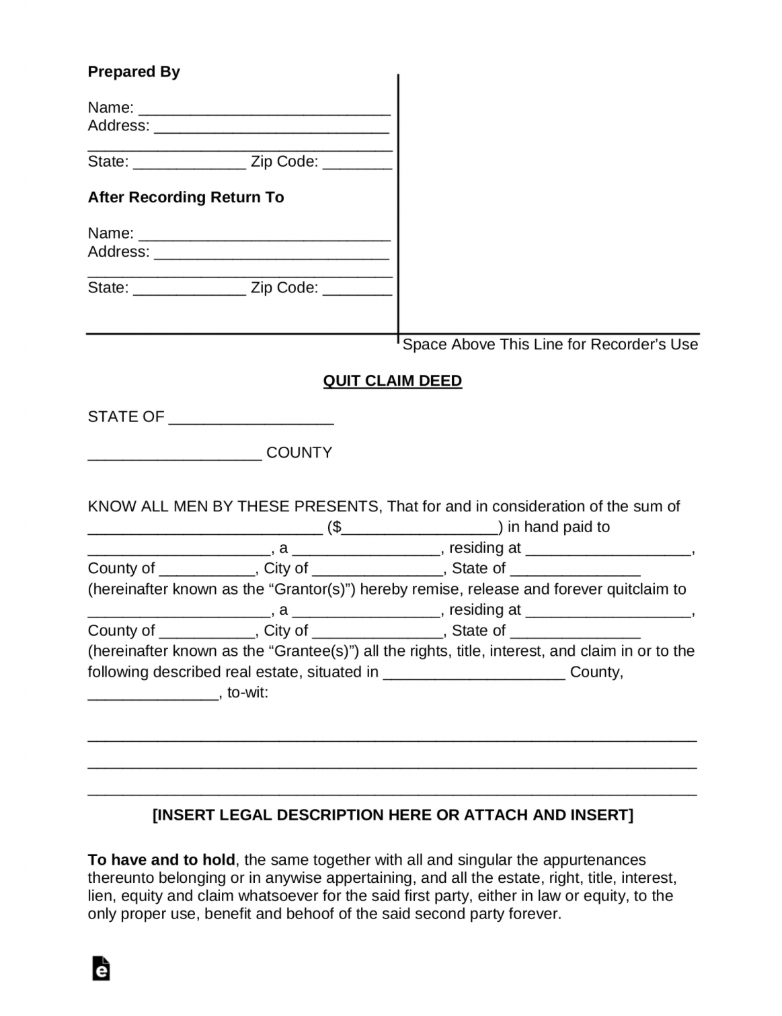
Can a quitclaim deed override a restrictive covenant on how land must be used?

Andrew F., Esq.
Andrew F., Esq.

42 satisfied customers

View context
Solved

What you are running into is not really a "transfer" problem, but rather a title restriction (a restrictive covenant or condition in the deed). The language requiring the land to "be used, kept, and maintained as a divine place of worship" is legally part of the chain of title and runs with the land, a legal doctrine known as a covenant running with the land, meaning every later owner is bound by it unless it is formally released or extinguished.

A quitclaim deed (QCD) by itself does not override that restriction. A QCD only transfers whatever interest the grantor currently has; it does not erase prior recorded covenants. So if the original grantor imposed a use restriction, simply drafting a new deed that omits the language will not remove it. The restriction still exists because it was recorded earlier and remains enforceable by whoever holds the benefit (often the original grantor, heirs, or sometimes neighboring property owners). The key legal concept is that you are not "rewriting" the deed; you are clearing an encumbrance on title.

To actually allow the church to convey part of the parcel, you typically need a recorded release, modification, or termination of the restrictive covenant from the party who has enforcement rights, not just a new QCD from your church. In practice this is usually done through a separate document, often called a "Release of Restrictive Covenant," "Covenant Modification," or similar instrument, signed by the original grantor (or successors) and recorded, specifically stating that the worship-use restriction is released as to the portion being conveyed (or entirely). The new QCD transferring the small parcel would then reference that recorded release.

If you instead try to include "override language" inside the church's new deed, the title company will likely reject insuring the buyer's title, because your church cannot unilaterally extinguish a covenant it did not create. So the focus should be on identifying who currently holds the right to enforce the restriction and obtaining a properly drafted and recorded release first. Once that encumbrance is cleared, the parcel transfer becomes a routine conveyance.

Does that make sense?

0

Quit Claim Deed

Full Conversation


I believe I need to put this QCD in place to override the language of the original deed, in the last paragraph of my Schedule A, that refers to the property needing to "be used, kept, and maintained as a divine place of worship," etc.

Lexi

Lexi, Chatbot

I understand that dealing with property deeds can be quite complex. Can you please share what specific changes you are looking to make with the QCD?

I don't know.

Lexi

Lexi, Chatbot

Have you already consulted with any legal professionals regarding this matter, or is this your first step in seeking assistance?

I don't know.

Andrew F., Esq.

Andrew F., Esq.

Good day and welcome. Please give me a moment to review your question. Note that I am a hearing impaired expert, so phone calls are difficult for me. Thank you for understanding. Just so you are aware, this is a legal information only site. I do not provide representation, and no attorney-client relationship is formed. My answers and comments should not be considered legal advice. It is always best to hire a local attorney to review the specifics of your particular case to ensure that a proper review is conducted.

Any other recent developments?

I've spoken with my local attorney on this. His take is what is described in my first message. I'm trying to play the role of paralegal here, as he is inundated with other work. My main question is whether we need to include or omit the original language of the deed in the new QCD. I believe we need language that overrides the aforementioned "use for divine worship" restriction. Our overall desire, as a church, is to transfer a small parcel of adjoining land to another adjoining landowner, and this seemingly restrictive language prohibits the church from doing so until we get a QCD from the original owner of the adjoining parcel.

Andrew F., Esq.

Andrew F., Esq.

What you are running into is not really a "transfer" problem, but rather a title restriction (a restrictive covenant or condition in the deed). The language requiring the land to "be used, kept, and maintained as a divine place of worship" is legally part of the chain of title and runs with the land, a legal doctrine known as a covenant running with the land, meaning every later owner is bound by it unless it is formally released or extinguished.

A quitclaim deed (QCD) by itself does not override that restriction. A QCD only transfers whatever interest the grantor currently has; it does not erase prior recorded covenants. So if the original grantor imposed a use restriction, simply drafting a new deed that omits the language will not remove it. The restriction still exists because it was recorded earlier and remains enforceable by whoever holds the benefit (often the original grantor, heirs, or sometimes neighboring property owners). The key legal concept is that you are not "rewriting" the deed; you are clearing an encumbrance on title.

To actually allow the church to convey part of the parcel, you typically need a recorded release, modification, or termination of the restrictive covenant from the party who has enforcement rights, not just a new QCD from your church. In practice this is usually done through a separate document, often called a "Release of Restrictive Covenant," "Covenant Modification," or similar instrument, signed by the original grantor (or successors) and recorded, specifically stating that the worship-use restriction is released as to the portion being conveyed (or entirely). The new QCD transferring the small parcel would then reference that recorded release.

If you instead try to include "override language" inside the church's new deed, the title company will likely reject insuring the buyer's title, because your church cannot unilaterally extinguish a covenant it did not create. So the focus should be on identifying who currently holds the right to enforce the restriction and obtaining a properly drafted and recorded release first. Once that encumbrance is cleared, the parcel transfer becomes a routine conveyance.

Does that make sense?

Yes, generally speaking. Here's a bit more detail: we are the church, owning Parcel A, 3 acres. We acquired a neighboring parcel of 2 acres, Parcel B, in 2000, and that acquisition included the restrictive language. We have been approached to "slice off" about a quarter acre for the neighbor on the far side of Parcel B, so he can legally upgrade his septic system. He needs about 30 more feet. It seems incredibly odd and restrictive that we, as the church, can't simply slice off the needed 30 feet to do this without a QCD or other modification. Please elaborate more.

Andrew F., Esq.

Andrew F., Esq.

It feels odd, but legally the restriction is a condition running with the land, so even though the church owns Parcel B, you cannot subdivide or convey any portion for a non-church use (like a neighbor's septic field) until the party who originally imposed that worship-use covenant, or their successors, signs and records a formal release or modification clearing that restriction from title.

The former owner is still living, and I spoke with her about her willingness to sign some document to make this happen. She is more than agreeable. I just want to ensure we're going down the right path, and do it once.

Andrew F., Esq.

Andrew F., Esq.

So sorry you're dealing with this.

So, the best recommendation is a "Release of Restrictive Covenant," "Covenant Modification," or similar instrument? Roger that, thanks much for the steer.

Andrew F., Esq.

Andrew F., Esq.

You bet. Best of luck to you.

Andrew F., Esq.

Andrew F., Esq.

42 satisfied customers

Andrew F., Esq.
Welcome! Have a similar question?

12 lawyers online now

0:00

By messaging AskALawyer, you agree to our Terms and Privacy Policy.

Disclaimer


By messaging AskaLawyer.com, you agree to our Terms and have read our Privacy Policy.

The information provided on AskaLawyer.com is for general informational purposes only and does not constitute legal advice. While we strive to ensure the accuracy and timeliness of the information presented, we make no guarantees regarding its completeness or applicability to your specific circumstances.

Use of this website does not create an attorney-client relationship between you and AskaLawyer.com or any of its attorneys. Communications through this website, including any responses from attorneys, are not privileged or confidential. For advice tailored to your individual situation, we recommend consulting a licensed attorney in your jurisdiction.

AskaLawyer.com disclaims any liability for actions taken or not taken based on the content of this site. We are not responsible for any third-party content that may be accessed through this website. Reliance on any information provided herein is solely at your own risk.

Ask a Lawyer Logo
Ask a Lawyer Logo
Intake Questions
Step  of 3
Loading...

What's your legal question?

Lexi, Chatbot

How would you like your legal question to be answered?

Online

Loading...

How do you like to pay?

By proceeding with payment, you agree to our Terms and Privacy Policy. You authorize us to charge $ today and $ thereafter until canceled. You may cancel anytime in the My Account section to stop future charges.

Total Due:

After purchasing, your chat will begin with an attorney.

By proceeding with payment, you agree to our Terms and Privacy Policy. You authorize us to charge $ today and $ thereafter until canceled. You may cancel anytime in the My Account section to stop future charges.

Total Due:

After purchasing, your chat will begin with an attorney.

After connecting, your chat will begin with an attorney. After choosing, your chat will continue with Legal AI.

It looks like you already have an account with Ask a Lawyer.

We have sent you a magic link to . Click the link in your email to sign in and continue your chat.

spin

Step of 6 •

You'll receive an email at as soon as the lawyer joins the conversation 🙏🏻😊

Over 90% of lawyers connect within 5 minutes. If you're not online at that moment, don't worry — the lawyer will reply to your message while you're away.

You're also welcome to stay in the chat while waiting to be connected 💬✨

Waiting for lawyer

We couldn't send your message. Please try again.

Your lawyer will reply as soon as possible

If there’s a delay, please don’t worry. Your chat will stay open, and they’ll get back to you as soon as they can. There’s no rush on your end either. You’ll receive an email notification as soon as there’s a new message.

You've reached your AI chat limit

Upgrade your plan to continue chatting and get instant domain-specific answers.

0:00