[MI] How can I prepare for divorce to protect assets?

MI Divorce
Jon
Jon

556 satisfied customers

View context
Solved

Michigan is an equitable distribution state under MCL 552.23(1) and MCL 552.401, which means property is divided fairly—not automatically 50/50. Michigan courts follow long-standing case law (including Sparks v. Sparks, 440 Mich 141 (1992)) requiring division based on equity and the circumstances of the marriage.

1. Premarital vs. Marital Property

You purchased the home in 2015 and married in 2017. That timing is legally significant.

Under Michigan law:

  • Property owned before marriage is generally considered separate property.
  • However, appreciation in value during the marriage may be considered marital if marital efforts or funds contributed to the increase (see Reeves v. Reeves, 226 Mich App 490 (1997)).

Therefore:

  • Equity accumulated from 2015–2017 is typically your separate property.
  • Equity growth from 2017 to present is potentially marital property, especially if marital income was used to pay down the mortgage or improve the property.

2. How Courts Typically Analyze This

If total current equity is approximately $100,000, the court would typically:

  1. Determine the home’s value and mortgage balance as of the date of marriage (2017).
  2. Set aside that premarital equity to you.
  3. Calculate the increase in equity from 2017 to present.
  4. Divide that marital portion equitably.

Equitable does not necessarily mean equal. Courts may adjust percentages based on fairness factors.

3. Survivor Benefits

Your children’s survivor benefits under 42 U.S.C. § 402(d) are federal Social Security benefits payable for the benefit of the child. Those funds legally belong to the child and are intended for support.

Michigan courts do not treat Social Security benefits as divisible marital property, and federal law preempts state courts from dividing Social Security benefits as property (see Hisquierdo v. Hisquierdo, 439 U.S. 572 (1979), applied broadly to Social Security protections).

If those benefits helped subsidize housing, utilities, or general household expenses, that fact is relevant. It supports the argument that marital income alone was not solely responsible for building equity in the home.

4. Michigan Equitable Distribution Factors

Under Sparks and related case law, courts consider:

  • Duration of the marriage
  • Contributions of the parties to the marital estate
  • Age and health of the parties
  • Life status and earning abilities
  • Needs of the parties and children
  • Source of the property
  • General principles of equity

Your marriage began in 2017. In divorce terms, that is considered a relatively shorter-term marriage. Michigan courts are often reluctant to significantly redistribute premarital assets in shorter marriages absent strong equitable reasons.

5. Likely Structure of Division

A common equitable framework would be:

  • Determine current fair market value.
  • Subtract current mortgage balance.
  • Determine equity at date of marriage (set aside to you).
  • Divide only the equity growth during the marriage.
  • Adjust based on contributions and fairness factors.

That analysis frequently results in a buyout that is significantly less than half of total current equity, particularly where there was substantial premarital ownership.

The key evidence in your case will be documentation of the home’s value and mortgage balance in 2017, mortgage payment history, and proof of how household expenses were funded.

0

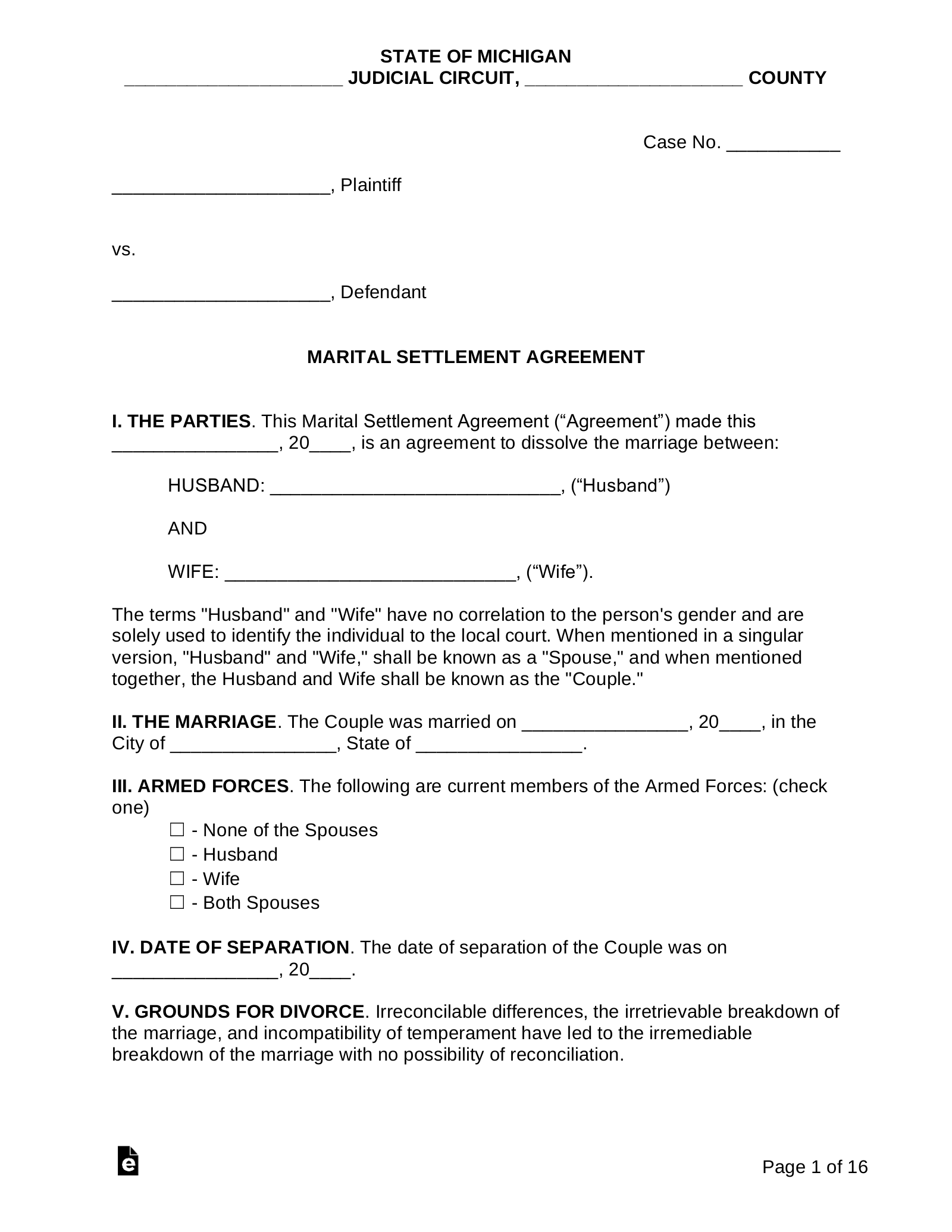
Michigan Marital Settlement Agreement
Full Conversation


I am looking for basic information about what divorce prep I need to do in the state of Michigan when divorcing and dividing a household that includes my kids from a previous marriage. Am trying to find the “safest” way to make sure when we divorce it can be fair to him, without destroying me financially in the process.

Lexi

Lexi, Chatbot

I understand that preparing for a divorce can be overwhelming, especially when children are involved. Have you already discussed the divorce with your spouse, or is this still in the planning stages?

Yes, we have discussed, but we know our situation is semi-unique and need to know more about what it can look like in our state.

Lexi

Lexi, Chatbot

Are there any specific concerns you have regarding child custody or financial arrangements that you would like to address?

No custody issues, the children are both mine from a previous marriage. I’m trying to find out what I would need to plan to financially provide to him in order for us to divorce and me to keep the house. Other than the home itself, there are no real assets to divide, and we don’t share bank accounts.

Lexi

Lexi, Chatbot

Is there anything else the Family Lawyer should know before I connect you?

He contributes a set amount monthly into one checking account I have that goes toward home expenses, and all bills and the rest of the expenses are paid from my regular checking account with my income, with the assistance of my children’s social security they get to help support them after their father passed in the army.

Jon

Jon

Hello, and thank you for reaching out. I’m Jon, a licensed attorney, and I’ll walk you through how Michigan approaches this.

Jon

Jon

Michigan is an equitable distribution state under MCL 552.23(1) and MCL 552.401, which means property is divided fairly—not automatically 50/50. Michigan courts follow long-standing case law (including Sparks v. Sparks, 440 Mich 141 (1992)) requiring division based on equity and the circumstances of the marriage.

1. Premarital vs. Marital Property

You purchased the home in 2015 and married in 2017. That timing is legally significant.

Under Michigan law:

  • Property owned before marriage is generally considered separate property.
  • However, appreciation in value during the marriage may be considered marital if marital efforts or funds contributed to the increase (see Reeves v. Reeves, 226 Mich App 490 (1997)).

Therefore:

  • Equity accumulated from 2015–2017 is typically your separate property.
  • Equity growth from 2017 to present is potentially marital property, especially if marital income was used to pay down the mortgage or improve the property.

2. How Courts Typically Analyze This

If total current equity is approximately $100,000, the court would typically:

  1. Determine the home’s value and mortgage balance as of the date of marriage (2017).
  2. Set aside that premarital equity to you.
  3. Calculate the increase in equity from 2017 to present.
  4. Divide that marital portion equitably.

Equitable does not necessarily mean equal. Courts may adjust percentages based on fairness factors.

3. Survivor Benefits

Your children’s survivor benefits under 42 U.S.C. § 402(d) are federal Social Security benefits payable for the benefit of the child. Those funds legally belong to the child and are intended for support.

Michigan courts do not treat Social Security benefits as divisible marital property, and federal law preempts state courts from dividing Social Security benefits as property (see Hisquierdo v. Hisquierdo, 439 U.S. 572 (1979), applied broadly to Social Security protections).

If those benefits helped subsidize housing, utilities, or general household expenses, that fact is relevant. It supports the argument that marital income alone was not solely responsible for building equity in the home.

4. Michigan Equitable Distribution Factors

Under Sparks and related case law, courts consider:

  • Duration of the marriage
  • Contributions of the parties to the marital estate
  • Age and health of the parties
  • Life status and earning abilities
  • Needs of the parties and children
  • Source of the property
  • General principles of equity

Your marriage began in 2017. In divorce terms, that is considered a relatively shorter-term marriage. Michigan courts are often reluctant to significantly redistribute premarital assets in shorter marriages absent strong equitable reasons.

5. Likely Structure of Division

A common equitable framework would be:

  • Determine current fair market value.
  • Subtract current mortgage balance.
  • Determine equity at date of marriage (set aside to you).
  • Divide only the equity growth during the marriage.
  • Adjust based on contributions and fairness factors.

That analysis frequently results in a buyout that is significantly less than half of total current equity, particularly where there was substantial premarital ownership.

The key evidence in your case will be documentation of the home’s value and mortgage balance in 2017, mortgage payment history, and proof of how household expenses were funded.

With my previous divorce in Kentucky, we did a non-contested divorce using one lawyer to draft agreed terms. Does Michigan have a similar simple way if we agree?

Jon

Jon

Yes. Michigan allows uncontested divorces.

If you both agree:

• One attorney can draft the documents.
• The other spouse signs as unrepresented.
• Filing fees are typically around $175–$225 depending on county.

Because there are minor children in the household, Michigan requires a 6-month waiting period under MCL 552.9f. Courts can sometimes shorten it to 2 months for good cause when both parties agree.

You can absolutely structure a settlement that:

  • Recognizes the home as premarital.
  • Identifies the marital portion clearly.
  • Sets a defined buyout amount.
  • Avoids a full 50% division of total equity.

Are we allowed to even say that the children’s benefits contributed to the cost of living in the home?

Jon

Jon

Yes. The Social Security Administration requires those funds to be used for the children’s “current needs,” which includes housing and utilities. It is entirely appropriate to explain that those benefits supported household expenses. That does not mean you are claiming the children “own” equity — it simply explains that marital income was not the sole source of the household’s financial support.

Even indirect contribution — meaning the funds covered living expenses generally — is a reasonable explanation in settlement discussions.

Once terms are agreed upon, how do we remove his name from the home? Would it force a refinance and affect the interest rate?

Jon

Jon

This is an important distinction:

  1. Ownership (title) is removed by a Quitclaim Deed.
  2. Mortgage liability is controlled by the lender.

If there is a mortgage, removing him from title does not remove him from the loan.

Typically you must either:

• Refinance into your sole name, OR
• Obtain lender approval for a mortgage assumption (less common but possible)

If refinancing is required, it would be at current interest rates. Divorce does not preserve your old rate automatically.

Some settlements address this by:

  • Giving a defined period to refinance.
  • Agreeing to sell if refinancing fails.
  • Structuring a temporary arrangement (though this carries risk to the spouse remaining on the loan).

You cannot remove him from the mortgage without lender approval. A divorce judgment does not override the loan contract.

Because your credit is higher but income is lower, qualification would depend on:

  • Your income alone
  • Debt-to-income ratio
  • Current interest rates

This is often the practical piece that determines whether keeping the house is feasible.

Jon

Jon

556 satisfied customers

Jon
Welcome! Have a similar question?

12 lawyers online now

0:00

By messaging AskALawyer, you agree to our Terms and Privacy Policy.

Disclaimer


By messaging AskaLawyer.com, you agree to our Terms and have read our Privacy Policy.

The information provided on AskaLawyer.com is for general informational purposes only and does not constitute legal advice. While we strive to ensure the accuracy and timeliness of the information presented, we make no guarantees regarding its completeness or applicability to your specific circumstances.

Use of this website does not create an attorney-client relationship between you and AskaLawyer.com or any of its attorneys. Communications through this website, including any responses from attorneys, are not privileged or confidential. For advice tailored to your individual situation, we recommend consulting a licensed attorney in your jurisdiction.

AskaLawyer.com disclaims any liability for actions taken or not taken based on the content of this site. We are not responsible for any third-party content that may be accessed through this website. Reliance on any information provided herein is solely at your own risk.

Ask a Lawyer Logo
Ask a Lawyer Logo
Intake Questions
Step  of 3
Loading...

Lexi, Chatbot

How would you like your legal question to be answered?

Online

Legal AI

Using ChatGPT 4o

Loading...

How do you like to pay?

By proceeding with payment, you agree to our Terms and Privacy Policy. You authorize us to charge $ today and $ thereafter until canceled. You may cancel anytime in the My Account section to stop future charges.

Total Due:

After purchasing, your chat will begin with an attorney.

By proceeding with payment, you agree to our Terms and Privacy Policy. You authorize us to charge $ today and $ thereafter until canceled. You may cancel anytime in the My Account section to stop future charges.

Total Due:

After purchasing, your chat will begin with an attorney.

After connecting, your chat will begin with an attorney.

After choosing, your chat will continue with Legal AI.

It looks like you already have an account with Ask a Lawyer.

We have sent you a magic link to . Click the link in your email to sign in and continue your chat.

spin

Step of 6 •

You'll receive an email at as soon as the lawyer joins the conversation 🙏🏻😊

Over 90% of lawyers connect within 5 minutes. If you're not online at that moment, don't worry — the lawyer will reply to your message while you're away.

You're also welcome to stay in the chat while waiting to be connected 💬✨

Waiting for lawyer

0:00