[VA] Can a small business use a non-compete agreement for a salaried employee?

Jon
Jon

556 satisfied customers

View context
Solved

In Virginia, whether a non-compete is enforceable depends a lot on how the employee is paid and how they are classified. Virginia has some of the strictest non-compete laws in the country.

First, Virginia Code Section 40.1-28.7:8 bans non-competes for "low-wage employees." The threshold for 2026 is roughly $76,000 to $78,000 per year, or about $1,463 per week. Even if an employee earns more than that, if they are non-exempt under the Fair Labor Standards Act, meaning they are entitled to overtime pay, a non-compete is generally illegal.

There is an important exception for insurance agents: employees whose pay comes primarily from commissions, bonuses, or other incentive-based earnings are not considered low-wage employees. However, since the agent in question receives a flat salary with all commissions going to the agency, she likely qualifies for low-wage protections, and a traditional non-compete could be void. Violating this rule could expose you to a $10,000 penalty for each violation under Va. Code Section 40.1-28.7:8.

It is also important to understand the difference between a non-compete and a non-solicitation agreement in Virginia. A non-compete would stop the employee from working in insurance entirely within a certain area, which is very hard to enforce for salaried employees under current law. A non-solicitation agreement, by contrast, prevents an employee from contacting your specific clients or trying to take them. Virginia generally allows non-solicitation agreements, even for low-wage employees, as long as the employee is the one initiating contact.

Regarding duration, Virginia courts are skeptical of long non-compete periods. While two years is technically the maximum courts might consider, anything longer than one year for a standard employee is risky and could be struck down as preventing the employee from earning a living.

In short, a non-compete for your salaried insurance agent is likely unenforceable, but a non-solicitation agreement protecting your clients is generally allowed. Virginia is also a "no-blue-pencil" state under established case law, meaning a court cannot fix an overly broad contract and will throw out the entire agreement, so careful drafting is essential.

0

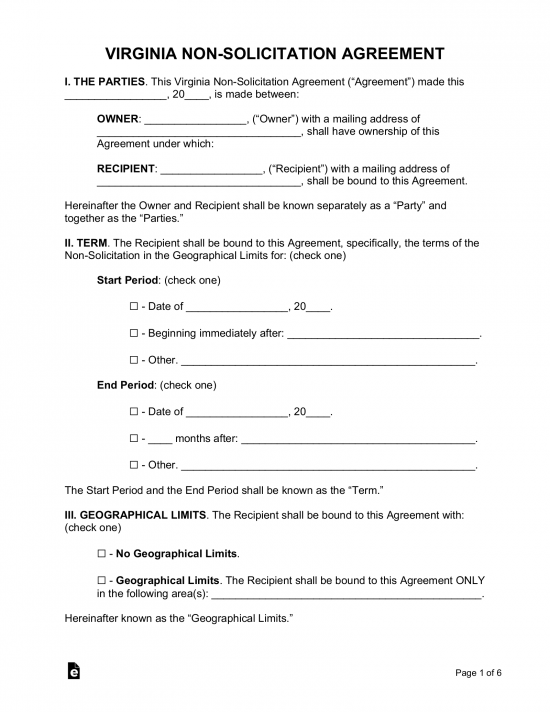
Virginia Non-Solicitation Agreement

Full Conversation


Am I allowed, as a small insurance agency, to use a non-compete agreement for a salaried employee in Virginia?

Lexi

Lexi, Chatbot

understand that dealing with non-compete agreements can be quite stressful. Can you please share if you have already signed a non-compete agreement with your employer?

No.

Lexi

Lexi, Chatbot

How long is the duration of the non-compete clause in your agreement?

2 years.

Jon

Jon

Hello, and thank you for reaching out! I'm Jon, a licensed attorney with over 13 years of experience, here to help. I understand legal matters can feel overwhelming, but you're in good hands. My goal is to explain things clearly and guide you toward the best possible solution for your situation. Just a quick note: our conversation is for general legal information only and does not create an attorney-client relationship.

Ok.

Jon

Jon

Thanks for confirming that you're in Virginia. Could you tell me more about the specific terms of the non-compete agreement? For example, does it restrict the employee from working with certain competitors or in specific regions?

I need to know for a small insurance agency here in Virginia, can I do a non-compete clause of 2 years with a salaried employee?

It would be specifically for Virginia.

Jon

Jon

Got it, thanks for clarifying! In Virginia, non-compete agreements can be enforceable, but they must be reasonable in scope, duration, and geographic area. Could you share more about the employee's role and what specific activities or competitors you're looking to restrict?

She is a LOA agent meaning she services and sells insurance but all commissions come to our agency and we have been paying her a salary. I do not want her to be able to contact our clients for 2 years if she left. I would not want her to be able to go to another agency and solicit our clients.

Jon

Jon

Understood! Is there anything else you would like to add before I start working on your answer?

That is it, thank you.

Jon

Jon

Got it! I just need a few minutes to put together a complete response. Thanks so much for waiting.

Ok.

Jon

Jon

In Virginia, whether a non-compete is enforceable depends a lot on how the employee is paid and how they are classified. Virginia has some of the strictest non-compete laws in the country.

First, Virginia Code Section 40.1-28.7:8 bans non-competes for "low-wage employees." The threshold for 2026 is roughly $76,000 to $78,000 per year, or about $1,463 per week. Even if an employee earns more than that, if they are non-exempt under the Fair Labor Standards Act, meaning they are entitled to overtime pay, a non-compete is generally illegal.

There is an important exception for insurance agents: employees whose pay comes primarily from commissions, bonuses, or other incentive-based earnings are not considered low-wage employees. However, since the agent in question receives a flat salary with all commissions going to the agency, she likely qualifies for low-wage protections, and a traditional non-compete could be void. Violating this rule could expose you to a $10,000 penalty for each violation under Va. Code Section 40.1-28.7:8.

It is also important to understand the difference between a non-compete and a non-solicitation agreement in Virginia. A non-compete would stop the employee from working in insurance entirely within a certain area, which is very hard to enforce for salaried employees under current law. A non-solicitation agreement, by contrast, prevents an employee from contacting your specific clients or trying to take them. Virginia generally allows non-solicitation agreements, even for low-wage employees, as long as the employee is the one initiating contact.

Regarding duration, Virginia courts are skeptical of long non-compete periods. While two years is technically the maximum courts might consider, anything longer than one year for a standard employee is risky and could be struck down as preventing the employee from earning a living.

In short, a non-compete for your salaried insurance agent is likely unenforceable, but a non-solicitation agreement protecting your clients is generally allowed. Virginia is also a "no-blue-pencil" state under established case law, meaning a court cannot fix an overly broad contract and will throw out the entire agreement, so careful drafting is essential.

So we should then do a non-solicitation agreement instead, and 2 years is allowed under that?

Is that agreement on eForms?

Jon

Jon

In Virginia, a non-solicitation agreement is a much safer alternative to a non-compete for a salaried agent. While a 2-year duration is generally permissible, it must be narrowly limited to prohibiting the agent from initiating contact with clients she actually served or had access to. You cannot legally prevent her from working in insurance or from accepting a client who reaches out to her first, but you can prevent her from actively soliciting your accounts. To avoid the $10,000 statutory penalty, ensure the language focuses strictly on client solicitation rather than restricting her future employment.

Jon

Jon

Did that help clear things up for you? If you have any other questions or need more help, please do not hesitate to ask.

Jon

Jon

I do hope the information I provided was helpful and addressed your question. If there is anything else you need, please do not hesitate to reach out. Wishing you a fantastic day ahead!

Thank you!

Jon

Jon

You're so welcome! Do not hesitate to reach out if you need anything at all!

Jon

Jon

556 satisfied customers

Jon
Welcome! Have a similar question?

12 lawyers online now

0:00

By messaging AskALawyer, you agree to our Terms and Privacy Policy.

Disclaimer


By messaging AskaLawyer.com, you agree to our Terms and have read our Privacy Policy.

The information provided on AskaLawyer.com is for general informational purposes only and does not constitute legal advice. While we strive to ensure the accuracy and timeliness of the information presented, we make no guarantees regarding its completeness or applicability to your specific circumstances.

Use of this website does not create an attorney-client relationship between you and AskaLawyer.com or any of its attorneys. Communications through this website, including any responses from attorneys, are not privileged or confidential. For advice tailored to your individual situation, we recommend consulting a licensed attorney in your jurisdiction.

AskaLawyer.com disclaims any liability for actions taken or not taken based on the content of this site. We are not responsible for any third-party content that may be accessed through this website. Reliance on any information provided herein is solely at your own risk.

Ask a Lawyer Logo
Ask a Lawyer Logo
Intake Questions
Step  of 3
Loading...

What's your legal question?

Lexi, Chatbot

How would you like your legal question to be answered?

Online

Legal AI

Using ChatGPT 4o

Loading...

How do you like to pay?

By proceeding with payment, you agree to our Terms and Privacy Policy. You authorize us to charge $ today and $ thereafter until canceled. You may cancel anytime in the My Account section to stop future charges.

Total Due:

After purchasing, your chat will begin with an attorney.

By proceeding with payment, you agree to our Terms and Privacy Policy. You authorize us to charge $ today and $ thereafter until canceled. You may cancel anytime in the My Account section to stop future charges.

Total Due:

After purchasing, your chat will begin with an attorney.

After connecting, your chat will begin with an attorney. After choosing, your chat will continue with Legal AI.

It looks like you already have an account with Ask a Lawyer.

We have sent you a magic link to . Click the link in your email to sign in and continue your chat.

spin

Step of 6 •

You'll receive an email at as soon as the lawyer joins the conversation 🙏🏻😊

Over 90% of lawyers connect within 5 minutes. If you're not online at that moment, don't worry — the lawyer will reply to your message while you're away.

You're also welcome to stay in the chat while waiting to be connected 💬✨

Waiting for lawyer

We couldn't send your message. Please try again.

Your lawyer will reply as soon as possible

If there’s a delay, please don’t worry. Your chat will stay open, and they’ll get back to you as soon as they can. There’s no rush on your end either. You’ll receive an email notification as soon as there’s a new message.

You've reached your AI chat limit

Upgrade your plan to continue chatting and get instant domain-specific answers.

0:00