Is an independent contractor entitled to post-petition wages in a Chapter 11 bankruptcy?

Angelo M
Angelo M

16,348 satisfied customers

View context
Solved

Based on what you've described, your situation is still strong even though you were classified as an independent contractor. In Chapter 11 cases, post-petition services performed by independent contractors are also treated as administrative expense claims under 11 U.S.C. § 503(b)(1)(A), not just employee wages, and those claims receive priority over general unsecured debt under § 507(a)(2). Because you provided therapy services after the February 16 filing date and the practice continued operating and collecting revenue from your services, they are generally required to pay you in the ordinary course of business. As debtor-in-possession, a Chapter 11 business also has ongoing duties to operate the estate and account for its obligations under 11 U.S.C. § 1107, so refusing to provide revenue reports while withholding payment can raise serious concerns about whether those duties are being met.

The fact that they paid you $957 on March 16 after you followed up is also important. That suggests they acknowledged the obligation to pay post-petition earnings, which strengthens your position. If they then withheld your March 27 payment and are refusing to provide the revenue report used to calculate your compensation, that can support a claim that they are improperly withholding post-petition compensation. Bankruptcy courts generally expect businesses to continue paying contractors they rely on, particularly where services directly generate revenue, as appears to be the case with therapy sessions.

You have several practical options at this stage. First, you can send a formal written demand referencing that your services were performed post-petition and therefore constitute an administrative expense under bankruptcy law. Often, once a debtor realizes the legal exposure, payment is made quickly. Second, if that does not resolve it, you can file an Administrative Expense Claim in the Chapter 11 case. Even for $500, this can be effective because courts take post-petition obligations seriously. Third, you may also request accounting documentation (revenue reports, billing summaries, session logs) because they cannot reasonably calculate your compensation without providing those records.

There is also an additional issue worth noting. Many therapy practices classify clinicians as independent contractors, but depending on your arrangement (control over schedule, billing through the practice, use of their systems, percentage-based pay, and similar factors), there can sometimes be misclassification concerns. While that is a separate issue, it can further strengthen leverage because wage protections may apply if you were effectively functioning as an employee.

At this point, I would recommend the following immediate steps: send a written demand requesting payment and the revenue report, reference that services were performed post-petition after February 16, request payment within a reasonable timeframe (for example, 7 to 10 days), and if there is no response, prepare an Administrative Expense Claim in the bankruptcy case.

0

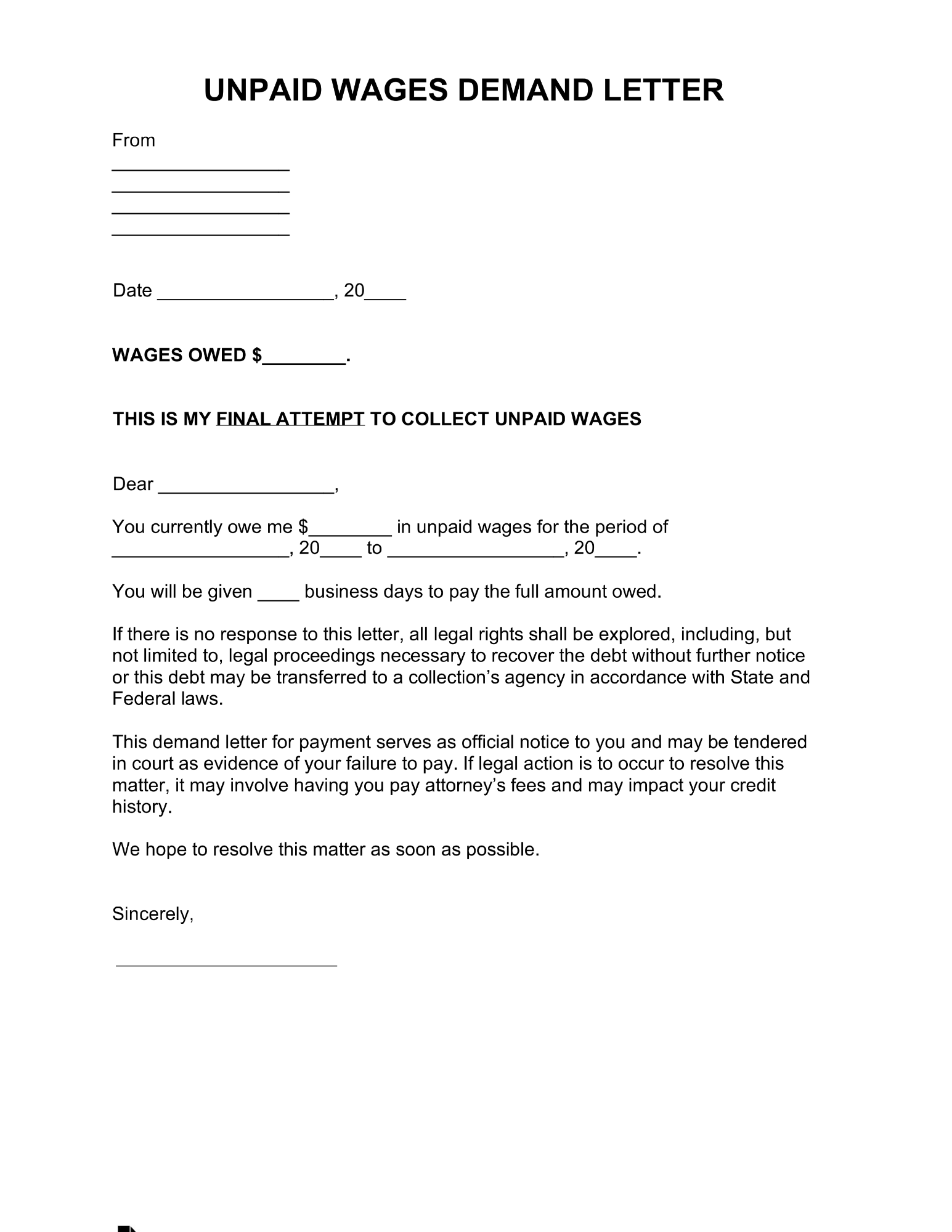
Unpaid Wages Demand Letter | Sample

Full Conversation


Post petition wages.

Lexi

Lexi, Chatbot

I understand that dealing with post-petition wages can be quite challenging. Can you please specify the type of petition you are referring to?

Chapter 11.

Lexi

Lexi, Chatbot

Are you currently facing any specific issues related to your wages after the petition was filed?

Yes.

Lexi

Lexi, Chatbot

Is there anything else the Lawyer should know before I connect you? Rest assured they'll be able to help with your post-petition wages.

No.

Angelo M

Angelo M

Greetings! I hope this message finds you well. I'm thrilled to have the opportunity to assist you with your situation and provide you with the support you need. Thank you for your patience, and I look forward to working with you.

In a Chapter 11 bankruptcy, post-petition wages generally refer to income earned after the bankruptcy case is filed. The treatment of those wages depends largely on whether the debtor is an individual Chapter 11 debtor or a business entity. For an individual Chapter 11, post-petition wages are typically considered property of the bankruptcy estate, which means the debtor must use those wages in accordance with the court-approved budget and, ultimately, the Chapter 11 reorganization plan. This is different from Chapter 7, where post-petition wages usually belong solely to the debtor.

If you are experiencing a specific issue, such as a creditor attempting to garnish post-petition wages, withholding pay, or disputes over how wages must be used, those actions may violate the automatic stay under 11 U.S.C. § 362. Once a Chapter 11 petition is filed, most collection efforts must stop immediately, including wage garnishments, unless a creditor obtains permission from the bankruptcy court. If a creditor continues collecting wages after the filing date, you may have grounds to file a motion for sanctions for violation of the automatic stay.

Additionally, in an individual Chapter 11 case, the court may require you to report monthly income and expenses, and you may be required to contribute disposable income toward repayment of creditors under your reorganization plan. This means that while you continue earning wages, you typically must follow court-approved financial controls and cannot freely use all income without regard to the bankruptcy process.

My prior workplace, which is in Chapter 11, will not pay me post petition wages earned after the Chapter 11 filing. I have left the company and they filed Feb 16th so this would be for wages earned after this date. I am not in bankruptcy, my former employer is and owes me money. For wages earned after the chapter 11 was filed.

Angelo M

Angelo M

When your employer files Chapter 11, the rules are very different than when an individual files. In your situation, wages earned after the Chapter 11 filing (post-petition wages) are generally treated as administrative expense claims, which are given high priority under bankruptcy law. This is important because post-petition wages are not treated like ordinary unsecured debt, but instead are typically required to be paid in the ordinary course of business or given priority payment under 11 U.S.C. § 503(b)(1)(A) and § 507(a)(2).

Because you performed work after February 16 (the filing date), those wages are considered post-petition obligations of the debtor company. Courts typically require Chapter 11 debtors to pay employees for post-petition services, especially when the company continues operating as a debtor-in-possession. If they refuse to pay wages earned after filing, that can be a serious issue because the company is benefiting from your labor during bankruptcy but not paying for it.

Since you are no longer employed there, you generally have three primary options. First, you can file an Administrative Expense Claim in the bankruptcy case for your unpaid post-petition wages. This is often the most direct and effective remedy. Administrative expense claims are prioritized and must typically be paid before general unsecured creditors. Second, if the bankruptcy court already entered a wage order (which many courts do early in Chapter 11 cases), the company may already be required to pay post-petition wages. If they are violating that order, you may be able to file a motion to compel payment. Third, you may also have potential claims under state wage laws (for example, unpaid wages, final paycheck laws, or waiting time penalties), although those claims are typically still handled within the bankruptcy court once Chapter 11 is filed.

To move forward, you should identify the bankruptcy court and case number (from public records or PACER), review whether the court entered a "first day wage order," file an Administrative Expense Claim for post-petition wages, and consider filing a Motion to Allow Administrative Expense if payment is refused.

One important point: post-petition wages are generally stronger claims than pre-petition wages. Pre-petition wages may be limited or delayed, but post-petition wages are typically expected to be paid in the ordinary course of business.

A few quick questions that would help clarify your position: approximately how much are the unpaid wages, were you an employee or independent contractor, did the company continue operating after the Chapter 11 filing, and have they given any reason for refusing to pay? These details can affect how quickly you can obtain payment and what strategy is best.

Based on what you've described so far, you appear to have a strong administrative priority claim for wages earned after February 16, and the bankruptcy court generally takes these claims seriously.

Unpaid wages is probably about 500.00. I was an independent contractor therapist working with a therapy office, [business name redacted]. They will not send me a revenue report to verify exactly what my deposit was supposed to be March 27th. They also did not pay me March 13th, I emailed them about this and then a deposit showed up March 16th for 957.00. So there is money still owed for money earned after [business name redacted] filed.

Angelo M

Angelo M

Based on what you've described, your situation is still strong even though you were classified as an independent contractor. In Chapter 11 cases, post-petition services performed by independent contractors are also treated as administrative expense claims under 11 U.S.C. § 503(b)(1)(A), not just employee wages, and those claims receive priority over general unsecured debt under § 507(a)(2). Because you provided therapy services after the February 16 filing date and the practice continued operating and collecting revenue from your services, they are generally required to pay you in the ordinary course of business. As debtor-in-possession, a Chapter 11 business also has ongoing duties to operate the estate and account for its obligations under 11 U.S.C. § 1107, so refusing to provide revenue reports while withholding payment can raise serious concerns about whether those duties are being met.

The fact that they paid you $957 on March 16 after you followed up is also important. That suggests they acknowledged the obligation to pay post-petition earnings, which strengthens your position. If they then withheld your March 27 payment and are refusing to provide the revenue report used to calculate your compensation, that can support a claim that they are improperly withholding post-petition compensation. Bankruptcy courts generally expect businesses to continue paying contractors they rely on, particularly where services directly generate revenue, as appears to be the case with therapy sessions.

You have several practical options at this stage. First, you can send a formal written demand referencing that your services were performed post-petition and therefore constitute an administrative expense under bankruptcy law. Often, once a debtor realizes the legal exposure, payment is made quickly. Second, if that does not resolve it, you can file an Administrative Expense Claim in the Chapter 11 case. Even for $500, this can be effective because courts take post-petition obligations seriously. Third, you may also request accounting documentation (revenue reports, billing summaries, session logs) because they cannot reasonably calculate your compensation without providing those records.

There is also an additional issue worth noting. Many therapy practices classify clinicians as independent contractors, but depending on your arrangement (control over schedule, billing through the practice, use of their systems, percentage-based pay, and similar factors), there can sometimes be misclassification concerns. While that is a separate issue, it can further strengthen leverage because wage protections may apply if you were effectively functioning as an employee.

At this point, I would recommend the following immediate steps: send a written demand requesting payment and the revenue report, reference that services were performed post-petition after February 16, request payment within a reasonable timeframe (for example, 7 to 10 days), and if there is no response, prepare an Administrative Expense Claim in the bankruptcy case.

Thank you.

Angelo M

Angelo M

You're very welcome!!

Angelo M

Angelo M

16,348 satisfied customers

Angelo M
Welcome! Have a similar question?

12 lawyers online now

0:00

By messaging AskALawyer, you agree to our Terms and Privacy Policy.

Disclaimer


By messaging AskaLawyer.com, you agree to our Terms and have read our Privacy Policy.

The information provided on AskaLawyer.com is for general informational purposes only and does not constitute legal advice. While we strive to ensure the accuracy and timeliness of the information presented, we make no guarantees regarding its completeness or applicability to your specific circumstances.

Use of this website does not create an attorney-client relationship between you and AskaLawyer.com or any of its attorneys. Communications through this website, including any responses from attorneys, are not privileged or confidential. For advice tailored to your individual situation, we recommend consulting a licensed attorney in your jurisdiction.

AskaLawyer.com disclaims any liability for actions taken or not taken based on the content of this site. We are not responsible for any third-party content that may be accessed through this website. Reliance on any information provided herein is solely at your own risk.

Ask a Lawyer Logo
Ask a Lawyer Logo
Intake Questions
Step  of 3
Loading...

What's your legal question?

Lexi, Chatbot

How would you like your legal question to be answered?

Online

Loading...

How do you like to pay?

By proceeding with payment, you agree to our Terms and Privacy Policy. You authorize us to charge $ today and $ thereafter until canceled. You may cancel anytime in the My Account section to stop future charges.

Total Due:

After purchasing, your chat will begin with an attorney.

By proceeding with payment, you agree to our Terms and Privacy Policy. You authorize us to charge $ today and $ thereafter until canceled. You may cancel anytime in the My Account section to stop future charges.

Total Due:

After purchasing, your chat will begin with an attorney.

After connecting, your chat will begin with an attorney. After choosing, your chat will continue with Legal AI.

It looks like you already have an account with Ask a Lawyer.

We have sent you a magic link to . Click the link in your email to sign in and continue your chat.

spin

Step of 6 •

You'll receive an email at as soon as the lawyer joins the conversation 🙏🏻😊

Over 90% of lawyers connect within 5 minutes. If you're not online at that moment, don't worry — the lawyer will reply to your message while you're away.

You're also welcome to stay in the chat while waiting to be connected 💬✨

Waiting for lawyer

We couldn't send your message. Please try again.

Your lawyer will reply as soon as possible

If there’s a delay, please don’t worry. Your chat will stay open, and they’ll get back to you as soon as they can. There’s no rush on your end either. You’ll receive an email notification as soon as there’s a new message.

You've reached your AI chat limit

Upgrade your plan to continue chatting and get instant domain-specific answers.

0:00