[WA] Does transferring a home into a revocable living trust trigger the mortgage’s due on sale clause?

Brandon
Brandon

17,789 satisfied customers

View context
Solved

First, about filing the trust in Pierce County.

In Washington, a standard revocable living trust is generally not filed with the court or the county just because it's been created. Once you sign it and have it notarized, it becomes valid. You keep the original in a safe place, such as a fireproof safe at home or a safe deposit box. There is no routine filing with the Pierce County Superior Court for a basic living trust.

Now, the more important part: adding your house to the trust. Creating the trust alone does not automatically move your home into it. You have to transfer ownership from yourself as an individual to yourself as trustee of your trust. In Washington, that is usually done by recording a new deed, consistent with the recording requirements set out in (WA Rev Code § 65.08.030-180).

Here is how that typically works in Pierce County:

  1. A new deed is prepared. This is often a quit claim deed or a statutory warranty deed. The grantor would be you in your individual capacity. The grantee would be you as trustee of your living trust, using the full legal name of the trust exactly as it appears in the document.
  2. The deed must be signed and notarized.
  3. The deed is recorded with the Pierce County Auditor's Office. Once recorded, the property is legally owned by the trust. Recording is the key step. That is what puts the public on notice that the trust now owns the home.

Now, about your mortgage lender. In most cases involving a revocable living trust where you are still the borrower and still living in the home, you do not need to get prior approval from your lender to transfer the property into your own trust. Federal law, specifically the Garn-St. Germain Depository Institutions Act of 1982, codified at (12 U.S.C. § 1701j-3), generally protects this kind of transfer from triggering the due on sale clause, as long as:

  1. The trust is revocable.
  2. You remain a beneficiary.
  3. You continue to live in the property.

That said, you usually do not send your lender the deed automatically. However, it can be helpful to:

  • Review your mortgage documents to see if there are any notice requirements.
  • Notify your homeowner's insurance company so they can add the trust as an additional insured or adjust the policy wording.

0

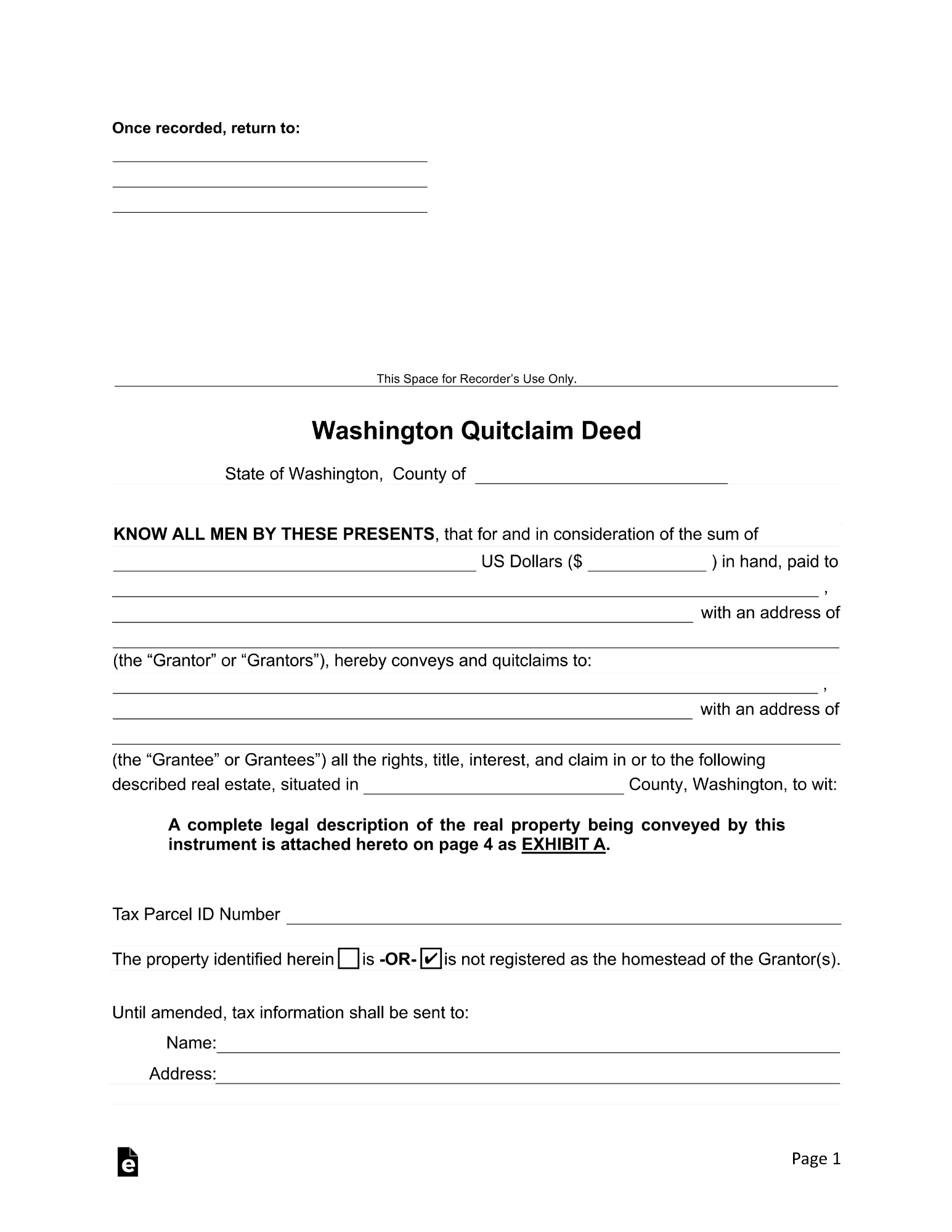
Washington Quit Claim Deed

Full Conversation


Hi there! I just downloaded my living trust to my phone and sent it to a printing service to be printed. Where do I send it to file after I get it notarized?

Lexi

Lexi, Chatbot

I understand that you're looking to properly file your living trust after notarization. Have you already identified the specific county or state where you plan to file the document?

Pierce County, WA.

Lexi

Lexi, Chatbot

Are there any specific requirements or forms you need to complete for filing in your jurisdiction?

How do I notify/add my house to the trust?

Brandon

Brandon

Hi there. My name is Brandon, and I'm an attorney. I'll be happy to help you out today. I understand you're looking to file your living trust after notarization and add your house to it. Could you let me know if you have any other assets to include in the trust?

No, not really. Just personal items that even I would toss out or donate, like clothes. No jewelry. Just the house. Is there a document I need to send to my mortgage lender?

I just wanted to know what I need to send to the mortgage lender to place the house in the trust.

Brandon

Brandon

First, about filing the trust in Pierce County.

In Washington, a standard revocable living trust is generally not filed with the court or the county just because it's been created. Once you sign it and have it notarized, it becomes valid. You keep the original in a safe place, such as a fireproof safe at home or a safe deposit box. There is no routine filing with the Pierce County Superior Court for a basic living trust.

Now, the more important part: adding your house to the trust. Creating the trust alone does not automatically move your home into it. You have to transfer ownership from yourself as an individual to yourself as trustee of your trust. In Washington, that is usually done by recording a new deed, consistent with the recording requirements set out in (WA Rev Code § 65.08.030-180).

Here is how that typically works in Pierce County:

  1. A new deed is prepared. This is often a quit claim deed or a statutory warranty deed. The grantor would be you in your individual capacity. The grantee would be you as trustee of your living trust, using the full legal name of the trust exactly as it appears in the document.
  2. The deed must be signed and notarized.
  3. The deed is recorded with the Pierce County Auditor's Office. Once recorded, the property is legally owned by the trust. Recording is the key step. That is what puts the public on notice that the trust now owns the home.

Now, about your mortgage lender. In most cases involving a revocable living trust where you are still the borrower and still living in the home, you do not need to get prior approval from your lender to transfer the property into your own trust. Federal law, specifically the Garn-St. Germain Depository Institutions Act of 1982, codified at (12 U.S.C. § 1701j-3), generally protects this kind of transfer from triggering the due on sale clause, as long as:

  1. The trust is revocable.
  2. You remain a beneficiary.
  3. You continue to live in the property.

That said, you usually do not send your lender the deed automatically. However, it can be helpful to:

  • Review your mortgage documents to see if there are any notice requirements.
  • Notify your homeowner's insurance company so they can add the trust as an additional insured or adjust the policy wording.

Where do I find a quit claim deed? Is that a form I find here? Where do I get the form?

Brandon

Brandon

In Pierce County, Washington, you do not get the form directly from the Superior Court. This is not filed with the court. Instead, deeds are recorded with the Pierce County Auditor's Office.

Where do I get the form? -- At their office or their website.

Ok so here is what I'm hearing. I need to file a quit claim deed releasing my interest on the property, and on the same form I will place who I'm releasing it to, the trust. Is that correct?

Brandon

Brandon

Correct.

Ok so it's one form. After releasing interest, I send it to the auditor's office, will it then be in the trust? After I send it to the auditor's office, will it then be in the trust? Or is there a step missing? I have a mortgage lender. Let me know before you leave please.

Brandon

Brandon

Once you properly prepare the deed, sign it, have it notarized, and record it with the Pierce County Auditor's Office, the property is legally titled in the name of your trust. There is no additional court filing required for a standard revocable living trust. There is no separate step with the Superior Court. Recording the deed is the operative act that transfers ownership.

So in practical terms:

  • The trust must already exist and be signed.
  • The deed must correctly name you as grantor.
  • The deed must correctly name you as trustee of your trust as grantee, using the exact legal name of the trust.
  • The deed must be notarized.
  • The deed must be accepted and recorded by the auditor. Once the auditor records it, the legal title changes. At that point, yes, the home is in the trust.

There is not a hidden extra filing step. The recording is what makes it official in the public record. Now let's talk about your mortgage. You mentioned you have a mortgage through your mortgage lender. In most situations like yours, transferring your primary residence into your own revocable living trust does not trigger the due on sale clause. Federal law generally protects this type of transfer as long as:

  1. The trust is revocable.
  2. You remain the beneficiary.
  3. You continue to live in the home.

You do not usually need prior approval from your lender. However, here are two smart follow up steps after recording:

  1. Check your mortgage documents for any notice language. Most lenders do not require notice for this type of transfer, but it is worth confirming.
  2. Call your homeowner's insurance carrier and have them update the policy so that you, as trustee of the trust, are listed as an additional insured. This is very important. If the house burns down and the policy only names you individually, it can create avoidable headaches.

One more small but important detail. In Washington, when you record a deed, you will also file a Real Estate Excise Tax Affidavit. A transfer into your own revocable trust is generally exempt from excise tax under, but the exemption must be properly claimed on the form.

Where would I get and file this affidavit? Is there a form here?

Brandon

Brandon

When you transfer real estate, Washington law requires a Real Estate Excise Tax Affidavit to be submitted with the deed, even if no tax is actually owed. A transfer into your own revocable living trust is generally exempt from tax, but the affidavit is still required to claim that exemption.

In Pierce County, you obtain and submit this form through the Washington State Department of Revenue's online system. The county does not use a paper-only local form anymore for most filings. You complete the affidavit electronically through the state system, and then it routes to the county.

Can you tell me the name of this form from the WA DOR that I'm looking for?

Do I submit the auditor's form first, then the tax one online? Or do the tax online first and then the form to the county auditor?

Brandon

Brandon

First, the name of the form you are looking for is the Real Estate Excise Tax Affidavit, often referred to as REETA. It is handled through the Washington State Department of Revenue. The system you will use is the Department of Revenue's Real Estate Excise Tax electronic filing system. The agency involved is the Washington State Department of Revenue.

Now, about the order. You do not record the deed first. You complete the REETA process first. Here is the correct sequence in Pierce County:

  1. Prepare and sign your deed. Have it notarized.
  2. Go to the Department of Revenue REETA online system and complete the Real Estate Excise Tax Affidavit.
  3. Select the appropriate exemption for a transfer into your own revocable living trust with no change in beneficial ownership.
  4. Submit the affidavit online.
  5. Wait for the county treasurer to review and approve it. In many cases this happens quickly, but it must be approved before recording. Once approved, you will receive confirmation.
  6. Then you record the deed with the Pierce County Auditor's Office. The auditor will not record your deed unless the REETA has been processed and approved. So the tax affidavit comes first, even if no tax is due. You do not submit an auditor form first. The auditor handles recording. The treasurer handles the excise tax affidavit through the DOR system. The REETA must clear before recording.

At any point would there be a reason I would possibly be denied?

Brandon

Brandon

No, you have nothing to be worried about.

Ok thank you! I still owe on the house, but I just wanted to make sure I can file that.

Brandon

Brandon

You are welcome. I wish you the best.

Thank you! I appreciate your help.

Brandon

Brandon

17,789 satisfied customers

Brandon
Welcome! Have a similar question?

12 lawyers online now

0:00

By messaging AskALawyer, you agree to our Terms and Privacy Policy.

Queeneth E. Esq
Queeneth E. Esq

Commercial Contracts Attorney

4.61 (6,631)

[FL] What makes a power of attorney legally valid?

9

2

Answered 2 weeks ago

Disclaimer


By messaging AskaLawyer.com, you agree to our Terms and have read our Privacy Policy.

The information provided on AskaLawyer.com is for general informational purposes only and does not constitute legal advice. While we strive to ensure the accuracy and timeliness of the information presented, we make no guarantees regarding its completeness or applicability to your specific circumstances.

Use of this website does not create an attorney-client relationship between you and AskaLawyer.com or any of its attorneys. Communications through this website, including any responses from attorneys, are not privileged or confidential. For advice tailored to your individual situation, we recommend consulting a licensed attorney in your jurisdiction.

AskaLawyer.com disclaims any liability for actions taken or not taken based on the content of this site. We are not responsible for any third-party content that may be accessed through this website. Reliance on any information provided herein is solely at your own risk.

Ask a Lawyer Logo
Ask a Lawyer Logo
Intake Questions
Step  of 3
Loading...

What's your legal question?

Lexi, Chatbot

How would you like your legal question to be answered?

Online

Loading...

How do you like to pay?

By proceeding with payment, you agree to our Terms and Privacy Policy. You authorize us to charge $ today and $ thereafter until canceled. You may cancel anytime in the My Account section to stop future charges.

Total Due:

After purchasing, your chat will begin with an attorney.

By proceeding with payment, you agree to our Terms and Privacy Policy. You authorize us to charge $ today and $ thereafter until canceled. You may cancel anytime in the My Account section to stop future charges.

Total Due:

After purchasing, your chat will begin with an attorney.

After connecting, your chat will begin with an attorney. After choosing, your chat will continue with Legal AI.

It looks like you already have an account with Ask a Lawyer.

We have sent you a magic link to . Click the link in your email to sign in and continue your chat.

spin

Step of 6 •

You'll receive an email at as soon as the lawyer joins the conversation 🙏🏻😊

Over 90% of lawyers connect within 5 minutes. If you're not online at that moment, don't worry — the lawyer will reply to your message while you're away.

You're also welcome to stay in the chat while waiting to be connected 💬✨

Waiting for lawyer

We couldn't send your message. Please try again.

Your lawyer will reply as soon as possible

If there’s a delay, please don’t worry. Your chat will stay open, and they’ll get back to you as soon as they can. There’s no rush on your end either. You’ll receive an email notification as soon as there’s a new message.

You've reached your AI chat limit

Upgrade your plan to continue chatting and get instant domain-specific answers.

0:00