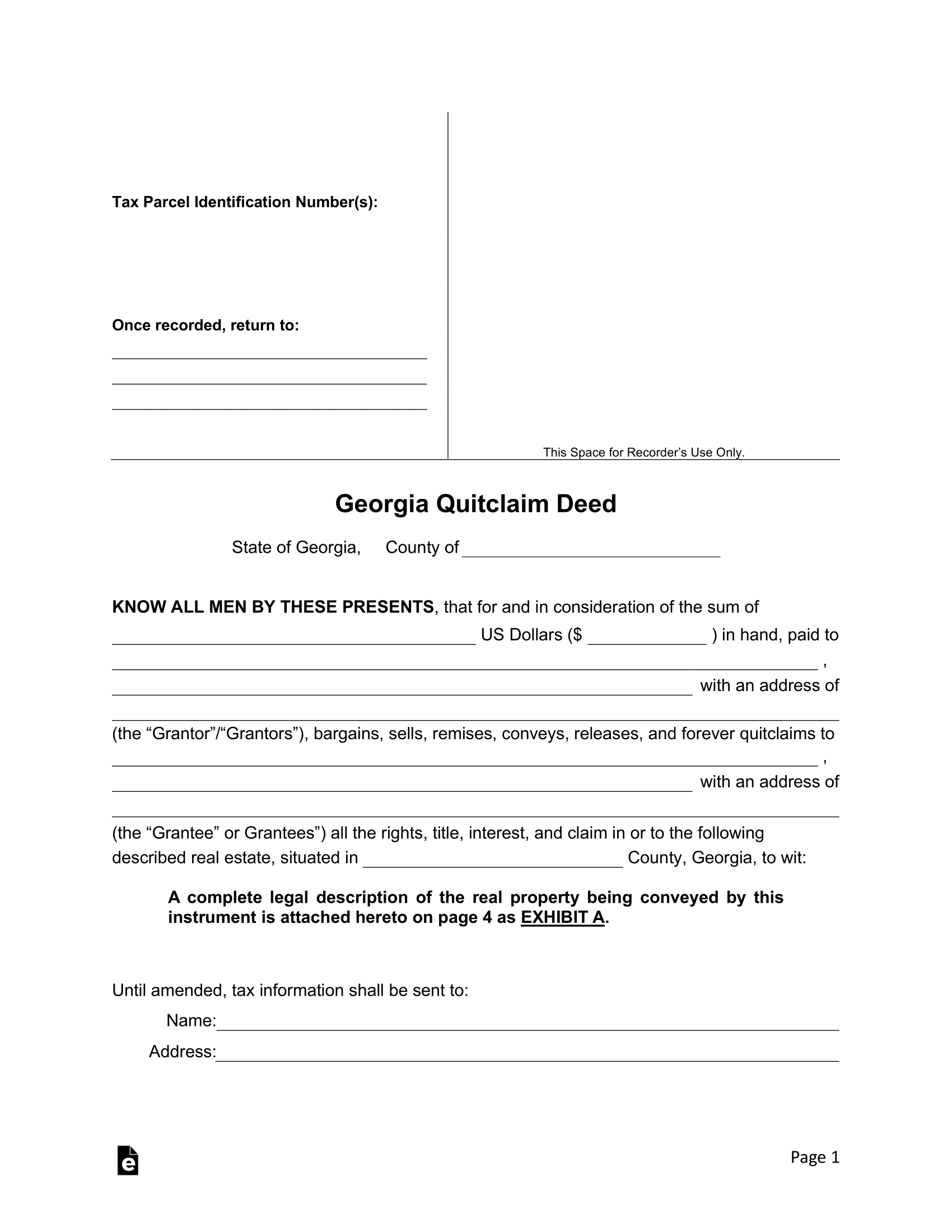
[GA] When using a quitclaim deed to add my spouse for homestead purposes, can I list both of us as grantees?

Queeneth E. Esq
Queeneth E. Esq

4,470 satisfied customers

View context
Solved

Yes — you may list your spouse’s name along with yours as the grantee.

Because you are currently the sole owner, you will be the Grantor (the person conveying the property), and the Grantee will be both you and your spouse together. This is the standard method for adding a co-owner while retaining your own ownership interest.

How the Grantee Line Should Read

A typical format in Georgia would be:

“John A. Smith and Mary B. Smith, as joint tenants with right of survivorship.”

So the deed would reflect:

  • Grantor: John A. Smith
  • Grantee: John A. Smith and Mary B. Smith, as joint tenants with right of survivorship

Under O.C.G.A. § 44-6-190, Georgia allows joint tenancy with right of survivorship when it is clearly expressed in the deed. The survivorship language must be explicit; otherwise, the ownership defaults to tenants in common.

How Title Is Held in Georgia

Georgia does not recognize tenancy by the entirety between spouses. The two primary options are:

Joint Tenancy with Right of Survivorship (JTWROS)
If one spouse dies, the surviving spouse automatically owns the entire property by operation of law. This is typically preferred for married couples who want automatic survivorship.

Tenants in Common
Each spouse owns a separate fractional interest that passes through their estate at death. This is less common between spouses unless there is a specific estate-planning reason.

For most married couples seeking survivorship protection, joint tenancy with right of survivorship is appropriate.

Homestead Considerations

In Georgia, homestead exemption eligibility is tied to ownership and residency. While requirements vary slightly by county, the individual claiming the homestead exemption generally must be reflected in the property records. Adding your spouse to the deed can help ensure compliance with county tax assessor requirements if she will remain living in the home.

Georgia Recording Requirements

Under O.C.G.A. § 44-2-21, a deed must:

  • Be signed by the Grantor,
  • Be attested or acknowledged before a notary public, and
  • Have one additional unofficial witness.

After execution:

  • Record the deed with the Clerk of Superior Court in the county where the property is located.
  • Complete the PT-61 Real Estate Transfer Tax Form online through the Georgia Superior Court Clerks’ Cooperative Authority (GSCCCA) website.
  • Notify the County Tax Assessor so homestead records can be updated.

Practical Notes

A quitclaim deed transfers whatever interest you currently hold, without warranties of title. If there is an existing mortgage, review your loan documents. While federal law under the Garn–St. Germain Depository Institutions Act (12 U.S.C. § 1701j-3(d)) generally prevents enforcement of a due-on-sale clause when property is transferred to a spouse, it is still prudent to confirm with your lender.

Once recorded, retain a certified copy of the deed for your records.

0

Georgia Quit Claim Deed

Full Conversation


Hello, I’ve prepared a quitclaim deed in order to add my spouse to the deed for purposes of homestead. On the form where “grantee” is required, may I enter my spouse’s name along with mine? Thanks.

Lexi

Lexi, Chatbot

I understand you're looking to add your spouse to the deed, which is an important step for homestead purposes. Can you confirm if both you and your spouse are currently on the title of the property?

No, I’m the only one on the title.

Lexi

Lexi, Chatbot

Have you already reviewed your state’s laws regarding quitclaim deeds?

Queeneth E. Esq

Queeneth E. Esq

Hello, my name is Queeneth. I am an attorney with over 8 years of legal experience, and I will do my best to assist you today. Kindly note that this conversation does not establish an attorney-client relationship.

Georgia.
I plan to keep my name on the deed.

I will be relocating to another state for a new job. My spouse will stay in the house with my daughter. The county told me that to keep my homestead, she needs to be on the title as well.

Queeneth E. Esq

Queeneth E. Esq

Thank you for your patience.

Queeneth E. Esq

Queeneth E. Esq

Yes — you may list your spouse’s name along with yours as the grantee.

Because you are currently the sole owner, you will be the Grantor (the person conveying the property), and the Grantee will be both you and your spouse together. This is the standard method for adding a co-owner while retaining your own ownership interest.

How the Grantee Line Should Read

A typical format in Georgia would be:

“John A. Smith and Mary B. Smith, as joint tenants with right of survivorship.”

So the deed would reflect:

  • Grantor: John A. Smith
  • Grantee: John A. Smith and Mary B. Smith, as joint tenants with right of survivorship

Under O.C.G.A. § 44-6-190, Georgia allows joint tenancy with right of survivorship when it is clearly expressed in the deed. The survivorship language must be explicit; otherwise, the ownership defaults to tenants in common.

How Title Is Held in Georgia

Georgia does not recognize tenancy by the entirety between spouses. The two primary options are:

Joint Tenancy with Right of Survivorship (JTWROS)
If one spouse dies, the surviving spouse automatically owns the entire property by operation of law. This is typically preferred for married couples who want automatic survivorship.

Tenants in Common
Each spouse owns a separate fractional interest that passes through their estate at death. This is less common between spouses unless there is a specific estate-planning reason.

For most married couples seeking survivorship protection, joint tenancy with right of survivorship is appropriate.

Homestead Considerations

In Georgia, homestead exemption eligibility is tied to ownership and residency. While requirements vary slightly by county, the individual claiming the homestead exemption generally must be reflected in the property records. Adding your spouse to the deed can help ensure compliance with county tax assessor requirements if she will remain living in the home.

Georgia Recording Requirements

Under O.C.G.A. § 44-2-21, a deed must:

  • Be signed by the Grantor,
  • Be attested or acknowledged before a notary public, and
  • Have one additional unofficial witness.

After execution:

  • Record the deed with the Clerk of Superior Court in the county where the property is located.
  • Complete the PT-61 Real Estate Transfer Tax Form online through the Georgia Superior Court Clerks’ Cooperative Authority (GSCCCA) website.
  • Notify the County Tax Assessor so homestead records can be updated.

Practical Notes

A quitclaim deed transfers whatever interest you currently hold, without warranties of title. If there is an existing mortgage, review your loan documents. While federal law under the Garn–St. Germain Depository Institutions Act (12 U.S.C. § 1701j-3(d)) generally prevents enforcement of a due-on-sale clause when property is transferred to a spouse, it is still prudent to confirm with your lender.

Once recorded, retain a certified copy of the deed for your records.

Thank you so much, Queeneth. I greatly appreciate your support. Have a wonderful day.

Queeneth E. Esq

Queeneth E. Esq

You're very welcome. I'm happy I could assist you today. I wish you and your family all the best with your relocation and the homestead update.

Queeneth E. Esq

Queeneth E. Esq

4,470 satisfied customers

Queeneth E. Esq
Welcome! Have a similar question?

12 lawyers online now

0:00

By messaging AskALawyer, you agree to our Terms and Privacy Policy.

Disclaimer


By messaging AskaLawyer.com, you agree to our Terms and have read our Privacy Policy.

The information provided on AskaLawyer.com is for general informational purposes only and does not constitute legal advice. While we strive to ensure the accuracy and timeliness of the information presented, we make no guarantees regarding its completeness or applicability to your specific circumstances.

Use of this website does not create an attorney-client relationship between you and AskaLawyer.com or any of its attorneys. Communications through this website, including any responses from attorneys, are not privileged or confidential. For advice tailored to your individual situation, we recommend consulting a licensed attorney in your jurisdiction.

AskaLawyer.com disclaims any liability for actions taken or not taken based on the content of this site. We are not responsible for any third-party content that may be accessed through this website. Reliance on any information provided herein is solely at your own risk.

Ask a Lawyer Logo
Ask a Lawyer Logo
Intake Questions
Step  of 3
Loading...

Lexi, Chatbot

How would you like your legal question to be answered?

Online

Legal AI

Using ChatGPT 4o

Loading...

How do you like to pay?

By proceeding with payment, you agree to our Terms and Privacy Policy. You authorize us to charge $ today and $ thereafter until canceled. You may cancel anytime in the My Account section to stop future charges.

Total Due:

After purchasing, your chat will begin with an attorney.

By proceeding with payment, you agree to our Terms and Privacy Policy. You authorize us to charge $ today and $ thereafter until canceled. You may cancel anytime in the My Account section to stop future charges.

Total Due:

After purchasing, your chat will begin with an attorney.

After connecting, your chat will begin with an attorney.

After choosing, your chat will continue with Legal AI.

It looks like you already have an account with Ask a Lawyer.

We have sent you a magic link to . Click the link in your email to sign in and continue your chat.

spin

Step of 6 •

You'll receive an email at as soon as the lawyer joins the conversation 🙏🏻😊

Over 90% of lawyers connect within 5 minutes. If you're not online at that moment, don't worry — the lawyer will reply to your message while you're away.

You're also welcome to stay in the chat while waiting to be connected 💬✨

Waiting for lawyer

0:00