[NE] Can heirs avoid probate for estate paychecks under $100,000 when banks refuse a small estate affidavit?

Queeneth E. Esq
Queeneth E. Esq

5,738 satisfied customers

View context
Solved

You may still be able to avoid probate even though the checks are payable to “The Estate of (Dad’s Name).”

Nebraska’s small-estate “collection by affidavit” statute expressly covers checks payable to the decedent or the decedent’s estate. If the estate’s total personal property (minus liens) is $100,000 or less, and no personal representative has been appointed, a person holding or owing estate property must deliver or pay it when you present the affidavit.

Most importantly for your situation, the “claiming successor” may endorse or negotiate a check payable to the decedent or the decedent’s estate, and the financial institution that accepts it is discharged from claims for the amount accepted. So the bank telling you “we need probate papers” is often a policy or knowledge issue, not a legal requirement.

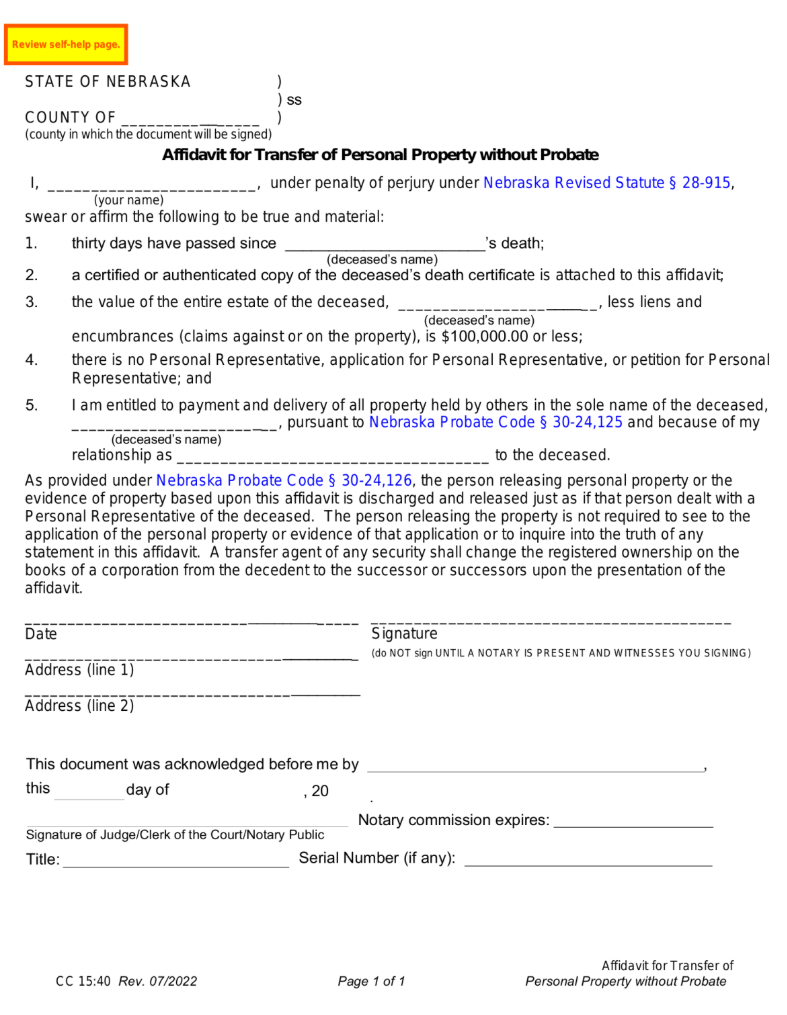
Use the Nebraska court’s affidavit form with an original signature and notarization. Use “Affidavit for Transfer of Personal Property without Probate (CC 15:40)” and attach a certified death certificate.

Nebraska Judicial Branch guidance also notes you generally need everyone who inherited an interest to sign unless no one else has a right to it. Because it’s you and your brother, the safest option is to have both of you sign, or have your brother sign an assignment or authorization that you can present along with your affidavit.

When you go to deposit or cash the checks, endorse them like this:

“Estate of (Dad’s Name) — endorsed by [Your Name], successor under Neb. Rev. Stat. § 30-24,125

Then sign your name.

If the bank wants your brother involved, have him endorse similarly or deposit into an account requiring both endorsements, depending on the bank’s procedures.

Go back to the bank, but ask for a manager or compliance review. Bring:

  • The notarized CC 15:40 affidavit with original signatures and death certificate
  • A printed copy of Neb. Rev. Stat. § 30-24,125(c) showing:
    • A successor can negotiate a check payable to the estate, and
    • The financial institution is discharged if it accepts it

Ask them to route it to their branch manager or legal/compliance team because tellers often have not seen this statute language.

If your current banks still refuse anyway, try these options in order:

  1. The bank the check is drawn on (the employer’s payroll bank)
  2. A Nebraska-based bank or credit union
  3. Ask the employer to void and reissue the checks payable to the heirs directly

Even if payroll prefers “Estate of…,” that is typically a policy choice rather than a legal impossibility.

If every financial institution still refuses, then the practical workaround is opening a simple informal intestate estate just to obtain Letters of Personal Representative, deposit the checks, distribute the funds, and close the estate.

Nebraska inheritance tax is beneficiary-based, and children generally have a large exemption amount, so $18,500 split between two children usually would not trigger inheritance tax, although it is county-administered and worth confirming locally.

0

Nebraska Small Estate Affidavit | Form CC 15:40
Full Conversation


I’m wondering how I can get around going to probate. My dad died in August and had zero debts and no will. Me and my brother are the heirs as he was not married. His final paycheck/vacation pay is around $18,500 in three checks and I was able to get them from his work by using a Nebraska small estate affidavit. But banks will not accept it and need probate papers and his work cannot legally change the name it’s made out to which is “to the estate of dad’s name”. I really want to avoid probate as it’s such a small amount and it’s under the required amount $100,000. Is there anything I can do?

Lexi

Lexi, Chatbot

I understand how challenging this situation must be for you. Have you and your brother discussed the possibility of using a small estate affidavit for other assets besides the final paycheck?

No, we don’t need it for anything else.

Lexi

Lexi, Chatbot

Are there any other assets or accounts that your father had that might complicate the situation further?

No.

Queeneth E. Esq

Queeneth E. Esq

Hello and welcome to this service. My name is Queeneth. I am an attorney with over 8 years of legal experience. I will do my best to assist you today. First, I need to ask you a few questions to give you the best answer. (Kindly note that our conversation does not establish an attorney-client relationship.)

Queeneth E. Esq

Queeneth E. Esq

Since the checks are made out to the estate, have you tried contacting the bank where your father held his account to see if they have a specific process for small estates in Nebraska?

Have you already deposited or attempted to deposit any of these checks, or are they all still in your possession?

This is not an account he held, but final paychecks and unused vacation hours issued from his work. Also, I have been to several banks and called and they are all needing letters of testimony or proof of probate.

Queeneth E. Esq

Queeneth E. Esq

Thank you for the feedback. Please allow me some time to prepare a response. I will get back to you shortly.

Queeneth E. Esq

Queeneth E. Esq

You may still be able to avoid probate even though the checks are payable to “The Estate of (Dad’s Name).”

Nebraska’s small-estate “collection by affidavit” statute expressly covers checks payable to the decedent or the decedent’s estate. If the estate’s total personal property (minus liens) is $100,000 or less, and no personal representative has been appointed, a person holding or owing estate property must deliver or pay it when you present the affidavit.

Most importantly for your situation, the “claiming successor” may endorse or negotiate a check payable to the decedent or the decedent’s estate, and the financial institution that accepts it is discharged from claims for the amount accepted. So the bank telling you “we need probate papers” is often a policy or knowledge issue, not a legal requirement.

Use the Nebraska court’s affidavit form with an original signature and notarization. Use “Affidavit for Transfer of Personal Property without Probate (CC 15:40)” and attach a certified death certificate.

Nebraska Judicial Branch guidance also notes you generally need everyone who inherited an interest to sign unless no one else has a right to it. Because it’s you and your brother, the safest option is to have both of you sign, or have your brother sign an assignment or authorization that you can present along with your affidavit.

When you go to deposit or cash the checks, endorse them like this:

“Estate of (Dad’s Name) — endorsed by [Your Name], successor under Neb. Rev. Stat. § 30-24,125

Then sign your name.

If the bank wants your brother involved, have him endorse similarly or deposit into an account requiring both endorsements, depending on the bank’s procedures.

Go back to the bank, but ask for a manager or compliance review. Bring:

  • The notarized CC 15:40 affidavit with original signatures and death certificate
  • A printed copy of Neb. Rev. Stat. § 30-24,125(c) showing:
    • A successor can negotiate a check payable to the estate, and
    • The financial institution is discharged if it accepts it

Ask them to route it to their branch manager or legal/compliance team because tellers often have not seen this statute language.

If your current banks still refuse anyway, try these options in order:

  1. The bank the check is drawn on (the employer’s payroll bank)
  2. A Nebraska-based bank or credit union
  3. Ask the employer to void and reissue the checks payable to the heirs directly

Even if payroll prefers “Estate of…,” that is typically a policy choice rather than a legal impossibility.

If every financial institution still refuses, then the practical workaround is opening a simple informal intestate estate just to obtain Letters of Personal Representative, deposit the checks, distribute the funds, and close the estate.

Nebraska inheritance tax is beneficiary-based, and children generally have a large exemption amount, so $18,500 split between two children usually would not trigger inheritance tax, although it is county-administered and worth confirming locally.

I’ve had compliance teams tell me no. Also, is there a difference between an informal probate and informal intestacy estate?

Queeneth E. Esq

Queeneth E. Esq

Yes. If bank compliance teams are still saying no, that often means either:

  • They are choosing a policy refusal even though Nebraska law protects them, or
  • Their internal procedures require Letters of Personal Representative regardless of the statute

At that point, the practical solution is usually an informal appointment in intestacy to obtain Letters.

“Informal probate” versus “informal intestacy estate” are terms people often use loosely, but Nebraska law distinguishes them this way:

  • Informal probate = an informal proceeding to admit a will to probate
  • Informal appointment = an informal proceeding to appoint a personal representative, either with or without a will

Since your father had no will, your situation would be an informal appointment in intestacy, often casually called “informal intestacy probate.”

The court would issue Letters of Personal Representative, which is what the banks are asking for.

Nebraska law treats these as “informal probate or appointment proceedings,” and informal proceedings are generally handled by the registrar without a full court hearing unless there is a dispute. That makes them faster and simpler than formal probate.

There is not really a separate legal process officially called an “informal intestacy estate.” It is basically an informal appointment of a personal representative for someone who died without a will.

You are correct that Neb. Rev. Stat. § 30-24,125(c) expressly states a successor may endorse or negotiate a check payable to the decedent or the decedent’s estate, and that the financial institution is discharged from claims if it accepts it.

But in practice, some institutions still refuse because:

  • Their internal risk policies require Letters
  • Staff are unfamiliar with successor endorsements
  • They do not have procedures for handling small-estate affidavit negotiations

At this point, your realistic options are:

Option A — Try the issuing bank or payroll bank
Go directly to the bank the checks are drawn on. They are sometimes more willing to handle these situations.

Option B — Try a Nebraska-based community bank or credit union
Smaller Nebraska institutions are often more familiar with Nebraska’s small-estate affidavit process.

Option C — Escalate the refusal in writing
Ask the bank whether:

  • They believe Nebraska law prohibits acceptance, or
  • They acknowledge the law but are refusing as a matter of policy

If it is merely policy, they may still refuse, but at least you know the issue is not legal.

Option D — File for informal appointment in intestacy
If multiple banks have refused, this is usually the fastest guaranteed solution.

You would file for informal appointment of a personal representative for an intestate estate. Once the court issues Letters of Personal Representative, you can open an estate account, deposit the checks, distribute the funds, and close the estate.

Queeneth E. Esq

Queeneth E. Esq

5,738 satisfied customers

Queeneth E. Esq
Welcome! Have a similar question?

12 lawyers online now

0:00

By messaging AskALawyer, you agree to our Terms and Privacy Policy.

Disclaimer


By messaging AskaLawyer.com, you agree to our Terms and have read our Privacy Policy.

The information provided on AskaLawyer.com is for general informational purposes only and does not constitute legal advice. While we strive to ensure the accuracy and timeliness of the information presented, we make no guarantees regarding its completeness or applicability to your specific circumstances.

Use of this website does not create an attorney-client relationship between you and AskaLawyer.com or any of its attorneys. Communications through this website, including any responses from attorneys, are not privileged or confidential. For advice tailored to your individual situation, we recommend consulting a licensed attorney in your jurisdiction.

AskaLawyer.com disclaims any liability for actions taken or not taken based on the content of this site. We are not responsible for any third-party content that may be accessed through this website. Reliance on any information provided herein is solely at your own risk.

Ask a Lawyer Logo
Ask a Lawyer Logo
Intake Questions
Step  of 3
Loading...

What's your legal question?

Lexi, Chatbot

How would you like your legal question to be answered?

Online

Legal AI

Using ChatGPT 4o

Loading...

How do you like to pay?

By proceeding with payment, you agree to our Terms and Privacy Policy. You authorize us to charge $ today and $ thereafter until canceled. You may cancel anytime in the My Account section to stop future charges.

Total Due:

After purchasing, your chat will begin with an attorney.

By proceeding with payment, you agree to our Terms and Privacy Policy. You authorize us to charge $ today and $ thereafter until canceled. You may cancel anytime in the My Account section to stop future charges.

Total Due:

After purchasing, your chat will begin with an attorney.

After connecting, your chat will begin with an attorney. After choosing, your chat will continue with Legal AI.

It looks like you already have an account with Ask a Lawyer.

We have sent you a magic link to . Click the link in your email to sign in and continue your chat.

spin

Step of 6 •

You'll receive an email at as soon as the lawyer joins the conversation 🙏🏻😊

Over 90% of lawyers connect within 5 minutes. If you're not online at that moment, don't worry — the lawyer will reply to your message while you're away.

You're also welcome to stay in the chat while waiting to be connected 💬✨

Waiting for lawyer

We couldn't send your message. Please try again.

Your lawyer will reply as soon as possible

If there’s a delay, please don’t worry. Your chat will stay open, and they’ll get back to you as soon as they can. There’s no rush on your end either. You’ll receive an email notification as soon as there’s a new message.

You've reached your AI chat limit

Upgrade your plan to continue chatting and get instant domain-specific answers.

0:00