[ND] Should I evict my month-to-month tenant for nonpayment of rent or allow them to leave voluntarily?

Benjamin
Benjamin

679 satisfied customers

View context
Solved

In North Dakota, evictions for nonpayment of rent are governed by N.D. Cent. Code §§ 47-32-01 through 47-32-04. Here’s the step-by-step process:

Start a Summary Eviction (Unlawful Detainer) Action

You file a Complaint in Unlawful Detainer in district court (in the county where the property is located). At the same time, you request a Summons.

Forms are available at North Dakota Supreme Court website:

Service of Summons and Complaint

The tenant must be served with the summons and complaint by a sheriff, process server, or another adult who is not a party to the case.

Service must occur at least 3 days before the court hearing.

Court Hearing

The court schedules a quick hearing, often within 3–15 days.

At the hearing, you must prove:

  • A rental agreement exists
  • Rent was due and unpaid
  • The tenant is still in possession

Judgment & Writ of Restitution

If you win, the court issues a judgment for possession. The tenant may also be ordered to pay back rent, costs, and attorney’s fees if allowed by the lease.

The court issues a Writ of Restitution authorizing the sheriff to remove the tenant if they do not leave voluntarily.

Sheriff’s Role

Only the sheriff can enforce the writ. You cannot lock out the tenant, remove belongings, or shut off utilities—self-help evictions are illegal.

0

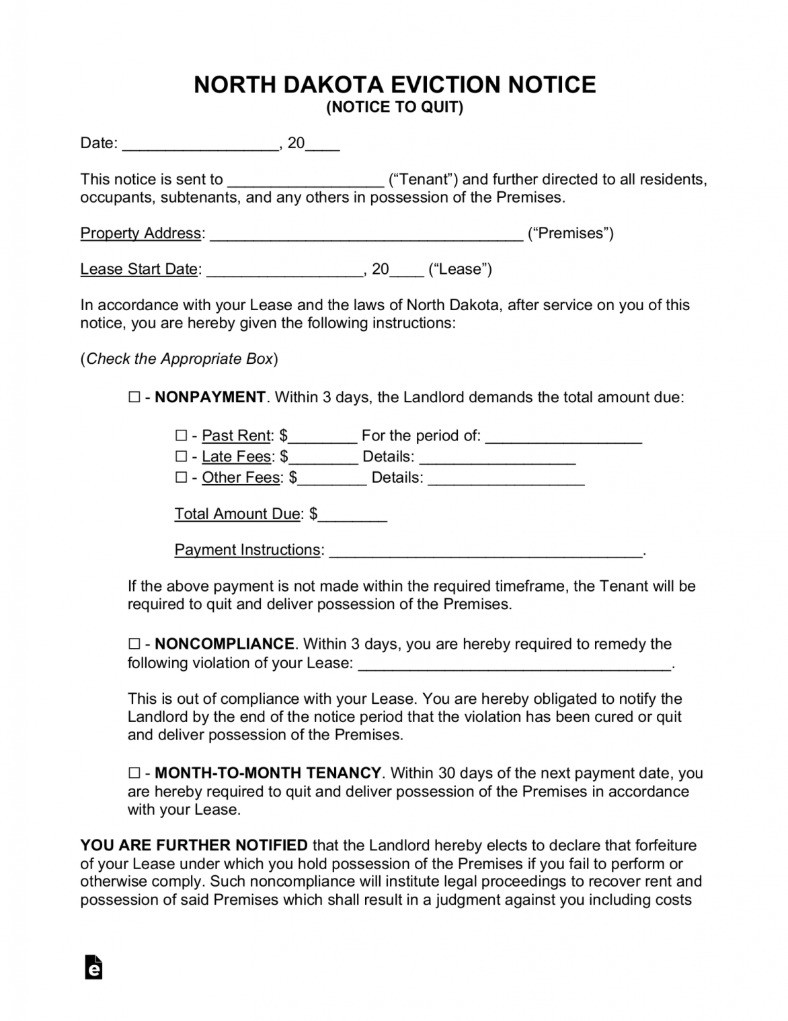
North Dakota Eviction Notice Form

Full Conversation


I have a tenant that has not paid rent on a month-to-month basis, and there are months where they haven’t paid rent at all. Can I evict them for that, and what forms would I need?

Lexi

Lexi, Chatbot

I understand how frustrating it can be to deal with a tenant who isn’t paying rent. How long has the tenant been in your property?

Since April of 2024.

Lexi

Lexi, Chatbot

Have you already communicated with the tenant about the unpaid rent, and if so, what was their response?

Yes. Their response was that they will try to pay and do their best to abide by the terms of the agreement.

Lexi

Lexi, Chatbot

Is there anything else the landlord-tenant lawyer should know before I connect you? Rest assured they’ll be able to help with your eviction process.

The tenant is living in a house with my mother and me, so this is not a normal apartment-style living situation. The tenant agreed upon moving in to follow house rules and help with things around the house. He also agreed to pay half of everything and rent. None of this has been followed. There were periods where paying half of everything was never done, and there were several months where rent was not paid either.

Benjamin

Benjamin

Hey there! I’m Benjamin, an attorney with many years of experience. Just so you are aware, this service provides legal information only, and no attorney-client relationship is formed.

Regarding your tenant situation, what type of lease did they have, and what state are you in?

Month to month, North Dakota.

Benjamin

Benjamin

In North Dakota, evictions for nonpayment of rent are governed by N.D. Cent. Code §§ 47-32-01 through 47-32-04. Here’s the step-by-step process:

Start a Summary Eviction (Unlawful Detainer) Action

You file a Complaint in Unlawful Detainer in district court (in the county where the property is located). At the same time, you request a Summons.

Forms are available at North Dakota Supreme Court website:

Service of Summons and Complaint

The tenant must be served with the summons and complaint by a sheriff, process server, or another adult who is not a party to the case.

Service must occur at least 3 days before the court hearing.

Court Hearing

The court schedules a quick hearing, often within 3–15 days.

At the hearing, you must prove:

  • A rental agreement exists
  • Rent was due and unpaid
  • The tenant is still in possession

Judgment & Writ of Restitution

If you win, the court issues a judgment for possession. The tenant may also be ordered to pay back rent, costs, and attorney’s fees if allowed by the lease.

The court issues a Writ of Restitution authorizing the sheriff to remove the tenant if they do not leave voluntarily.

Sheriff’s Role

Only the sheriff can enforce the writ. You cannot lock out the tenant, remove belongings, or shut off utilities—self-help evictions are illegal.

What if the tenant had a lease agreement that expired and then went month to month—would a new agreement need to be signed?

Benjamin

Benjamin

No. The terms of the original written lease still apply once it converts to a month-to-month tenancy.

If the tenant is willing to leave or accepts us asking them to leave on their own, is that legal? Or would we still need to go through the eviction process?

Benjamin

Benjamin

If both parties agree to terminate the lease, that is legal and does not require an eviction proceeding.

If the tenant has no place to go and is only staying because of that, can they still be asked to leave or evicted?

Benjamin

Benjamin

That is not your concern as the landlord. The tenant is obligated to pay rent. If they do not, they are subject to eviction. Yes, you can ask them to leave and/or evict them.

So if we ask the tenant to leave and they agree, no further action is required? And they can’t later claim unlawful eviction or removal?

Would we need something in writing stating they are leaving voluntarily?

Benjamin

Benjamin

If they vacate voluntarily, no further action is required, and they cannot come back later claiming unlawful eviction. To protect yourself, you should have a written agreement terminating their occupancy.

If a written agreement is made and notarized, does that make it legal and binding? Or is there a form we should use?

Benjamin

Benjamin

Notarization is not required for it to be legally binding, but it can strengthen the agreement. There is no official form—this is simply a private agreement to voluntarily terminate the lease.

I created an Agreement to Vacate. Can that be used as a legally binding document?

Benjamin

Benjamin

Yes. As long as it clearly outlines the agreed terms, including the move-out date, and both parties sign it, it can be legally binding. Notarization adds extra validation but is not required.

Do you have any other input or clarification that might help me?

Benjamin

Benjamin

You’re doing exactly what needs to be done. This is not overly complicated. If the tenant agrees to leave, get it in writing. If they don’t, file the eviction and let the court handle it. You’re on the right track. Good luck.

You as well, thank you.

Benjamin

Benjamin

679 satisfied customers

Benjamin
Welcome! Have a similar question?

12 lawyers online now

0:00

By messaging AskALawyer, you agree to our Terms and Privacy Policy.

Disclaimer


By messaging AskaLawyer.com, you agree to our Terms and have read our Privacy Policy.

The information provided on AskaLawyer.com is for general informational purposes only and does not constitute legal advice. While we strive to ensure the accuracy and timeliness of the information presented, we make no guarantees regarding its completeness or applicability to your specific circumstances.

Use of this website does not create an attorney-client relationship between you and AskaLawyer.com or any of its attorneys. Communications through this website, including any responses from attorneys, are not privileged or confidential. For advice tailored to your individual situation, we recommend consulting a licensed attorney in your jurisdiction.

AskaLawyer.com disclaims any liability for actions taken or not taken based on the content of this site. We are not responsible for any third-party content that may be accessed through this website. Reliance on any information provided herein is solely at your own risk.

Ask a Lawyer Logo
Ask a Lawyer Logo
Intake Questions
Step  of 3
Loading...

Lexi, Chatbot

How would you like your legal question to be answered?

Online

Legal AI

Using ChatGPT 4o

Loading...

How do you like to pay?

By proceeding with payment, you agree to our Terms and Privacy Policy. You authorize us to charge $ today and $ thereafter until canceled. You may cancel anytime in the My Account section to stop future charges.

Total Due:

After purchasing, your chat will begin with an attorney.

By proceeding with payment, you agree to our Terms and Privacy Policy. You authorize us to charge $ today and $ thereafter until canceled. You may cancel anytime in the My Account section to stop future charges.

Total Due:

After purchasing, your chat will begin with an attorney.

After connecting, your chat will begin with an attorney.

After choosing, your chat will continue with Legal AI.

It looks like you already have an account with Ask a Lawyer.

We have sent you a magic link to . Click the link in your email to sign in and continue your chat.

spin

Step of 6 •

You'll receive an email at as soon as the lawyer joins the conversation 🙏🏻😊

Over 90% of lawyers connect within 5 minutes. If you're not online at that moment, don't worry — the lawyer will reply to your message while you're away.

You're also welcome to stay in the chat while waiting to be connected 💬✨

Waiting for lawyer

0:00