Should I list my deceased father on a quitclaim deed if probate was already completed years ago?

Legal Eagle
Legal Eagle

128,690 satisfied customers

View context
Solved

When a property owner has passed away, the critical legal issue is who holds title now, not whose name still appears on the assessor’s records. The assessor’s listing (showing your father’s name “et al.”) is not determinative of ownership and often lags behind recorded deeds. What controls is the last recorded deed and the outcome of the completed probate or estate process.

If probate was completed years ago and title was transferred—either solely to your mother or to specific heirs—then only the current title holder(s) should be listed as grantor(s) on a quitclaim deed. You generally should not list a deceased person as a grantor, even with “et al.,” because a deceased person cannot convey property. If your mother received full title through probate, survivorship, or a recorded deed, she alone should be the grantor.

A birth certificate is not required for a quitclaim deed and does not establish authority to convey property. What matters is proof of title, which typically comes from the final probate order, recorded distribution deed, survivorship deed, or prior recorded deed showing ownership vested in your mother.

Before printing or recording the deed, you should confirm ownership by checking the county recorder’s records for the most recent deed after probate. If the title is vested solely in your mother, remove your father’s name entirely from the grantor section. If title was distributed to multiple heirs, all owners must sign or otherwise convey their interests. Getting this part wrong can result in a rejected recording or a defective chain of title.

0

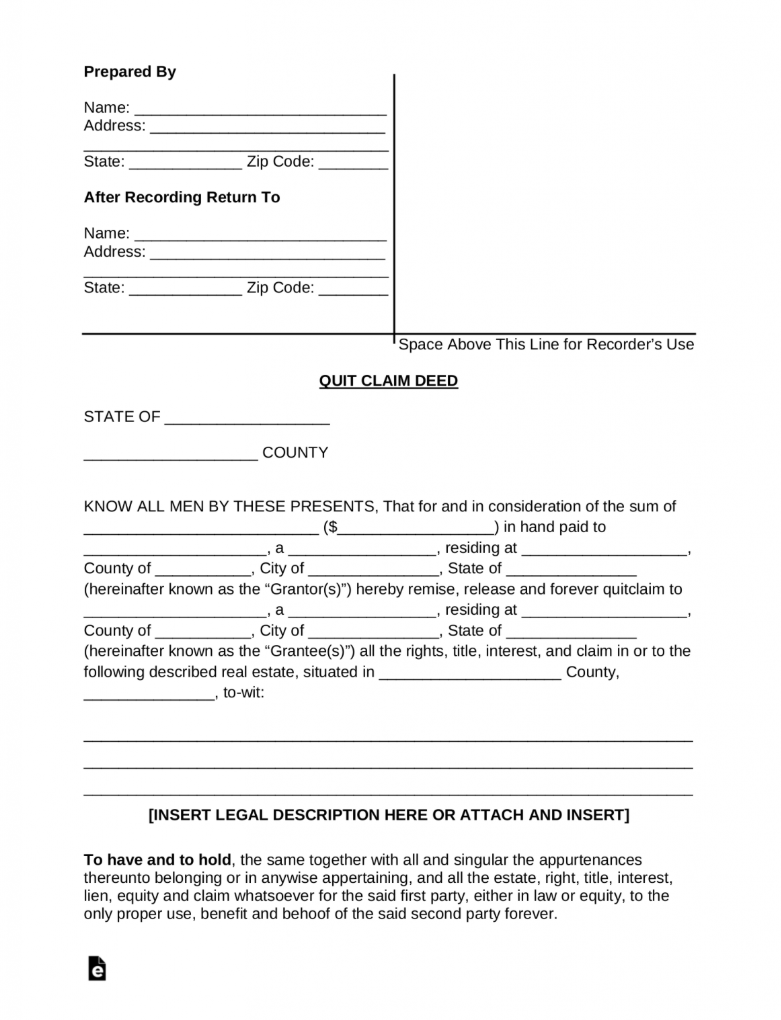
Quit Claim Deed Form

Full Conversation


Looking to complete a quick claim deed. My father owned the property and he is deceased. The assessment states his name et al. I have listed my mother as the seller but also included his name et al. Is this right?

Lexi

Lexi, Chatbot

I understand that dealing with property matters after a loved one’s passing can be challenging. Can you confirm if there is a will or probate process involved regarding your father’s estate?

That was all completed years ago.

Lexi

Lexi, Chatbot

Have you already obtained the necessary documentation to prove your relationship to your father and mother for the quick claim deed?

What is needed? I do have a birth certificate with them listed as parents.

Legal Eagle

Legal Eagle

Good day and welcome. Please give me a moment to review your question. Note that I am a hearing impaired expert, so phone calls are difficult for me. Thank you for understanding. Just so you are aware, this is a legal information only site. I do not provide representation and no attorney-client relationship is formed. My answers and comments should not be considered legal advice. It is always best to hire a local attorney to review the specifics of your particular case to ensure that a proper review is conducted.

Legal Eagle

Legal Eagle

Have you drafted the deed yet?

Yes, via eForms (this site). Have not printed it yet.

Legal Eagle

Legal Eagle

When a property owner has passed away, the critical legal issue is who holds title now, not whose name still appears on the assessor’s records. The assessor’s listing (showing your father’s name “et al.”) is not determinative of ownership and often lags behind recorded deeds. What controls is the last recorded deed and the outcome of the completed probate or estate process.

If probate was completed years ago and title was transferred—either solely to your mother or to specific heirs—then only the current title holder(s) should be listed as grantor(s) on a quitclaim deed. You generally should not list a deceased person as a grantor, even with “et al.,” because a deceased person cannot convey property. If your mother received full title through probate, survivorship, or a recorded deed, she alone should be the grantor.

A birth certificate is not required for a quitclaim deed and does not establish authority to convey property. What matters is proof of title, which typically comes from the final probate order, recorded distribution deed, survivorship deed, or prior recorded deed showing ownership vested in your mother.

Before printing or recording the deed, you should confirm ownership by checking the county recorder’s records for the most recent deed after probate. If the title is vested solely in your mother, remove your father’s name entirely from the grantor section. If title was distributed to multiple heirs, all owners must sign or otherwise convey their interests. Getting this part wrong can result in a rejected recording or a defective chain of title.

That was very helpful. I will contact the county recorder’s office.

Legal Eagle

Legal Eagle

Best of luck, my friend.

Thank you.

Legal Eagle

Legal Eagle

128,690 satisfied customers

Criminal law, employment law, family law, landlord-tenant, and real estate law.

Legal Eagle
Welcome! Have a similar question?

12 lawyers online now

0:00

By messaging AskALawyer, you agree to our Terms and Privacy Policy.

Disclaimer


By messaging AskaLawyer.com, you agree to our Terms and have read our Privacy Policy.

The information provided on AskaLawyer.com is for general informational purposes only and does not constitute legal advice. While we strive to ensure the accuracy and timeliness of the information presented, we make no guarantees regarding its completeness or applicability to your specific circumstances.

Use of this website does not create an attorney-client relationship between you and AskaLawyer.com or any of its attorneys. Communications through this website, including any responses from attorneys, are not privileged or confidential. For advice tailored to your individual situation, we recommend consulting a licensed attorney in your jurisdiction.

AskaLawyer.com disclaims any liability for actions taken or not taken based on the content of this site. We are not responsible for any third-party content that may be accessed through this website. Reliance on any information provided herein is solely at your own risk.

Ask a Lawyer Logo
Ask a Lawyer Logo
Intake Questions
Step  of 3
Loading...

Lexi, Chatbot

How would you like your legal question to be answered?

Online

Legal AI

Using ChatGPT 4o

Loading...

How do you like to pay?

By proceeding with payment, you agree to our Terms and Privacy Policy. You authorize us to charge $ today and $ thereafter until canceled. You may cancel anytime in the My Account section to stop future charges.

Total Due:

After purchasing, your chat will begin with an attorney.

By proceeding with payment, you agree to our Terms and Privacy Policy. You authorize us to charge $ today and $ thereafter until canceled. You may cancel anytime in the My Account section to stop future charges.

Total Due:

After purchasing, your chat will begin with an attorney.

After connecting, your chat will begin with an attorney.

After choosing, your chat will continue with Legal AI.

It looks like you already have an account with Ask a Lawyer.

We have sent you a magic link to . Click the link in your email to sign in and continue your chat.

spin

Step of 6 •

You'll receive an email at as soon as the lawyer joins the conversation 🙏🏻😊

Over 90% of lawyers connect within 5 minutes. If you're not online at that moment, don't worry — the lawyer will reply to your message while you're away.

You're also welcome to stay in the chat while waiting to be connected 💬✨

Waiting for lawyer

0:00