[AK] Is listing both spouses as grantors and myself as sole grantee correct for transferring full title in a spouse buyout deed?

Benjamin
Benjamin

679 satisfied customers

View context
Solved

When spouses currently hold title jointly and one spouse is buying out the other’s interest, it is standard practice to list both current owners as grantors and the buying spouse as the sole grantee. This ensures the entire ownership interest is conveyed and avoids any ambiguity in the chain of title.

In your case, the deed should show:

  • Grantors: You and your wife (the current joint owners)
  • Grantee: You alone

Both of you should sign the deed as grantors, and the signatures should be properly notarized before the document is recorded. (AK Stat § 34.15.010)

Once recorded, the deed transfers your wife’s ownership interest to you, and because you are also conveying your own existing interest through the same instrument, the result is that title vests solely in you as the grantee.

This approach is commonly used in spouse buyouts and is generally preferred because it clearly shows that all prior owners joined in the conveyance, which helps prevent title questions later.

Just make sure that:

  • The legal description exactly matches the current recorded deed
  • The deed includes the statutory warranty language if you are using a warranty deed (for example, “grants and warrants”)
  • The deed is properly notarized and recorded with the Alaska recorder’s office

If your lender is providing financing for the buyout, they will typically require the mortgage or deed of trust to be recorded immediately after the deed, which is standard practice.

With those elements in place, the deed structure you described should correctly transfer full title to you.

0

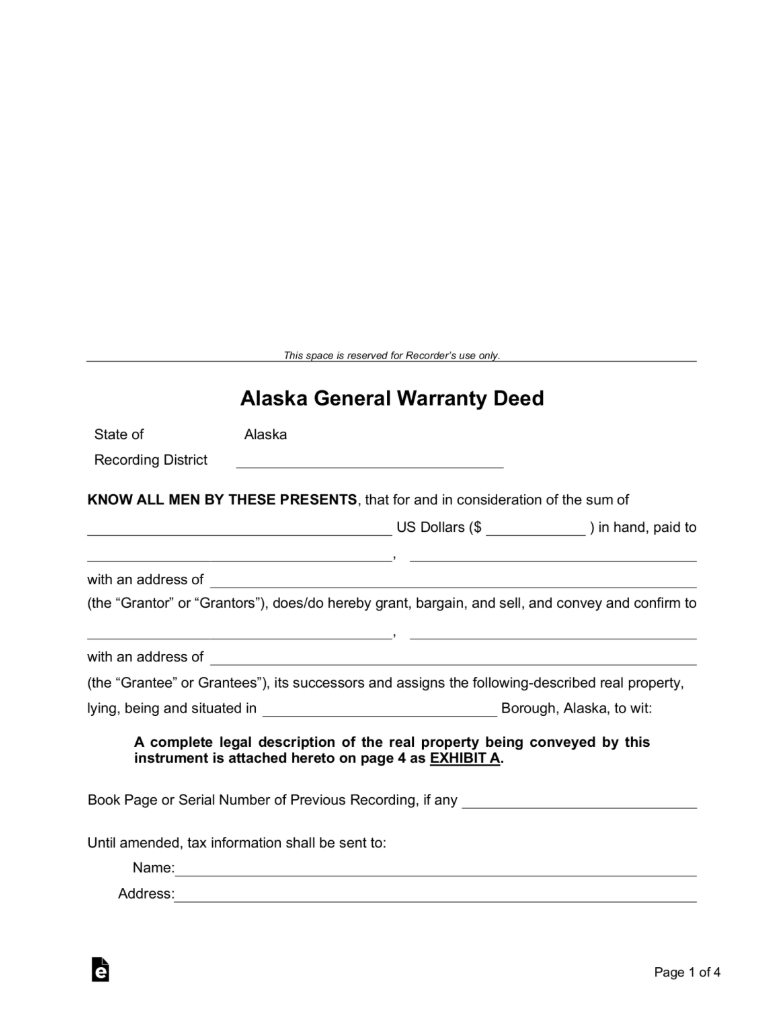
Alaska General (Statutory) Warranty Deed Form
Full Conversation


I have secured a loan/mortgage to pay for the sale, for which this real estate is the collateral. Is there any issue with this relative to a sale between my wife and myself?

Benjamin

Benjamin

Deed vs. mortgage (deed of trust) — different functions.

Attorney: In Alaska:

  • The warranty deed transfers title.
  • The mortgage or deed of trust creates a lien against that title.

They do not conflict, and one does not invalidate the other.

You can absolutely:

  • Convey the property by statutory/general warranty deed.
  • At the same time encumber it with a mortgage or deed of trust.

This is routine in Alaska real estate transactions.

Spouse-to-spouse sale + mortgage:

Because this is a transaction between spouses:

  • Confirm both spouses sign the mortgage/deed of trust if required by the lender.
  • Alaska does not require spousal joinder by default, but lenders often do.
  • If the property is or will be a primary residence, lender rules control.

This is a lender issue, not a deed-validity issue.

There is no issue using a statutory/general warranty deed when the purchase is financed by a mortgage secured by the same property. This is exactly how financed real estate transactions are structured in Alaska.

I want to confirm that I am preparing this deed correctly. My wife and I currently own the property jointly. The purpose of the deed is to transfer her entire ownership interest to me as part of a buyout. I have listed both of us as grantors (requiring both signatures), and myself alone as the grantee. Is this the correct and appropriate way to structure a deed in this situation to ensure that full title vests solely in me?

Benjamin

Benjamin

When spouses currently hold title jointly and one spouse is buying out the other’s interest, it is standard practice to list both current owners as grantors and the buying spouse as the sole grantee. This ensures the entire ownership interest is conveyed and avoids any ambiguity in the chain of title.

In your case, the deed should show:

  • Grantors: You and your wife (the current joint owners)
  • Grantee: You alone

Both of you should sign the deed as grantors, and the signatures should be properly notarized before the document is recorded. (AK Stat § 34.15.010)

Once recorded, the deed transfers your wife’s ownership interest to you, and because you are also conveying your own existing interest through the same instrument, the result is that title vests solely in you as the grantee.

This approach is commonly used in spouse buyouts and is generally preferred because it clearly shows that all prior owners joined in the conveyance, which helps prevent title questions later.

Just make sure that:

  • The legal description exactly matches the current recorded deed
  • The deed includes the statutory warranty language if you are using a warranty deed (for example, “grants and warrants”)
  • The deed is properly notarized and recorded with the Alaska recorder’s office

If your lender is providing financing for the buyout, they will typically require the mortgage or deed of trust to be recorded immediately after the deed, which is standard practice.

With those elements in place, the deed structure you described should correctly transfer full title to you.

Benjamin

Benjamin

679 satisfied customers

Benjamin
Welcome! Have a similar question?

12 lawyers online now

0:00

By messaging AskALawyer, you agree to our Terms and Privacy Policy.

Disclaimer


By messaging AskaLawyer.com, you agree to our Terms and have read our Privacy Policy.

The information provided on AskaLawyer.com is for general informational purposes only and does not constitute legal advice. While we strive to ensure the accuracy and timeliness of the information presented, we make no guarantees regarding its completeness or applicability to your specific circumstances.

Use of this website does not create an attorney-client relationship between you and AskaLawyer.com or any of its attorneys. Communications through this website, including any responses from attorneys, are not privileged or confidential. For advice tailored to your individual situation, we recommend consulting a licensed attorney in your jurisdiction.

AskaLawyer.com disclaims any liability for actions taken or not taken based on the content of this site. We are not responsible for any third-party content that may be accessed through this website. Reliance on any information provided herein is solely at your own risk.

Ask a Lawyer Logo
Ask a Lawyer Logo
Intake Questions
Step  of 3
Loading...

Lexi, Chatbot

How would you like your legal question to be answered?

Online

Legal AI

Using ChatGPT 4o

Loading...

How do you like to pay?

By proceeding with payment, you agree to our Terms and Privacy Policy. You authorize us to charge $ today and $ thereafter until canceled. You may cancel anytime in the My Account section to stop future charges.

Total Due:

After purchasing, your chat will begin with an attorney.

By proceeding with payment, you agree to our Terms and Privacy Policy. You authorize us to charge $ today and $ thereafter until canceled. You may cancel anytime in the My Account section to stop future charges.

Total Due:

After purchasing, your chat will begin with an attorney.

After connecting, your chat will begin with an attorney.

After choosing, your chat will continue with Legal AI.

It looks like you already have an account with Ask a Lawyer.

We have sent you a magic link to . Click the link in your email to sign in and continue your chat.

spin

Step of 6 •

You'll receive an email at as soon as the lawyer joins the conversation 🙏🏻😊

Over 90% of lawyers connect within 5 minutes. If you're not online at that moment, don't worry — the lawyer will reply to your message while you're away.

You're also welcome to stay in the chat while waiting to be connected 💬✨

Waiting for lawyer

0:00