
[IN] Does an existing mortgage need to be included in a land sale purchase agreement?

Jon
Jon

556 satisfied customers

View context
Solved

You are right that the title company is the one that actually handles the payoff behind the scenes, but it is still very normal and smart to mention it briefly in the purchase agreement. Most real estate contracts already deal with this through a "marketable title" or "liens" provision. The whole point of that language is to make clear that even though a lien exists now, it will be cleared at closing.

Including this protects everyone involved. It reassures the buyer that the approximately $27,000 mortgage will be paid off and that they will receive a clean, marketable title when the deal closes. It also gives the title company clear direction once they receive the signed contract, letting them know they need to order a payoff from your lender and handle it as part of closing. Just as importantly, it protects you by preventing a buyer from later arguing that you breached the contract because there was a lien on the property before closing.

You do not need complicated legal language to do this. A straightforward sentence in the purchase price or title section is usually enough, such as: "The Seller shall provide clear and marketable title at closing. Any existing mortgages or liens on the property shall be paid in full by the seller from the proceeds of the sale at the time of closing." This aligns with Indiana's marketable title requirements under Indiana Code 32-20-1.

Since this transaction is moving quickly, it is also worth double-checking your original mortgage documents for a due-on-sale clause. Most modern mortgages have one, which means the full balance becomes due when the property is transferred under Indiana Code 32-29-1. This is routine and something the title company handles automatically, but it is good to know what to expect. Calling your lender is a good next step. Ask them for a payoff statement effective through your expected closing date so there are no surprises.

Finally, Indiana requires you to complete State Form 46021, the Indiana Sales Disclosure Form, as required under Indiana Code 6-1.1-5.5. Section E of that form asks for details about the financing involved in the sale, so having your payoff information handy will make that part easier.

0

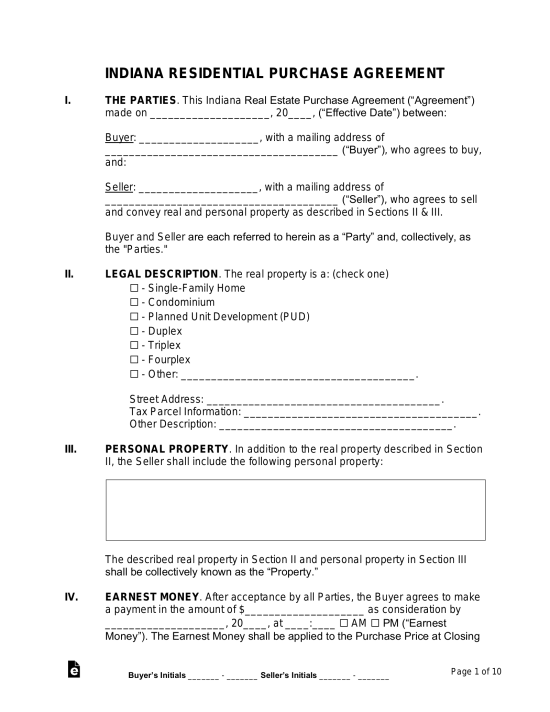
Indiana Residential Purchase and Sale Form
Full Conversation


I have typed up a land sale agreement and we are the sellers but we still owe approximately $27,000 on the land to be paid off at the time of closing with part of the money from the sale. Does that need to be stated anywhere in this agreement, or is that just something I tell the title company and they will take care of it at closing?

Lexi

Lexi, Chatbot

I understand that navigating land sale agreements can be complex. Have you already discussed the details of the outstanding balance with the buyer?

No, they came to us and asked to purchase the land. It was not actually up for sale, so we just negotiated a price and decided to sell.

Lexi

Lexi, Chatbot

Is this land sale agreement being handled through a title company or are you managing the closing process independently?

I am personally typing up the purchase agreement which we will all sign, and then it will go to a title company to do the actual closing and they will handle the funds.

Jon

Jon

Hello, and thank you for reaching out! I'm Jon, a licensed attorney with over 13 years of experience, here to help. I understand legal matters can feel overwhelming, but you're in good hands. My goal is to explain things clearly and guide you toward the best possible solution for your situation. Just a quick note: our conversation is for general legal information only and does not create an attorney-client relationship.

Jon

Jon

What state is the property located in?

Jon

Jon

If you're comfortable sharing more about your situation, I can offer advice tailored specifically to your needs. If not, no worries. I'm happy to provide a general overview based on what I know so far.

It is in Indiana.

Jon

Jon

Thank you. Is there currently a mortgage or lien on the property, or is the $27,000 owed part of a land contract or another type of financing?

We have 2 acres in Oxford that we have not built on, it is bare ground. Someone contacted us and asked to buy it and we decided to move forward with the sale. It was not actually for sale. We owe approximately $27,000 on the land. I was just wondering if anywhere in this agreement I need to state that it will be paid off with the sale of the land.

We have a mortgage of approximately $27,000 left on the land.

We are selling the land for $73,000 so we will still have money owed to us after the payoff.

Jon

Jon

Has your lender provided any specific instructions or requirements for paying off the mortgage at closing?

I have not contacted them yet as this has been very fast. But I can contact them tomorrow. I also know there is no penalty for paying off the land early.

I did not know if the title company would take care of paying off the land at closing.

Jon

Jon

Understood! Is there anything else you would like to add before I start working on your answer?

I do not think so as of right now.

Jon

Jon

Got it! I just need a few minutes to put together a complete response. Thanks so much for waiting.

Jon

Jon

You are right that the title company is the one that actually handles the payoff behind the scenes, but it is still very normal and smart to mention it briefly in the purchase agreement. Most real estate contracts already deal with this through a "marketable title" or "liens" provision. The whole point of that language is to make clear that even though a lien exists now, it will be cleared at closing.

Including this protects everyone involved. It reassures the buyer that the approximately $27,000 mortgage will be paid off and that they will receive a clean, marketable title when the deal closes. It also gives the title company clear direction once they receive the signed contract, letting them know they need to order a payoff from your lender and handle it as part of closing. Just as importantly, it protects you by preventing a buyer from later arguing that you breached the contract because there was a lien on the property before closing.

You do not need complicated legal language to do this. A straightforward sentence in the purchase price or title section is usually enough, such as: "The Seller shall provide clear and marketable title at closing. Any existing mortgages or liens on the property shall be paid in full by the seller from the proceeds of the sale at the time of closing." This aligns with Indiana's marketable title requirements under Indiana Code 32-20-1.

Since this transaction is moving quickly, it is also worth double-checking your original mortgage documents for a due-on-sale clause. Most modern mortgages have one, which means the full balance becomes due when the property is transferred under Indiana Code 32-29-1. This is routine and something the title company handles automatically, but it is good to know what to expect. Calling your lender is a good next step. Ask them for a payoff statement effective through your expected closing date so there are no surprises.

Finally, Indiana requires you to complete State Form 46021, the Indiana Sales Disclosure Form, as required under Indiana Code 6-1.1-5.5. Section E of that form asks for details about the financing involved in the sale, so having your payoff information handy will make that part easier.

So this sales disclosure form needs to be filled out along with the sale purchase agreement?

Also, are you able to see the agreement I typed up? I was just wondering where I can add this wording into it.

Jon

Jon

Yes, you need to fill out the Sales Disclosure Form (State Form 46021) in addition to your purchase agreement. The purchase agreement is your private contract to sell the land, while the disclosure form is a state requirement used by the county auditor to record the deed and update property taxes. Since your property is vacant land, you typically only need this tax disclosure form and can skip the more complex residential defect disclosure required for houses. The title company will usually oversee the final signing of this form at closing and collect the $20 filing fee from your sale proceeds.

Jon

Jon

I apologize, but we are unable to view documents here. Did that help clear things up for you? If you have any other questions or need more help, please do not hesitate to ask.

Yes, that is all helpful. Thank you!

Jon

Jon

Great! I do hope the information I provided was helpful and addressed your question. If there is anything else you need, please do not hesitate to reach out. Wishing you a fantastic day ahead!

Jon

Jon

556 satisfied customers

Jon
Welcome! Have a similar question?

12 lawyers online now

0:00

By messaging AskALawyer, you agree to our Terms and Privacy Policy.

Benjamin
Benjamin

Managing Attorney

4.77 (771)

[FL] Can I sue an HOA contractor for property damage and lost rental income?

17

5

Answered 2 months ago

Disclaimer


By messaging AskaLawyer.com, you agree to our Terms and have read our Privacy Policy.

The information provided on AskaLawyer.com is for general informational purposes only and does not constitute legal advice. While we strive to ensure the accuracy and timeliness of the information presented, we make no guarantees regarding its completeness or applicability to your specific circumstances.

Use of this website does not create an attorney-client relationship between you and AskaLawyer.com or any of its attorneys. Communications through this website, including any responses from attorneys, are not privileged or confidential. For advice tailored to your individual situation, we recommend consulting a licensed attorney in your jurisdiction.

AskaLawyer.com disclaims any liability for actions taken or not taken based on the content of this site. We are not responsible for any third-party content that may be accessed through this website. Reliance on any information provided herein is solely at your own risk.

Ask a Lawyer Logo
Ask a Lawyer Logo
Intake Questions
Step  of 3
Loading...

What's your legal question?

Lexi, Chatbot

How would you like your legal question to be answered?

Online

Legal AI

Using ChatGPT 4o

Loading...

How do you like to pay?

By proceeding with payment, you agree to our Terms and Privacy Policy. You authorize us to charge $ today and $ thereafter until canceled. You may cancel anytime in the My Account section to stop future charges.

Total Due:

After purchasing, your chat will begin with an attorney.

By proceeding with payment, you agree to our Terms and Privacy Policy. You authorize us to charge $ today and $ thereafter until canceled. You may cancel anytime in the My Account section to stop future charges.

Total Due:

After purchasing, your chat will begin with an attorney.

After connecting, your chat will begin with an attorney. After choosing, your chat will continue with Legal AI.

It looks like you already have an account with Ask a Lawyer.

We have sent you a magic link to . Click the link in your email to sign in and continue your chat.

spin

Step of 6 •

You'll receive an email at as soon as the lawyer joins the conversation 🙏🏻😊

Over 90% of lawyers connect within 5 minutes. If you're not online at that moment, don't worry — the lawyer will reply to your message while you're away.

You're also welcome to stay in the chat while waiting to be connected 💬✨

Waiting for lawyer

We couldn't send your message. Please try again.

Your lawyer will reply as soon as possible

If there’s a delay, please don’t worry. Your chat will stay open, and they’ll get back to you as soon as they can. There’s no rush on your end either. You’ll receive an email notification as soon as there’s a new message.

You've reached your AI chat limit

Upgrade your plan to continue chatting and get instant domain-specific answers.

0:00