
[FL] If the mortgage is in my name but my husband is on the deed, do I have to split the proceeds if we’re not separated?

Jon
Jon

556 satisfied customers

View context
Solved

Since you’ve been married for 27 years, and you are not legally separated, Florida generally treats your assets and debts as marital property. That means if you were to divorce, everything would be viewed through the rules of equitable distribution. (FL Stat § 61.075)

When it comes to the home, the fact that your husband is on the deed makes him a legal co-owner, even though the mortgage is only in your name. That matters when you’re thinking about selling the house or dividing the money later. In Florida, anything acquired during a marriage—such as a house—is usually considered marital property. After a 27-year marriage, the court would almost certainly treat the home’s value and equity as a marital asset. If you divorced, the court typically starts from the idea of a 50/50 split, though the final division must be equitable, which means fair—though not necessarily perfectly equal.

If the second mortgage was taken out during the marriage, the law generally treats it as a marital debt. Any time a house is sold, all mortgages and liens must be paid off before anyone gets money from the sale. Only the remaining amount, the net proceeds, is what gets divided. If your husband agreed to pay part of the second mortgage but stopped paying during your separation, that can still matter. A court might take that into account when deciding how to divide debts or final proceeds, but simply being separated does not automatically remove his responsibility for the debt. And because he is on the deed, you cannot sell the house without his cooperation—he must sign the deed for the transfer to a buyer. (FL Stat § 689.01)

Your bank accounts and investments follow a similar principle. Even though you removed his name from them, any money or investments earned during your marriage are usually viewed as marital property in Florida. That means they would be subject to equitable distribution if you divorced.

The only things that might be excluded are assets you had before the marriage or anything you received as a gift or inheritance from someone else, as long as those funds were never mixed with marital money or used for marital expenses. (FL Stat § 61.075 (6)(b))

Given the financial stakes and the number of issues involved, it would be wise to speak with a Florida family-law attorney who handles equitable distribution cases. They can review your documents, explain how the law would likely apply to your home, your accounts, the second mortgage, and your plans for a trust, and help you make decisions that protect you moving forward.

0

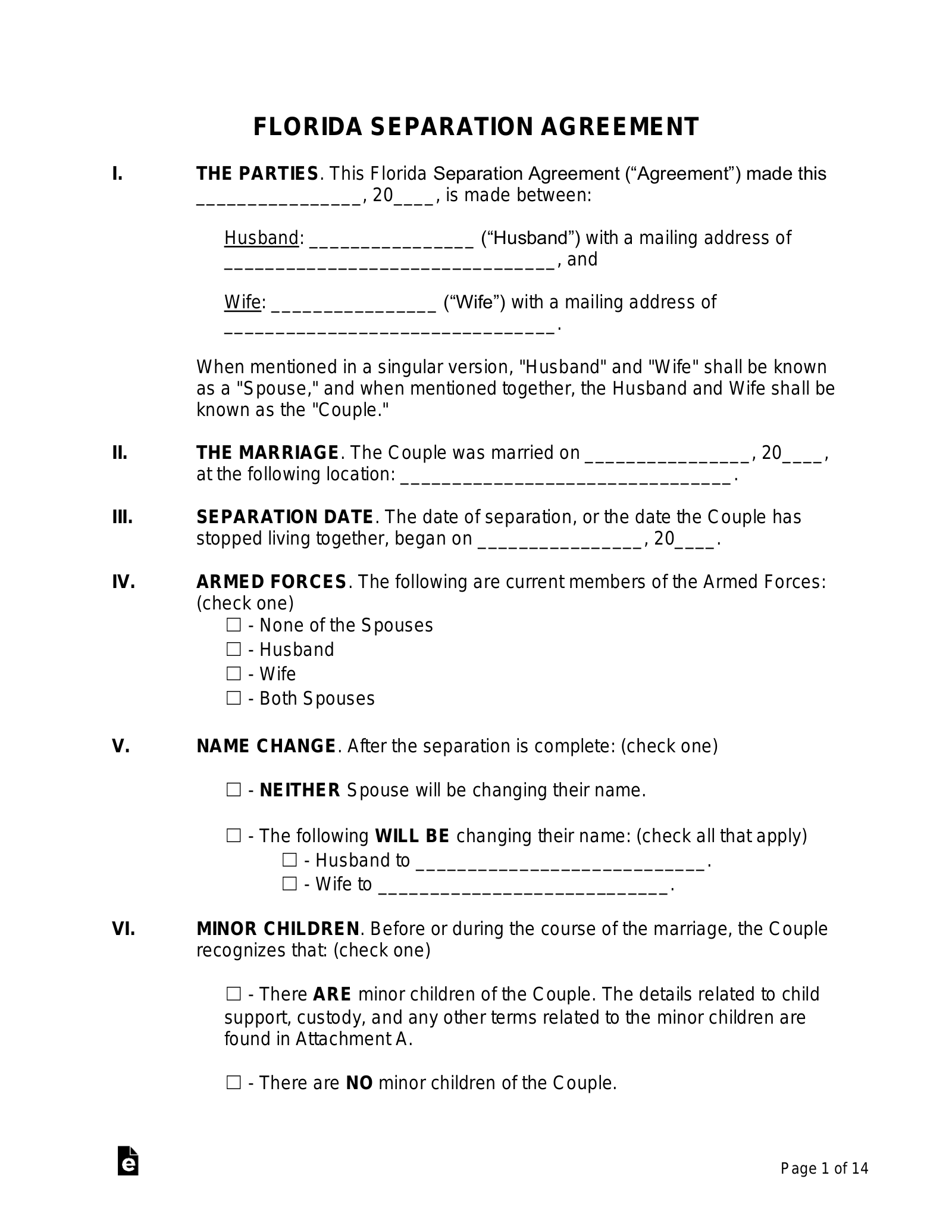
Florida Marital Separation Agreement
Full Conversation


I have investments, money in the bank. I removed my husband's name off of my accounts. The home mortgage is in my name but he is on the deed. I plan to sell the house in the next year or two. We have a lien, second mortgage, which he agreed to pay for now but is being difficult due to separation. If any money is left over from the property sale, I need to know if I am legally obligated to split the proceeds? We are not legally separated.

Lexi

Lexi, Chatbot

I understand that you're concerned about your husband's legal rights in your marriage. Can you tell me how long you have been married?

27 years.

Lexi

Lexi, Chatbot

Are there any specific legal matters or situations you are currently facing that you would like to discuss?

I would like to set up everything under a trust.

I plan to sell the house in the next year or two. If any money is left over from the property sale, I need to know if I am legally obligated to split the proceeds?

Jon

Jon

Hello, and thank you for reaching out! I’m Jon, a licensed attorney with over 13 years of experience, here to help.

I understand legal matters can feel overwhelming, but you’re in good hands. My goal is to explain things clearly and guide you toward the best possible solution for your situation. Just a quick note: our conversation is for general legal information only and does not create an attorney-client relationship.

Could you let me know which state you're located in? This helps me provide more accurate guidance.

Florida.

Jon

Jon

Thanks for letting me know you're in Florida. Are you and your husband legally separated, or are you in the process of getting a divorce? This can affect how the proceeds from the sale might be divided.

We're not legally separated.

Jon

Jon

Understood! I believe I have all the information I need. Is there anything else you'd like to add before I start working on your answer? If not, I’ll get started right away.

No

Jon

Jon

Got it! I just need a few minutes to put together a complete response for you. It shouldn’t take longer than about 4–5 minutes, and I want to make sure it’s clear and comprehensive. Thanks so much for waiting—I really appreciate your patience.

Jon

Jon

Since you’ve been married for 27 years, and you are not legally separated, Florida generally treats your assets and debts as marital property. That means if you were to divorce, everything would be viewed through the rules of equitable distribution. (FL Stat § 61.075)

When it comes to the home, the fact that your husband is on the deed makes him a legal co-owner, even though the mortgage is only in your name. That matters when you’re thinking about selling the house or dividing the money later. In Florida, anything acquired during a marriage—such as a house—is usually considered marital property. After a 27-year marriage, the court would almost certainly treat the home’s value and equity as a marital asset. If you divorced, the court typically starts from the idea of a 50/50 split, though the final division must be equitable, which means fair—though not necessarily perfectly equal.

If the second mortgage was taken out during the marriage, the law generally treats it as a marital debt. Any time a house is sold, all mortgages and liens must be paid off before anyone gets money from the sale. Only the remaining amount, the net proceeds, is what gets divided. If your husband agreed to pay part of the second mortgage but stopped paying during your separation, that can still matter. A court might take that into account when deciding how to divide debts or final proceeds, but simply being separated does not automatically remove his responsibility for the debt. And because he is on the deed, you cannot sell the house without his cooperation—he must sign the deed for the transfer to a buyer. (FL Stat § 689.01)

Your bank accounts and investments follow a similar principle. Even though you removed his name from them, any money or investments earned during your marriage are usually viewed as marital property in Florida. That means they would be subject to equitable distribution if you divorced.

The only things that might be excluded are assets you had before the marriage or anything you received as a gift or inheritance from someone else, as long as those funds were never mixed with marital money or used for marital expenses. (FL Stat § 61.075 (6)(b))

Given the financial stakes and the number of issues involved, it would be wise to speak with a Florida family-law attorney who handles equitable distribution cases. They can review your documents, explain how the law would likely apply to your home, your accounts, the second mortgage, and your plans for a trust, and help you make decisions that protect you moving forward.

Jon

Jon

After nearly three decades of marriage, it becomes very difficult to trace and prove which funds are separate, so courts often treat most financial accounts as marital.

You can set up a trust if you want to, since trusts are commonly used for estate planning or sometimes for asset protection. But placing marital assets—like your home or investments—into a trust doesn’t automatically turn them into non-marital property. If something was marital before it went into the trust, it is typically still marital for divorce purposes. And even if you try to change who receives your assets in a trust or will, Florida law gives a surviving spouse the right to claim an “elective share” of the estate unless that right was waived in a prenuptial or postnuptial agreement. A trust doesn’t override that protection.

Right now, the uncertainty about your marital status makes everything harder. It’s difficult to handle property decisions, debt issues, or long-term planning when you’re technically still married but living separately. If you decide to sell the home before a divorce, your husband’s signature is required, and as a co-owner he would be entitled to his share of whatever is left after the mortgages and liens are paid. His refusal to pay his part of the second mortgage is something that would usually be sorted out in divorce negotiations or by a court if negotiations fail.

Thank you for your response. I understand perfectly. Is there a way to print or save this dialog?

Jon

Jon

You can copy and paste the information as needed or ask customer service to send it to you. I do hope the information I provided was helpful and addressed your question. If there's anything else you need, please don't hesitate to reach out—I’m always happy to assist. Wishing you a fantastic day ahead!

Thank you.

Jon

Jon

You’re so welcome! I’m thrilled I could help — don’t hesitate to reach out if you need anything at all!

Jon

Jon

556 satisfied customers

Jon
Welcome! Have a similar question?

12 lawyers online now

0:00

By messaging AskALawyer, you agree to our Terms and Privacy Policy.

Gurney P
Gurney P

Partner

4.67 (13,616)

[WA] How do I get a child medical consent form notarized?

18

6

Answered 15 hours ago

Disclaimer


By messaging AskaLawyer.com, you agree to our Terms and have read our Privacy Policy.

The information provided on AskaLawyer.com is for general informational purposes only and does not constitute legal advice. While we strive to ensure the accuracy and timeliness of the information presented, we make no guarantees regarding its completeness or applicability to your specific circumstances.

Use of this website does not create an attorney-client relationship between you and AskaLawyer.com or any of its attorneys. Communications through this website, including any responses from attorneys, are not privileged or confidential. For advice tailored to your individual situation, we recommend consulting a licensed attorney in your jurisdiction.

AskaLawyer.com disclaims any liability for actions taken or not taken based on the content of this site. We are not responsible for any third-party content that may be accessed through this website. Reliance on any information provided herein is solely at your own risk.

Ask a Lawyer Logo
Ask a Lawyer Logo
Intake Questions
Step  of 3
Loading...

Lexi, Chatbot

How would you like your legal question to be answered?

Online

Legal AI

Using ChatGPT 4o

Loading...

How do you like to pay?

By proceeding with payment, you agree to our Terms and Privacy Policy. You authorize us to charge $ today and $ thereafter until canceled. You may cancel anytime in the My Account section to stop future charges.

Total Due:

After purchasing, your chat will begin with an attorney.

By proceeding with payment, you agree to our Terms and Privacy Policy. You authorize us to charge $ today and $ thereafter until canceled. You may cancel anytime in the My Account section to stop future charges.

Total Due:

After purchasing, your chat will begin with an attorney.

After connecting, your chat will begin with an attorney.

After choosing, your chat will continue with Legal AI.

It looks like you already have an account with Ask a Lawyer.

We have sent you a magic link to . Click the link in your email to sign in and continue your chat.

spin

Step of 6 •

You'll receive an email at as soon as the lawyer joins the conversation 🙏🏻😊

Over 90% of lawyers connect within 5 minutes. If you're not online at that moment, don't worry — the lawyer will reply to your message while you're away.

You're also welcome to stay in the chat while waiting to be connected 💬✨

Waiting for lawyer

0:00