[VA] Can a spouse force the higher earner to leave a jointly owned marital home during separation?

Benjamin
Benjamin

679 satisfied customers

View context
Solved

Your husband cannot legally force you out of a jointly owned marital home unless and until a court orders it. What he is telling you about “his lawyer said you have to leave” is not legally accurate.

Why He Cannot Make You Leave

1. You are both on the deed.
Because both of you are on the deed, you have equal legal rights to occupy the home.

  • Income level does not determine who stays
  • VA disability income does not give him priority
  • Neither spouse can unilaterally evict the other

Until a court says otherwise, you have the same right to live there as he does.

2. Virginia is an equitable distribution state.
Virginia divides property based on fairness, not “who makes more.”

Courts look at:

  • Contributions to the marriage (financial and non-financial)
  • Ability of each spouse to maintain housing
  • Who can realistically afford the home
  • Length of the marriage
  • Fault grounds (if any)

There is no rule in Virginia that says the higher earner must leave.

3. You do NOT need to leave unless one of these happens:

  • You voluntarily agree to move out
  • A court issues an order (very rare early on unless there’s abuse)
  • There is a protective order (not indicated here)

None of those exist right now.

Very Important Strategic Warning

Leaving the house voluntarily can hurt you later.

If you leave:

  • He may argue you abandoned the marital residence
  • He may try to establish status quo (him in the house, you out)
  • It can complicate negotiations about who keeps or sells the home
  • It puts you in the financial squeeze you’re already worried about

Virginia courts often favor maintaining the status quo, so leaving without an agreement or court order can weaken your position.

This is the reason they want you to leave probably, it supports their argument.

Virginia does not require one spouse to physically move out of the marital home in order to satisfy the 6-month (or 1-year) separation requirement.

You can be “legally separated” while living under the same roof if specific conditions are met.

Ownership of the deed does not control separation. Conduct does.

Under Virginia Code § 20-91(A)(9), separation means:

  • An intent to end the marriage, and
  • Cessation of marital cohabitation

It does not require:

  • Separate residences
  • One spouse leaving the home
  • A court order enforcing separation

To qualify, you must show all of the following:

1. Clear intent to separate: At least one spouse clearly communicates the marriage is over. Example: written notice, text, email, or separation agreement draft. You’ve already done this by drafting a separation agreement.

2. No marital relationship: You must stop behaving as a married couple:

  • No sexual relationship
  • No shared bedroom
  • No romantic conduct
  • No joint social activities as a couple

Sleeping in separate rooms is strong evidence.

3. Separate lives inside the home: This is the part judges look at closely:

  • Separate finances as much as possible
  • Separate groceries and meals (or clearly divided food prep)
  • Separate laundry
  • Minimal interaction beyond logistics
  • No holding yourselves out as spouses

You don’t have to be hostile — just clearly independent.

4. Corroboration (Enforcement mechanism)

This is how it’s “enforced”:

Virginia requires corroboration, meaning:

A third party (friend, family member, therapist, etc.) can testify or submit an affidavit stating:

  • They know when separation began
  • You were living separate lives
  • The marriage was over

There is no divorce police checking your house. The court enforces separation retroactively, at the time of divorce.

6 Months vs. 1 Year

You qualify for 6 months if:

  • No minor children
  • You have a signed separation agreement

If either is missing → 1 year.

Living arrangements do not change this rule.

0

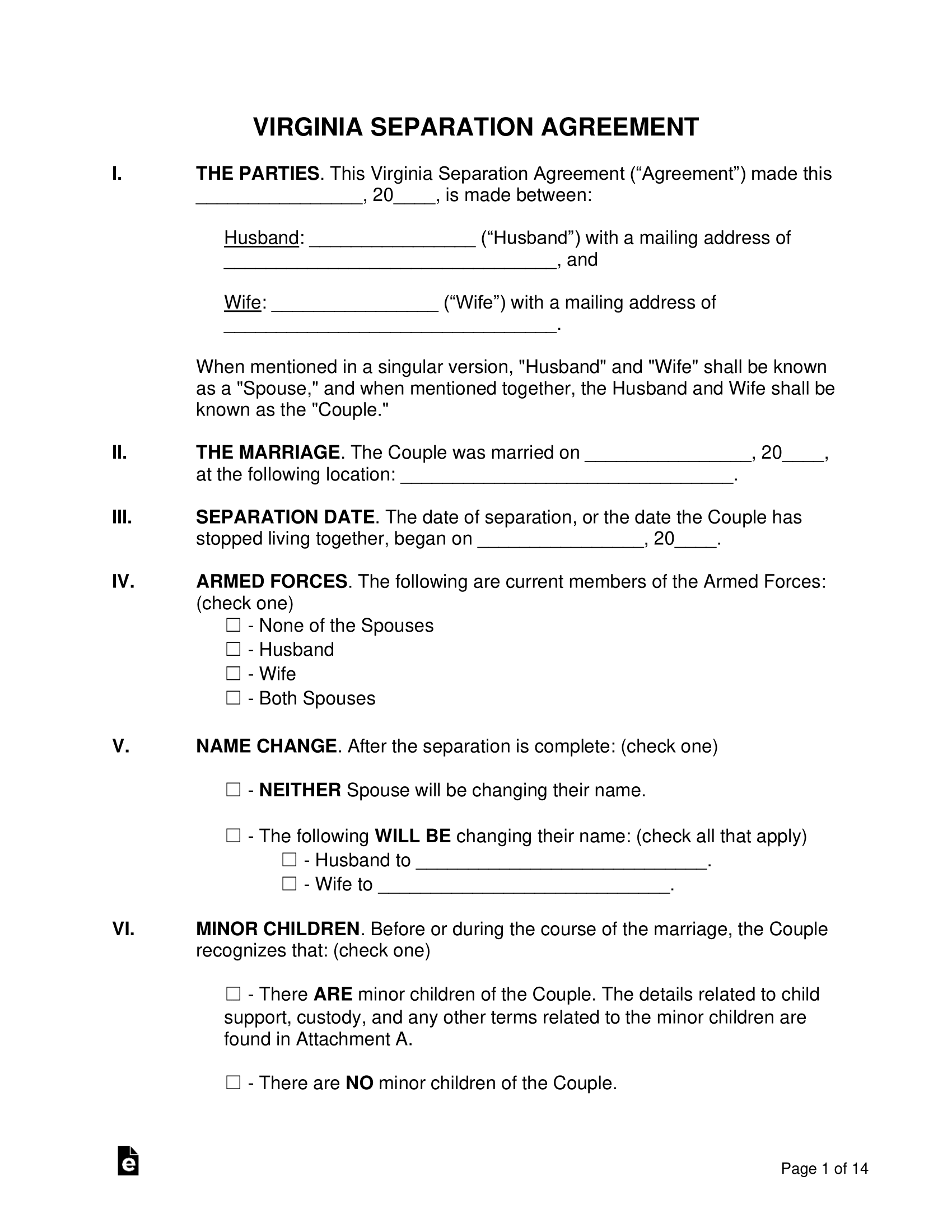
Virginia Separation Agreement

Full Conversation


I am the primary earner in my house. My husband gets some income from the Veterans Administration. We are at a point where we have irreconcilable differences. He tells me I have to leave the house because I make the majority of the money. He cannot afford the house, and I cannot afford to pay for the house, all the bills, and an apartment. I have farm animals here that I pay for. Do I need to leave?

Lexi

Lexi, Chatbot

I'm sorry to hear about the difficult situation you're facing. Have you and your husband discussed any potential arrangements for living separately?

I have tried, but he won't budge. Tells me his “lawyer said [you] need to leave.”

Lexi

Lexi, Chatbot

Are there any legal agreements or documents in place regarding ownership of the house or financial responsibilities?

Not yet. I have drawn up a separation agreement, but I feel he won't go for it.

Benjamin

Benjamin

Hello, my name is Benjamin, and I have been a licensed attorney for over 19 years. I understand you're dealing with a situation where your husband is asking you to leave the house due to financial reasons, and you're concerned about the farm animals you care for. Could you share more details about any specific concerns or questions you have regarding this situation? What state are you in? Are you both on the home deed?

Virginia, and yes, we're both on the deed right now.

He is telling me that I have to leave the house because I make the majority of the money and I should be the one to get an apartment.

He absolutely cannot afford the house. I have farm animals here, and if I leave, there is a likelihood that he will get rid of them.

I have a full-time position with the government and I have my VA disability.

We have been trying to get him SSDI, but it hasn’t come through yet.

Now in Virginia, it is required that we live separately for 6 months prior to the signed final order. How will this be enforced if we're both on the deed?

Benjamin

Benjamin

Your husband cannot legally force you out of a jointly owned marital home unless and until a court orders it. What he is telling you about “his lawyer said you have to leave” is not legally accurate.

Why He Cannot Make You Leave

1. You are both on the deed.
Because both of you are on the deed, you have equal legal rights to occupy the home.

  • Income level does not determine who stays
  • VA disability income does not give him priority
  • Neither spouse can unilaterally evict the other

Until a court says otherwise, you have the same right to live there as he does.

2. Virginia is an equitable distribution state.
Virginia divides property based on fairness, not “who makes more.”

Courts look at:

  • Contributions to the marriage (financial and non-financial)
  • Ability of each spouse to maintain housing
  • Who can realistically afford the home
  • Length of the marriage
  • Fault grounds (if any)

There is no rule in Virginia that says the higher earner must leave.

3. You do NOT need to leave unless one of these happens:

  • You voluntarily agree to move out
  • A court issues an order (very rare early on unless there’s abuse)
  • There is a protective order (not indicated here)

None of those exist right now.

Very Important Strategic Warning

Leaving the house voluntarily can hurt you later.

If you leave:

  • He may argue you abandoned the marital residence
  • He may try to establish status quo (him in the house, you out)
  • It can complicate negotiations about who keeps or sells the home
  • It puts you in the financial squeeze you’re already worried about

Virginia courts often favor maintaining the status quo, so leaving without an agreement or court order can weaken your position.

This is the reason they want you to leave probably, it supports their argument.

Virginia does not require one spouse to physically move out of the marital home in order to satisfy the 6-month (or 1-year) separation requirement.

You can be “legally separated” while living under the same roof if specific conditions are met.

Ownership of the deed does not control separation. Conduct does.

Under Virginia Code § 20-91(A)(9), separation means:

  • An intent to end the marriage, and
  • Cessation of marital cohabitation

It does not require:

  • Separate residences
  • One spouse leaving the home
  • A court order enforcing separation

To qualify, you must show all of the following:

1. Clear intent to separate: At least one spouse clearly communicates the marriage is over. Example: written notice, text, email, or separation agreement draft. You’ve already done this by drafting a separation agreement.

2. No marital relationship: You must stop behaving as a married couple:

  • No sexual relationship
  • No shared bedroom
  • No romantic conduct
  • No joint social activities as a couple

Sleeping in separate rooms is strong evidence.

3. Separate lives inside the home: This is the part judges look at closely:

  • Separate finances as much as possible
  • Separate groceries and meals (or clearly divided food prep)
  • Separate laundry
  • Minimal interaction beyond logistics
  • No holding yourselves out as spouses

You don’t have to be hostile — just clearly independent.

4. Corroboration (Enforcement mechanism)

This is how it’s “enforced”:

Virginia requires corroboration, meaning:

A third party (friend, family member, therapist, etc.) can testify or submit an affidavit stating:

  • They know when separation began
  • You were living separate lives
  • The marriage was over

There is no divorce police checking your house. The court enforces separation retroactively, at the time of divorce.

6 Months vs. 1 Year

You qualify for 6 months if:

  • No minor children
  • You have a signed separation agreement

If either is missing → 1 year.

Living arrangements do not change this rule.

I'm also concerned that he may lock me out, as I travel for work to DC every other week for 2 nights.

Benjamin

Benjamin

Changing locks, denying access, or barring you from entry is illegal.

This is considered unlawful exclusion / constructive eviction under Virginia law and can trigger immediate court relief.

What Happens if He Locks You Out

If he locks you out while you are traveling:

1. Police involvement is appropriate.

This is not a “civil-only” issue when ownership is clear.

You can:

  • Call local law enforcement
  • Show proof you are on the deed or mortgage
  • Explain you are being unlawfully excluded from your own home

Police commonly require the locking spouse to restore access.

2. Emergency court relief

You can file for:

  • Emergency motion for exclusive possession, or
  • Motion to restore access to marital residence

Judges take lockouts very seriously.

3. It hurts him in the divorce

Judges view lockouts as:

  • Coercive
  • Financial control
  • Bad-faith conduct

This can affect:

  • Temporary orders
  • Credibility
  • Property division
  • Attorney’s fees

PROTECT Yourself Before Your Next Trip

Secure proof of residency.

Keep digital and physical copies of:

  • Deed
  • Mortgage statement
  • Utility bill in your name
  • Driver’s license showing the address

Perfect; thank you so much! That's it for now. I appreciate you and your assistance.

Benjamin

Benjamin

Did that solve your issue?

Please let me know if you have any further questions. I believe I have addressed your inquiry, so I will mark it as complete. Thank you and have a wonderful day!

Thank you and you as well!

Benjamin

Benjamin

679 satisfied customers

Benjamin
Welcome! Have a similar question?

12 lawyers online now

0:00

By messaging AskALawyer, you agree to our Terms and Privacy Policy.

Disclaimer


By messaging AskaLawyer.com, you agree to our Terms and have read our Privacy Policy.

The information provided on AskaLawyer.com is for general informational purposes only and does not constitute legal advice. While we strive to ensure the accuracy and timeliness of the information presented, we make no guarantees regarding its completeness or applicability to your specific circumstances.

Use of this website does not create an attorney-client relationship between you and AskaLawyer.com or any of its attorneys. Communications through this website, including any responses from attorneys, are not privileged or confidential. For advice tailored to your individual situation, we recommend consulting a licensed attorney in your jurisdiction.

AskaLawyer.com disclaims any liability for actions taken or not taken based on the content of this site. We are not responsible for any third-party content that may be accessed through this website. Reliance on any information provided herein is solely at your own risk.

Ask a Lawyer Logo
Ask a Lawyer Logo
Intake Questions
Step  of 3
Loading...

Lexi, Chatbot

How would you like your legal question to be answered?

Online

Legal AI

Using ChatGPT 4o

Loading...

How do you like to pay?

By proceeding with payment, you agree to our Terms and Privacy Policy. You authorize us to charge $ today and $ thereafter until canceled. You may cancel anytime in the My Account section to stop future charges.

Total Due:

After purchasing, your chat will begin with an attorney.

By proceeding with payment, you agree to our Terms and Privacy Policy. You authorize us to charge $ today and $ thereafter until canceled. You may cancel anytime in the My Account section to stop future charges.

Total Due:

After purchasing, your chat will begin with an attorney.

After connecting, your chat will begin with an attorney.

After choosing, your chat will continue with Legal AI.

It looks like you already have an account with Ask a Lawyer.

We have sent you a magic link to . Click the link in your email to sign in and continue your chat.

spin

Step of 6 •

You'll receive an email at as soon as the lawyer joins the conversation 🙏🏻😊

Over 90% of lawyers connect within 5 minutes. If you're not online at that moment, don't worry — the lawyer will reply to your message while you're away.

You're also welcome to stay in the chat while waiting to be connected 💬✨

Waiting for lawyer

0:00