Brandon
The Key Issue
When someone passes away without a will in California, the court must appoint a personal representative to handle any assets that are still in the decedent's name. Social Security will not release unpaid benefits unless the person requesting them has legal authority from the court. Even though you were his caregiver and beneficiary on certain accounts, that alone does not give you authority over unpaid Social Security benefits. Those funds belong to his estate unless Social Security determines they go to a specific category of survivor under federal rules.
Because there was no will and no spouse or children, this is what we need to determine first: were there any living parents, siblings, nieces, nephews, or other blood relatives at the time of his death? You mentioned you were married to his only sibling and that your husband passed before your brother in law. That detail matters a lot. Under California intestate succession law, if your brother in law had no spouse, no children, and no surviving parents, his estate would typically pass to his siblings. If his only sibling predeceased him, then that sibling's children would usually inherit. If there are none, we look further down the family tree. (CA Prob Code § 6402)
What Social Security Is Asking For. Social Security is likely asking for one of the following:
Letters of Administration issued by the Probate Court, or a Small Estate Affidavit if the estate qualifies. Because you are in Los Angeles County, probate matters are handled by the Los Angeles County Superior Court, Probate Division.
Step One: Determine If Full Probate Is Required. In California, if the total value of the estate subject to probate is under a certain threshold, you may be able to use a simplified process under California's small estate procedures. Currently, if the estate is under approximately $184,500 in probate assets, a small estate procedure may be available. (CA Prob Code § 13100) However, unpaid Social Security benefits sometimes still require formal appointment depending on the amount and SSA's internal rules.
Here is what you need to find out from Social Security: how much is owed, and are they requiring full Letters of Administration, or will they accept a small estate affidavit. If it is a modest amount, you may not need full probate.
If Full Probate Is Required
If SSA insists on formal appointment, you would file a petition for appointment as administrator. Under (CA Prob Code § 8461), the court follows a statutory priority order for who may be appointed administrator when there is no will. In Los Angeles County, you would typically file:
- Petition for Letters of Administration (Form DE-111)
- Duties and Liabilities of Personal Representative (Form DE-147)
- Order for Probate (Form DE-140)
- Letters of Administration (Form DE-150).
These are filed with the Probate Division of the Los Angeles County Superior Court in the district where your brother in law lived at the time of death. You would need to open a probate case, notify all heirs under California intestate law, attend a short probate hearing, and receive Letters of Administration from the court. Once you have the Letters, you provide certified copies to Social Security.
A Very Important Point About Standing. This is the part we need to be careful with. Being his former sister in law does not automatically make you an heir under California law. If there are no living blood relatives, the estate may eventually escheat to the State of California. In that scenario, your ability to be appointed administrator could be limited unless you qualify as an interested party, such as a creditor for caregiving services.
Alternative: Small Estate Affidavit
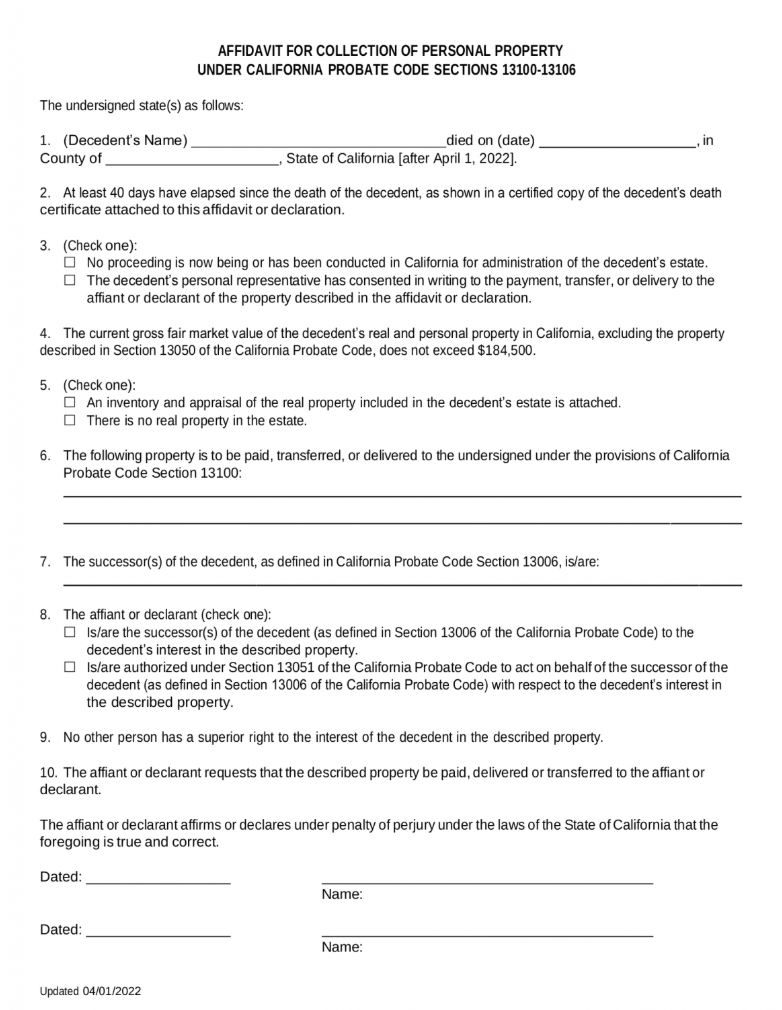
If the only asset is unpaid Social Security benefits and the amount is relatively small, you may be able to use an Affidavit for Collection of Personal Property (Form DE-310). This can sometimes be used 40 days after death without opening full probate. However, Social Security has its own federal priority order for payment of underpayments. Sometimes they will pay a surviving spouse, children, parents, or the legal representative of the estate. If there are no qualifying family members, they may require estate administration.
What I Recommend You Do Next: Call Social Security and confirm the exact amount owed and whether they require Letters of Administration specifically. Confirm whether there are any living blood relatives, and determine whether the estate qualifies for small estate procedures. You have already done a tremendous amount for your brother in law.

 Solved
 Create Document


 34
34
 14
14