[CO] Can an eviction and a restraining order be pursued against the same tenant at the same time?

Dan
Dan

30,565 satisfied customers

View context
Solved

It sounds like you have been under an incredible amount of stress dealing with both safety concerns and the complications of an unwanted tenant. From what you've described, you are the sole property owner in Mesa County, Colorado, and your ex-partner's sister-in-law has remained in your home without your consent. You've already filed for a civil protection order based on harassing behavior, and you're now considering filing an eviction at the same time. That question is entirely reasonable. In Colorado, both actions are legally separate and can proceed simultaneously, as the restraining order is governed under Colorado Revised Statutes §13-14-101 et seq., while evictions (unlawful detainers) fall under the Colorado Forcible Entry and Detainer statutes, §13-40-101 et seq. These processes can overlap if your safety and property rights are both at stake, and courts often understand the necessity of pursuing both when harassment and tenancy issues converge. Separately, because the tenancy here is month-to-month, the notice-to-terminate requirements are governed by C.R.S. §13-40-107, which sets out the minimum notice period a landlord must give before filing for possession, so it's worth confirming that any notice served lines up with what that statute requires. With that background in mind, let's look at the paths you can take from here.

One option is to continue both processes in parallel, keeping clear documentation of each. The restraining order protects you personally by restricting her contact or proximity to you or your property, while the eviction re-establishes your rights as the property owner. Because the restraining order focuses on safety and the eviction on possession, the court will treat them as distinct but complementary. This option makes sense if you are concerned about her behavior escalating or if you need to regain secure control of your home as soon as possible. It will, however, require you to stay organized with court dates and paperwork for both cases.

Another approach would be to wait to see whether the restraining order is granted before proceeding with the eviction. If the judge approves your restraining order, it may already restrict her access to the home, making a later eviction both simpler and safer to handle. The downside here is delay, since you might wait several weeks before you can take formal steps to remove her belongings or change locks, but it can sometimes streamline the process if the judge's order indirectly achieves your goal of removing her from the premises.

A third option is to coordinate the timing and documentation of both matters through legal counsel or a local self-help center in Mesa County. When two proceedings are active, it is helpful to ensure that your filings are consistent with each other. For example, if your restraining order identifies her as a threat or harasser, and your eviction claim lists her as a month-to-month tenant who failed to vacate, make sure the statements you provide line up factually so neither filing undermines the other. Court clerks can advise on scheduling conflicts, and a short consultation with a landlord-tenant attorney can help you avoid procedural errors that might delay one case.

Given what you've shared, I would recommend continuing both the eviction and the restraining order processes at the same time, while keeping records of every incident and communication. This balanced approach preserves your rights to safety and property simultaneously, without requiring you to wait for one case to finish before protecting yourself in the other.

0

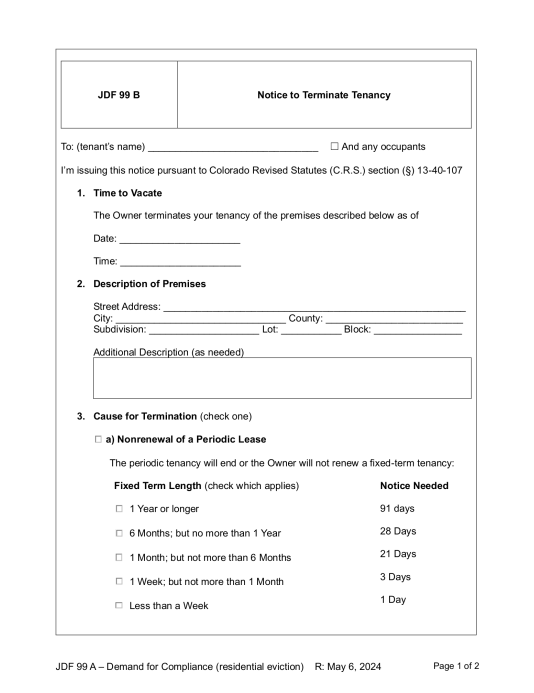
Colorado Notice to Terminate Tenancy (JDF 99 B)
Full Conversation


Is it a bad idea to have an eviction and a restraining order both on process at the same time?

Lexi

Lexi, Chatbot

I understand that dealing with both an eviction and a restraining order can be quite stressful. Can you tell me more about your current situation regarding the eviction?

So she has lived there for about 13 or 14 months, she is my ex-partner's sister-in-law and she needed a place to stay so we gave her a place for $400 a month and she only paid my ex-partner but I am the sole owner of the property. I tried to evict her before but there was a technical error on my part and it didn't go through, but the judge said she was an at will month to month tenant. I have since filed a restraining order request due to various harassing behaviors of hers. However I want to do an eviction as well just to make sure I have another layer of security. This all started after my ex-partner was arrested for DV assault on me and I didn't feel safe being in the same house as the sister-in-law. I want to know if having an eviction request and a restraining order request would be bad at the same time. Also I'm in Mesa County, Colorado.

Lexi

Lexi, Chatbot

Have you already filed for the restraining order, or is it still in the process of being filed?

I filed the restraining order today and will hear back if it is approved tomorrow. Then a court date will most likely be set.

Lexi

Lexi, Chatbot

Is there anything else the Lawyer should know before I connect you? Rest assured they'll be able to help with your eviction process.

No.

Dan

Dan

Hello, and welcome to our service. My name is Daniel, and I'm a licensed attorney with over 22 years of experience. I'm sorry you're dealing with this situation, and I'll do everything I can to help. I understand you're dealing with both an eviction and a restraining order in Mesa County, Colorado. Could you share more details about any communications you've had with the court or any other parties involved regarding these issues?

I had a previous eviction attempt that didn't go through because it was filed on the wrong day, but I am trying again. I just want to know if it would be bad to have both in at once. I have not had any contact with the court or any other parties regarding this aside from the court today to turn in the restraining order papers.

Dan

Dan

Could you tell me if you have any specific legal grounds or evidence that you plan to use for the eviction process?

  • Raising habitability concerns (Dec 11)
  • Moving cat food after the fact (no proof but mention)
  • Sending a text threatening more legal action if I pursued eviction (Jan 31)
  • Frequently calls the abuser after I am there (protection order) (Jan 5)
  • Filed false info in an attempt to get a restraining order so I couldn't be at my house (Dec 14)
  • In fear of threat or accusation, haven't stayed at my house for 4 months
  • Sister-in-law to the abuser
  • Stayed in the home despite telling the judge she would be leaving the end of January
  • Overheard the sister-in-law on the phone with the abuser conspiring ways for me not to return home (Jan 5)
  • Previously took the abuser's side during previous arguments prior to arrest
  • Attempted to disrupt plans for repair of the front door (Jan 12)
  • Texted me on a new number after I blocked the old one (Jan 31)
  • Withheld the mailbox key without mail for 2 months until I forwarded mail (asked for the mailbox key twice, once on 12/6 and again on 12/11)
  • Told me not to feed my cats because it's animal abuse (Jan 5)
  • Left a razor blade by the cat food (Jan 9)
  • Barricaded the door in an attempt to block entry (Jan 12, Jan 9)
  • Made plans to get me out and claim the place uninhabitable (Jan 5)
Dan

Dan

I really appreciate you taking the time to clarify that. It helps a lot and gives me a much clearer picture of what you're looking for. I'm pulling everything together now and should have your answer ready for you shortly.

Dan

Dan

It sounds like you have been under an incredible amount of stress dealing with both safety concerns and the complications of an unwanted tenant. From what you've described, you are the sole property owner in Mesa County, Colorado, and your ex-partner's sister-in-law has remained in your home without your consent. You've already filed for a civil protection order based on harassing behavior, and you're now considering filing an eviction at the same time. That question is entirely reasonable. In Colorado, both actions are legally separate and can proceed simultaneously, as the restraining order is governed under Colorado Revised Statutes §13-14-101 et seq., while evictions (unlawful detainers) fall under the Colorado Forcible Entry and Detainer statutes, §13-40-101 et seq. These processes can overlap if your safety and property rights are both at stake, and courts often understand the necessity of pursuing both when harassment and tenancy issues converge. Separately, because the tenancy here is month-to-month, the notice-to-terminate requirements are governed by C.R.S. §13-40-107, which sets out the minimum notice period a landlord must give before filing for possession, so it's worth confirming that any notice served lines up with what that statute requires. With that background in mind, let's look at the paths you can take from here.

One option is to continue both processes in parallel, keeping clear documentation of each. The restraining order protects you personally by restricting her contact or proximity to you or your property, while the eviction re-establishes your rights as the property owner. Because the restraining order focuses on safety and the eviction on possession, the court will treat them as distinct but complementary. This option makes sense if you are concerned about her behavior escalating or if you need to regain secure control of your home as soon as possible. It will, however, require you to stay organized with court dates and paperwork for both cases.

Another approach would be to wait to see whether the restraining order is granted before proceeding with the eviction. If the judge approves your restraining order, it may already restrict her access to the home, making a later eviction both simpler and safer to handle. The downside here is delay, since you might wait several weeks before you can take formal steps to remove her belongings or change locks, but it can sometimes streamline the process if the judge's order indirectly achieves your goal of removing her from the premises.

A third option is to coordinate the timing and documentation of both matters through legal counsel or a local self-help center in Mesa County. When two proceedings are active, it is helpful to ensure that your filings are consistent with each other. For example, if your restraining order identifies her as a threat or harasser, and your eviction claim lists her as a month-to-month tenant who failed to vacate, make sure the statements you provide line up factually so neither filing undermines the other. Court clerks can advise on scheduling conflicts, and a short consultation with a landlord-tenant attorney can help you avoid procedural errors that might delay one case.

Given what you've shared, I would recommend continuing both the eviction and the restraining order processes at the same time, while keeping records of every incident and communication. This balanced approach preserves your rights to safety and property simultaneously, without requiring you to wait for one case to finish before protecting yourself in the other.

Dan

Dan

Please let me know if these options make sense to you. I am happy to explain anything further. It's important to me that you fully understand your choices.

Okay perfect, also can you explain one thing to me on the paperwork for the eviction? It has date served and a spot for a failed attempt date, and the posted after the second failed attempt. This is the paper I have to serve her for the first eviction notice. I was told at my last eviction attempt that the first eviction notice has to be served on the last day of the month since she is a month to month at will tenant, then I have to go by monthly essentially. Can you explain what this means about the second attempt and what not? Also one more question, since she is a month to month at will tenant, the judge told me that a 3 day notice was sufficient, so today I'm planning on serving it to her. It's March 31. Would the move out date be April 3rd 11:59pm? Thank you so much.

Dan

Dan

For a month-to-month tenancy, Colorado law typically requires a landlord to provide a written notice to terminate the tenancy. The notice period is generally 10 days, but since the judge mentioned a 3-day notice, it seems there might be specific circumstances or agreements in place that allow for this shorter period.

The "date served" on the eviction notice refers to the date you physically deliver the notice to the tenant. If the tenant is not available to receive the notice, you may need to attempt service again. The "failed attempt date" is used to document any unsuccessful attempts to serve the notice. If you cannot serve the notice personally after two attempts, you may be able to post the notice in a conspicuous place on the property, such as the front door. This is often referred to as "posting and mailing" and is a common method when personal service is not possible.

Regarding the move-out date, if you serve the notice on March 31st and the notice period is indeed 3 days, the tenant would be expected to vacate by April 3rd at 11:59 PM. However, it's crucial to ensure that the notice complies with all legal requirements to avoid any procedural issues. I want to make sure everything is clear and that you're comfortable with the information I've shared. Is there anything you'd like me to clarify or any other questions I can help with? If everything makes sense, feel free to let me know. I'm always happy to answer any other questions.

Can the second attempt be in the same day? Or does it have to be the next day?

Dan

Dan

Yes, you can make a second attempt to serve the eviction notice on the same day. If the first attempt is unsuccessful, you can try again later that day. If both attempts fail, you can then post the notice in a conspicuous place, like the front door. I want to make sure everything is clear and that you're comfortable with the information I've shared. Is there anything you'd like me to clarify or any other questions I can help with? If everything makes sense, please reply "all clear." I'm always happy to answer any other questions.

Thank you so much for sharing your questions with me. I truly appreciate the opportunity to assist you and am very glad you reached out. If you have any additional questions, now or later, I'm here for you seven days a week.

Dan

Dan

30,565 satisfied customers

Dan
Welcome! Have a similar question?

12 lawyers online now

0:00

By messaging AskALawyer, you agree to our Terms and Privacy Policy.

Dan
Dan

Law Partner

4.53 (30,565)

[MI] Can a lease require tenants to cover the first $150 of repair costs?

17

7

Answered 4 days ago

Disclaimer


By messaging AskaLawyer.com, you agree to our Terms and have read our Privacy Policy.

The information provided on AskaLawyer.com is for general informational purposes only and does not constitute legal advice. While we strive to ensure the accuracy and timeliness of the information presented, we make no guarantees regarding its completeness or applicability to your specific circumstances.

Use of this website does not create an attorney-client relationship between you and AskaLawyer.com or any of its attorneys. Communications through this website, including any responses from attorneys, are not privileged or confidential. For advice tailored to your individual situation, we recommend consulting a licensed attorney in your jurisdiction.

AskaLawyer.com disclaims any liability for actions taken or not taken based on the content of this site. We are not responsible for any third-party content that may be accessed through this website. Reliance on any information provided herein is solely at your own risk.

Ask a Lawyer Logo
Ask a Lawyer Logo
Intake Questions
Step  of 3
Loading...

What's your legal question?

Lexi, Chatbot

How would you like your legal question to be answered?

Online

Loading...

How do you like to pay?

By proceeding with payment, you agree to our Terms and Privacy Policy. You authorize us to charge $ today and $ thereafter until canceled. You may cancel anytime in the My Account section to stop future charges.

Total Due:

After purchasing, your chat will begin with an attorney.

By proceeding with payment, you agree to our Terms and Privacy Policy. You authorize us to charge $ today and $ thereafter until canceled. You may cancel anytime in the My Account section to stop future charges.

Total Due:

After purchasing, your chat will begin with an attorney.

After connecting, your chat will begin with an attorney. After choosing, your chat will continue with Legal AI.

It looks like you already have an account with Ask a Lawyer.

We have sent you a magic link to . Click the link in your email to sign in and continue your chat.

spin

Step of 6 •

You'll receive an email at as soon as the lawyer joins the conversation 🙏🏻😊

Over 90% of lawyers connect within 5 minutes. If you're not online at that moment, don't worry — the lawyer will reply to your message while you're away.

You're also welcome to stay in the chat while waiting to be connected 💬✨

Waiting for lawyer

We couldn't send your message. Please try again.

Your lawyer will reply as soon as possible

If there’s a delay, please don’t worry. Your chat will stay open, and they’ll get back to you as soon as they can. There’s no rush on your end either. You’ll receive an email notification as soon as there’s a new message.

You've reached your AI chat limit

Upgrade your plan to continue chatting and get instant domain-specific answers.

0:00