[CA] What should an employee nondisclosure agreement include to be enforceable?

TJ, Esq.
TJ, Esq.

24,722 satisfied customers

View context
Solved

Good to know you're in California. I can give you guidance on what should go into your NDA, though I can't send you a pre made template through this platform.

California law is pretty employee friendly, so there are a few things to keep in mind. First, California courts scrutinize non competes heavily, but NDAs are generally enforceable if they're reasonable (CA Bus & Prof Code § 16608). You'll want to define confidential information narrowly and specifically, not just broadly. Include things like trade secrets, business strategies, client lists, pricing information, and proprietary processes. (CA Civ Code § 3426.1)

For the duration, California courts tend to look skeptically at perpetual restrictions. A reasonable timeframe is usually 2 to 5 years after employment ends, depending on the type of information. You should also include a carve out for information that becomes publicly available through no fault of the employee, and information they independently develop.

Make sure the NDA specifies that it survives termination of employment, includes a choice of law clause (California), and outlines remedies like injunctive relief if there's a breach. You might also want a clause requiring employees to return or destroy confidential information when they leave. Here's a basic framework you can use:

CONFIDENTIAL INFORMATION: Employee acknowledges that during employment, they will have access to confidential information including trade secrets, business strategies, customer lists, pricing, and proprietary processes. Employee agrees to keep this information confidential.

OBLIGATIONS: Employee will not disclose confidential information to anyone outside the company without written permission. Employee will use confidential information only for authorized business purposes.

DURATION: Confidentiality obligations continue for three years after employment ends.

EXCLUSIONS: Information that is publicly available, independently developed, or required to be disclosed by law is not confidential. (CA Govt Code § 12964.5)

RETURN OF INFORMATION: Upon termination, employee will return all confidential materials and certify destruction of copies.

REMEDIES: Employee understands that breach may result in injunctive relief and damages.

GOVERNING LAW: This agreement is governed by California law.

0

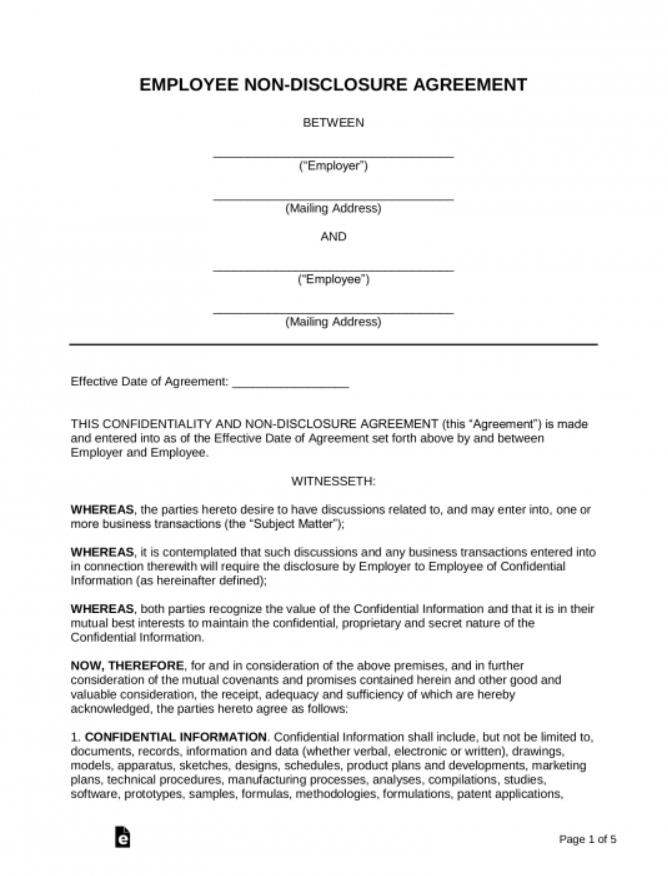
Employee Non-Disclosure Agreement (NDA)
Full Conversation


Hello, I need a template for my company to create NDA for workers.

Lexi

Lexi, Chatbot

I understand that creating an NDA for your workers is important for protecting your company's information. What type of information do you need to protect with this NDA?

I don't know.

Lexi

Lexi, Chatbot

Are you looking for a specific duration for the NDA, or will it be ongoing?

Endless if possible

Lexi

Lexi, Chatbot

Is there anything else the Lawyer should know before I connect you? Rest assured they'll be able to help with your NDA template.

No.

Lexi

Lexi, Chatbot

To create a Non-Disclosure Agreement (NDA) for your workers, it is essential to ensure that the agreement is comprehensive and legally enforceable. Here are some key elements that should be included in an NDA:

  1. Definition of Confidential Information: Clearly define what constitutes confidential information. This may include trade secrets, business strategies, customer lists, and any other proprietary information specific to your company.
  2. Obligations of the Parties: Specify the obligations of the employees regarding the handling of confidential information. This includes not disclosing the information to third parties and using it only for authorized purposes.
  3. Duration of Confidentiality: While you mentioned an indefinite duration, it is advisable to specify a reasonable time frame for confidentiality obligations, as some jurisdictions may not enforce perpetual NDAs.
  4. Exclusions from Confidentiality: Identify any information that is not considered confidential, such as information that is publicly available or independently developed by the employee without using confidential information.
  5. Consequences of Breach: Outline the consequences if an employee breaches the NDA, which may include legal action and financial penalties.
  6. Governing Law: Specify the state law that will govern the NDA. This is particularly important if your company operates in multiple states.

For a more tailored NDA, you may consider consulting with a legal professional who can draft an agreement specific to your company's needs. Additionally, you can find NDA templates online that can be customized to fit your requirements.

If you have any further questions or need additional assistance, please feel free to ask.

TJ, Esq.

TJ, Esq.

Hello! My name is TJ, and I'm an attorney with over 20 years of experience. Thanks so much for the opportunity to assist you!

An NDA protects your company's confidential information, and you'll want to clearly define what counts as confidential, set reasonable time limits (courts often won't enforce perpetual ones), and spell out what happens if someone breaches it. Most NDAs also exclude publicly available information and specify which state's law applies.

Since you mentioned wanting this to last indefinitely, what state is your company based in? And what types of information are you most concerned about protecting, like trade secrets, client lists, or something else? Thanks for reaching out!

My company based in California :) could you please send a legal template that would work best for this case?

TJ, Esq.

TJ, Esq.

Good to know you're in California. I can give you guidance on what should go into your NDA, though I can't send you a pre made template through this platform.

California law is pretty employee friendly, so there are a few things to keep in mind. First, California courts scrutinize non competes heavily, but NDAs are generally enforceable if they're reasonable (CA Bus & Prof Code § 16608). You'll want to define confidential information narrowly and specifically, not just broadly. Include things like trade secrets, business strategies, client lists, pricing information, and proprietary processes. (CA Civ Code § 3426.1)

For the duration, California courts tend to look skeptically at perpetual restrictions. A reasonable timeframe is usually 2 to 5 years after employment ends, depending on the type of information. You should also include a carve out for information that becomes publicly available through no fault of the employee, and information they independently develop.

Make sure the NDA specifies that it survives termination of employment, includes a choice of law clause (California), and outlines remedies like injunctive relief if there's a breach. You might also want a clause requiring employees to return or destroy confidential information when they leave. Here's a basic framework you can use:

CONFIDENTIAL INFORMATION: Employee acknowledges that during employment, they will have access to confidential information including trade secrets, business strategies, customer lists, pricing, and proprietary processes. Employee agrees to keep this information confidential.

OBLIGATIONS: Employee will not disclose confidential information to anyone outside the company without written permission. Employee will use confidential information only for authorized business purposes.

DURATION: Confidentiality obligations continue for three years after employment ends.

EXCLUSIONS: Information that is publicly available, independently developed, or required to be disclosed by law is not confidential. (CA Govt Code § 12964.5)

RETURN OF INFORMATION: Upon termination, employee will return all confidential materials and certify destruction of copies.

REMEDIES: Employee understands that breach may result in injunctive relief and damages.

GOVERNING LAW: This agreement is governed by California law.

TJ, Esq.

TJ, Esq.

24,722 satisfied customers

TJ, Esq.
Welcome! Have a similar question?

12 lawyers online now

0:00

By messaging AskALawyer, you agree to our Terms and Privacy Policy.

Disclaimer


By messaging AskaLawyer.com, you agree to our Terms and have read our Privacy Policy.

The information provided on AskaLawyer.com is for general informational purposes only and does not constitute legal advice. While we strive to ensure the accuracy and timeliness of the information presented, we make no guarantees regarding its completeness or applicability to your specific circumstances.

Use of this website does not create an attorney-client relationship between you and AskaLawyer.com or any of its attorneys. Communications through this website, including any responses from attorneys, are not privileged or confidential. For advice tailored to your individual situation, we recommend consulting a licensed attorney in your jurisdiction.

AskaLawyer.com disclaims any liability for actions taken or not taken based on the content of this site. We are not responsible for any third-party content that may be accessed through this website. Reliance on any information provided herein is solely at your own risk.

Ask a Lawyer Logo
Ask a Lawyer Logo
Intake Questions
Step  of 3
Loading...

What's your legal question?

Lexi, Chatbot

How would you like your legal question to be answered?

Online

Loading...

How do you like to pay?

By proceeding with payment, you agree to our Terms and Privacy Policy. You authorize us to charge $ today and $ thereafter until canceled. You may cancel anytime in the My Account section to stop future charges.

Total Due:

After purchasing, your chat will begin with an attorney.

By proceeding with payment, you agree to our Terms and Privacy Policy. You authorize us to charge $ today and $ thereafter until canceled. You may cancel anytime in the My Account section to stop future charges.

Total Due:

After purchasing, your chat will begin with an attorney.

After connecting, your chat will begin with an attorney. After choosing, your chat will continue with Legal AI.

It looks like you already have an account with Ask a Lawyer.

We have sent you a magic link to . Click the link in your email to sign in and continue your chat.

spin

Step of 6 •

You'll receive an email at as soon as the lawyer joins the conversation 🙏🏻😊

Over 90% of lawyers connect within 5 minutes. If you're not online at that moment, don't worry — the lawyer will reply to your message while you're away.

You're also welcome to stay in the chat while waiting to be connected 💬✨

Waiting for lawyer

We couldn't send your message. Please try again.

Your lawyer will reply as soon as possible

If there’s a delay, please don’t worry. Your chat will stay open, and they’ll get back to you as soon as they can. There’s no rush on your end either. You’ll receive an email notification as soon as there’s a new message.

You've reached your AI chat limit

Upgrade your plan to continue chatting and get instant domain-specific answers.

0:00