[FL] Can disclosing a retention bonus before signing the agreement violate its confidentiality clause?

Jon
Jon

556 satisfied customers

View context
Solved

When it comes to whether you may have already disclosed something you shouldn't have, timing matters a lot. Confidentiality obligations generally start once an agreement is in effect or once you've been clearly told certain information is confidential. If back in January you casually mentioned that the company might be working on some kind of bonus, and that was before this specific agreement or its terms even existed, that usually wouldn't count as a breach.

You can't violate terms that weren't in place yet. Where it gets a little more sensitive is the part about keeping the acquisition itself confidential. If anything you said earlier revealed that there was a pending acquisition that wasn't public knowledge at the time, an employer could try to argue that you didn't meet the conditions tied to getting paid. That said, since you haven't signed yet, you're not bound by these specific terms right now. Under Florida's restrictive covenant statute, Section 542.335, Florida Statutes, a restrictive covenant (which Florida courts have applied to confidentiality agreements) must be in a writing signed by the person it is being enforced against, and the employer must show a legitimate business interest, such as protecting confidential business information, to enforce it. Once you do sign, though, you're essentially agreeing to uphold that confidentiality going forward, so from here on out it's safest to keep everything quiet.

On the question of negotiating with a new employer, especially if you want them to offset or "buy out" this bonus, you're right to be careful. If your agreement says you can't share the exact amount except with a spouse or legal or tax advisor, then you shouldn't hand over the document or quote the number directly. The way around that is to speak more generally but still clearly.

You can explain that you're eligible for a significant retention payment in the mid-five-figure range and that leaving early would mean giving that up, so you'd need a sign-on bonus that makes up for it. That gets the point across without violating the agreement. If they push for details, it's perfectly reasonable to say you're bound by confidentiality and intend to honor it. In practice, that often works in your favor because it shows you take contractual obligations seriously.

The non-solicitation of employees piece is another area where the line isn't always obvious. In Florida, these clauses are usually enforced against active efforts to recruit or persuade coworkers to leave. That means you shouldn't be reaching out to colleagues encouraging them to join you or passing their names to recruiters in a way that could be seen as helping your new company hire them. Even indirectly doing that can create risk. On the other hand, if someone you used to work with reaches out to you on their own after you've left, and you just respond in a neutral way, like pointing them to a public job posting, that's generally less likely to be a problem. Where people get into trouble is when they go beyond that and start advocating for the person or making introductions that look like recruiting.

As for whether this agreement stops you from working in the same industry, it doesn't sound like it does. What you're dealing with here is a non-solicitation clause and a confidentiality agreement, not a full non-compete. That's an important difference. You're still free to take a job with a competitor. The limitation is that for a set period, usually a year, you can't go after your current employer's customers or active prospects and try to bring them over.

You also can't use confidential information, like client lists, internal systems, pricing strategies, or marketing methods, in your new role. That's often where disputes come up, because a former employer may claim that what you're doing at a new job relies on their trade secrets. Staying mindful of that boundary is key if you remain in the same field.

Putting it all together, the agreement is really about protecting the company's sensitive information and relationships rather than blocking your career move entirely. You can still change jobs and negotiate a strong offer, you just need to be careful about what you share, how you describe your current compensation, and how you interact with former coworkers and clients during that restricted period.

0

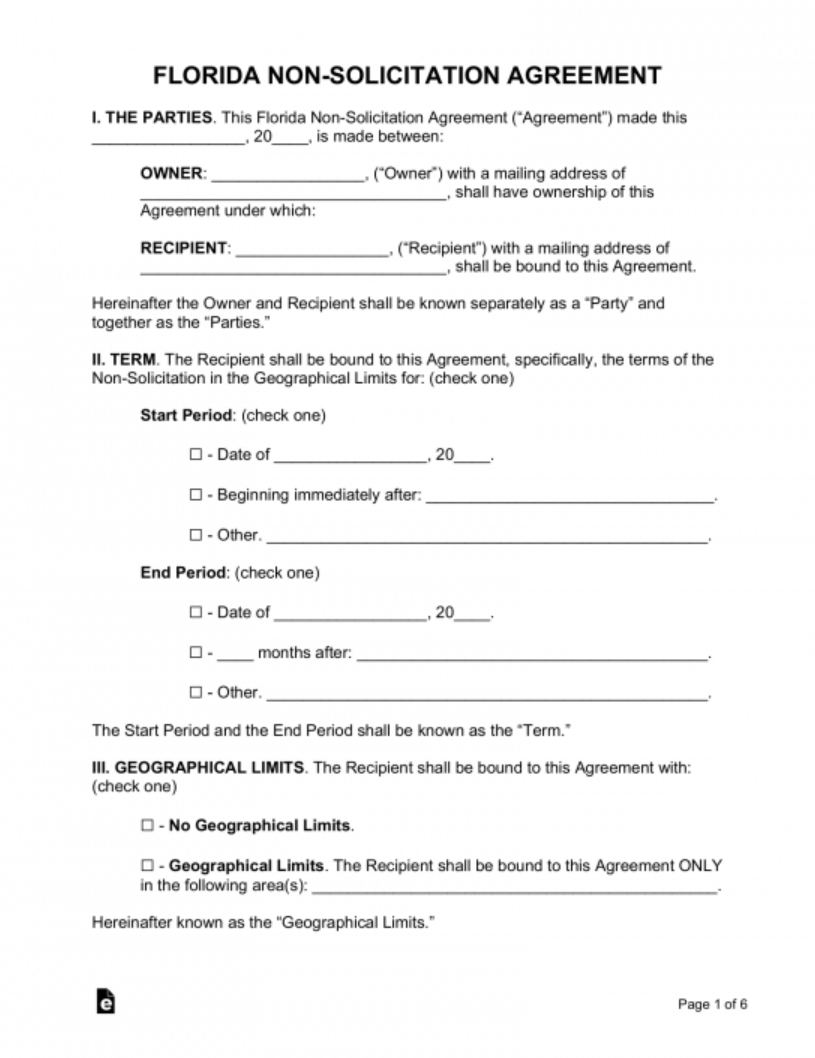
Florida Non-Solicitation Agreement

Full Conversation


I have a retention bonus agreement that I need reviewed and have questions about.

Lexi

Lexi, Chatbot

I understand that reviewing a retention bonus agreement can be quite important for your financial planning. Can you tell me if this agreement is with your current employer or a previous one?

Current employer.

Lexi

Lexi, Chatbot

Are there specific clauses or terms in the agreement that you are particularly concerned about?

This portion: "2. Initial Retention Bonus: Employer will pay Employee the lump sum of fifty Thousand Dollars ($50,000) less applicable withholding taxes on the first regular payroll date following the Closing Date. If Employee remains employed as of the Closing Date: provided however that it is a condition of payment of this bonus that Employee maintain the confidentiality of the acquisition itself until the Closing Date. It is understood that, should the Employee disclose the fact of the acquisition before the Closing Date or the terms of this Agreement henceforth, including the amount of this Initial Retention Bonus, to anyone other than their spouse and tax or legal advisors. Employee will not be paid this Initial Retention Bonus. In exchange for the promise of payment of this Initial Retention Bonus, Employee agrees to maintain their employment with the Employer and assist it in preparing for the acquisition." I had already disclosed that I was told they were working on a retention bonus, but it never came to fruition, as they originally said we would discuss it in January and it didn't happen. Would disclosing the potential agreement before the date of this cause issues, even though it wasn't signed at the time? Also, how do I negotiate a sign-on bonus for giving this up if I can't disclose this agreement?

Lexi

Lexi, Chatbot

Is there anything else the Lawyer should know before I connect you? Rest assured they'll be able to help with your retention bonus agreement.

No.

Jon

Jon

Hello, and thank you for reaching out! I'm Jon, a licensed attorney with over 14 years of experience, here to help. I understand legal matters can feel overwhelming, but you're in good hands. My goal is to explain things clearly and guide you toward the best possible solution for your situation. Just a quick note: our conversation is for general legal information only and does not create an attorney-client relationship.

Jon

Jon

Can you please let me know which state you're employed in, as employment laws can vary by location?

Florida.

Jon

Jon

Thanks for sharing that. To better understand your situation, could you clarify if you have already signed the retention bonus agreement? Also, have you had any discussions with your employer about the potential consequences of disclosing the agreement details before it was signed?

I have not signed and have not asked. Would you be considered legal advisors even though you state there is no attorney-client relationship? Does that also mean there is no attorney-client confidentiality?

Jon

Jon

I understand your concern. While I can provide general legal information and guidance, this platform does not establish an attorney-client relationship, which means that the confidentiality typically associated with such a relationship does not apply here. However, I am here to help you understand your situation and provide as much assistance as possible within these boundaries. If you need confidential legal advice, it might be best to consult directly with an attorney in your area.

Jon

Jon

Are you considering negotiating a sign-on bonus with your current employer or with a potential new employer?

A potential employer. Would you be considered legal advisors in this context? I don't want to jeopardize my job.

Jon

Jon

I can answer questions about the law, but please note that I am not your lawyer and cannot represent you as one.

Jon

Jon

Are you planning to disclose the existence of your current retention bonus agreement to the potential employer during your negotiations?

Right. But if the agreement states I can discuss the agreement with a legal advisor, would you be considered a legal advisor?

Yes. I would want to negotiate a sign-on bonus based on giving up this bonus.

Jon

Jon

I am a lawyer. Understood! I believe I have all the information I need. Is there anything else you'd like to add before I start working on your answer? If not, I'll get started right away.

It says I cannot entice nor solicit any employee of the employer to leave his/her employment for a period of one year. What would that include? What if someone else asks me for a recommendation to a recruiter?

Jon

Jon

Got it! I just need a few minutes to put together a complete response for you. It shouldn't take longer than about 4–5 minutes, and I want to make sure it's clear and comprehensive. Thanks so much for waiting. I really appreciate your patience.

Does this mean I can't work in the same industry? "Employee acknowledges that the Employer operates in a competitive industry and that the Employer's success depends in part upon protecting the confidentiality of all trade secrets and other Confidential Information of the Employer. Confidential Information will be interpreted broadly and shall include all information relating to or used in the business, operations, products, services, relationships, proprietary rights and goodwill of the Employer, including without limitation, marketing methods and procedures, customer lists, lists of referrals, sources of supplies and materials, and business systems and processes, whether prepared, compiled, developed or obtained by the Employee or by the Employer. Confidential Information does not include information which was known to the Employee before their employment with Employer, becomes generally available to the public other than as a result of a disclosure by employee, or becomes available to Employee on a non-confidential basis from a source other than the Employer, provided that such source is not known to be bound by a confidentiality agreement or other obligation of secrecy with respect to such information. The employee agrees that they will not copy, reproduce, disclose or divulge to others any Confidential Information of the Employer at any time, during or after their employment, except as required in the regular course of their duties, or except as expressly required by Employer or required by applicable law. Upon their termination from employment for any reason, Employee shall cease to use or disclose any Confidential Information and, upon request, shall immediately destroy, delete or return to the Employer all originals and copies in any form or medium (including memoranda, books, papers, plans, computer files, letters and other data) in their possession and control (including any of the foregoing stored or located in Employer's office, home, phone, laptop or other computer) that contain any Confidential Information. During Employee's employment with the Employer and for a period of one year thereafter, employee covenants that they will not, directly or indirectly, whether for their own benefit or the benefit of any other person or entity, contact or solicit any individual who is or was a customer or active prospective customer for the purpose of causing or assisting any other person or entity to perform or provide goods, items or services to or for such customer or prospective customer of the nature or type performed or provided by the Employer or any of its employees. "Active prospective customer" shall mean any prospective customer who was solicited or marketed by the Employer at any time within the one-year period prior to the effective date of the termination of Employee's employment."

And I also want to know: if I sign and then put in notice, does it look bad, or is it okay since they also have the right to fire me?

Jon

Jon

When it comes to whether you may have already disclosed something you shouldn't have, timing matters a lot. Confidentiality obligations generally start once an agreement is in effect or once you've been clearly told certain information is confidential. If back in January you casually mentioned that the company might be working on some kind of bonus, and that was before this specific agreement or its terms even existed, that usually wouldn't count as a breach.

You can't violate terms that weren't in place yet. Where it gets a little more sensitive is the part about keeping the acquisition itself confidential. If anything you said earlier revealed that there was a pending acquisition that wasn't public knowledge at the time, an employer could try to argue that you didn't meet the conditions tied to getting paid. That said, since you haven't signed yet, you're not bound by these specific terms right now. Under Florida's restrictive covenant statute, Section 542.335, Florida Statutes, a restrictive covenant (which Florida courts have applied to confidentiality agreements) must be in a writing signed by the person it is being enforced against, and the employer must show a legitimate business interest, such as protecting confidential business information, to enforce it. Once you do sign, though, you're essentially agreeing to uphold that confidentiality going forward, so from here on out it's safest to keep everything quiet.

On the question of negotiating with a new employer, especially if you want them to offset or "buy out" this bonus, you're right to be careful. If your agreement says you can't share the exact amount except with a spouse or legal or tax advisor, then you shouldn't hand over the document or quote the number directly. The way around that is to speak more generally but still clearly.

You can explain that you're eligible for a significant retention payment in the mid-five-figure range and that leaving early would mean giving that up, so you'd need a sign-on bonus that makes up for it. That gets the point across without violating the agreement. If they push for details, it's perfectly reasonable to say you're bound by confidentiality and intend to honor it. In practice, that often works in your favor because it shows you take contractual obligations seriously.

The non-solicitation of employees piece is another area where the line isn't always obvious. In Florida, these clauses are usually enforced against active efforts to recruit or persuade coworkers to leave. That means you shouldn't be reaching out to colleagues encouraging them to join you or passing their names to recruiters in a way that could be seen as helping your new company hire them. Even indirectly doing that can create risk. On the other hand, if someone you used to work with reaches out to you on their own after you've left, and you just respond in a neutral way, like pointing them to a public job posting, that's generally less likely to be a problem. Where people get into trouble is when they go beyond that and start advocating for the person or making introductions that look like recruiting.

As for whether this agreement stops you from working in the same industry, it doesn't sound like it does. What you're dealing with here is a non-solicitation clause and a confidentiality agreement, not a full non-compete. That's an important difference. You're still free to take a job with a competitor. The limitation is that for a set period, usually a year, you can't go after your current employer's customers or active prospects and try to bring them over.

You also can't use confidential information, like client lists, internal systems, pricing strategies, or marketing methods, in your new role. That's often where disputes come up, because a former employer may claim that what you're doing at a new job relies on their trade secrets. Staying mindful of that boundary is key if you remain in the same field.

Putting it all together, the agreement is really about protecting the company's sensitive information and relationships rather than blocking your career move entirely. You can still change jobs and negotiate a strong offer, you just need to be careful about what you share, how you describe your current compensation, and how you interact with former coworkers and clients during that restricted period.

Can I upload the full document for you to review? And should I be worried if I put in a notice after signing this?

Jon

Jon

I apologize, but we cannot review full documents here, and this is not confidential, as mentioned earlier. You will need to consult a local lawyer privately, as they have the necessary privilege to review that and assist you.

Jon

Jon

But did that help clear things up for you? If you have any other questions or need more help, please don't hesitate to ask. I'm here to support you!

Yes, it did.

Jon

Jon

556 satisfied customers

Jon
Welcome! Have a similar question?

12 lawyers online now

0:00

By messaging AskALawyer, you agree to our Terms and Privacy Policy.

Disclaimer


By messaging AskaLawyer.com, you agree to our Terms and have read our Privacy Policy.

The information provided on AskaLawyer.com is for general informational purposes only and does not constitute legal advice. While we strive to ensure the accuracy and timeliness of the information presented, we make no guarantees regarding its completeness or applicability to your specific circumstances.

Use of this website does not create an attorney-client relationship between you and AskaLawyer.com or any of its attorneys. Communications through this website, including any responses from attorneys, are not privileged or confidential. For advice tailored to your individual situation, we recommend consulting a licensed attorney in your jurisdiction.

AskaLawyer.com disclaims any liability for actions taken or not taken based on the content of this site. We are not responsible for any third-party content that may be accessed through this website. Reliance on any information provided herein is solely at your own risk.

Ask a Lawyer Logo
Ask a Lawyer Logo
Intake Questions
Step  of 3
Loading...

What's your legal question?

Lexi, Chatbot

How would you like your legal question to be answered?

Online

Loading...

How do you like to pay?

By proceeding with payment, you agree to our Terms and Privacy Policy. You authorize us to charge $ today and $ thereafter until canceled. You may cancel anytime in the My Account section to stop future charges.

Total Due:

After purchasing, your chat will begin with an attorney.

By proceeding with payment, you agree to our Terms and Privacy Policy. You authorize us to charge $ today and $ thereafter until canceled. You may cancel anytime in the My Account section to stop future charges.

Total Due:

After purchasing, your chat will begin with an attorney.

After connecting, your chat will begin with an attorney. After choosing, your chat will continue with Legal AI.

It looks like you already have an account with Ask a Lawyer.

We have sent you a magic link to . Click the link in your email to sign in and continue your chat.

spin

Step of 6 •

You'll receive an email at as soon as the lawyer joins the conversation 🙏🏻😊

Over 90% of lawyers connect within 5 minutes. If you're not online at that moment, don't worry — the lawyer will reply to your message while you're away.

You're also welcome to stay in the chat while waiting to be connected 💬✨

Waiting for lawyer

We couldn't send your message. Please try again.

Your lawyer will reply as soon as possible

If there’s a delay, please don’t worry. Your chat will stay open, and they’ll get back to you as soon as they can. There’s no rush on your end either. You’ll receive an email notification as soon as there’s a new message.

You've reached your AI chat limit

Upgrade your plan to continue chatting and get instant domain-specific answers.

0:00