[MN] Who must sign a certificate of trust for an irrevocable trust when the original trustee has been replaced?

Seth
Seth

7,784 satisfied customers

View context
Solved

Under Minnesota law, the individuals who must execute a Certificate of Trust are the currently acting trustees, not the settlor. Minnesota has adopted the Uniform Trust Code, and Minn. Stat. § 501C.1013 specifically authorizes a trustee to provide a certificate of trust to confirm the existence of the trust and the trustee’s authority to act on its behalf. The statute contemplates execution by the trustee(s) and allows third parties to rely on the certificate without reviewing the full trust instrument.

Accordingly, your two adult children, as the current trustees, are the proper affiants. They must sign the Certificate of Trust and have their signatures notarized, as the document is used to establish who presently holds legal authority to bind the trust in transactions with banks, title companies, or other third parties.

As the original grantor/settlor, your signature is not required unless you retained powers to act as a trustee or co-trustee. Since you have confirmed that you did not retain trustee authority, including your signature would be unnecessary and could create confusion or raise questions for institutions relying on the certificate

0

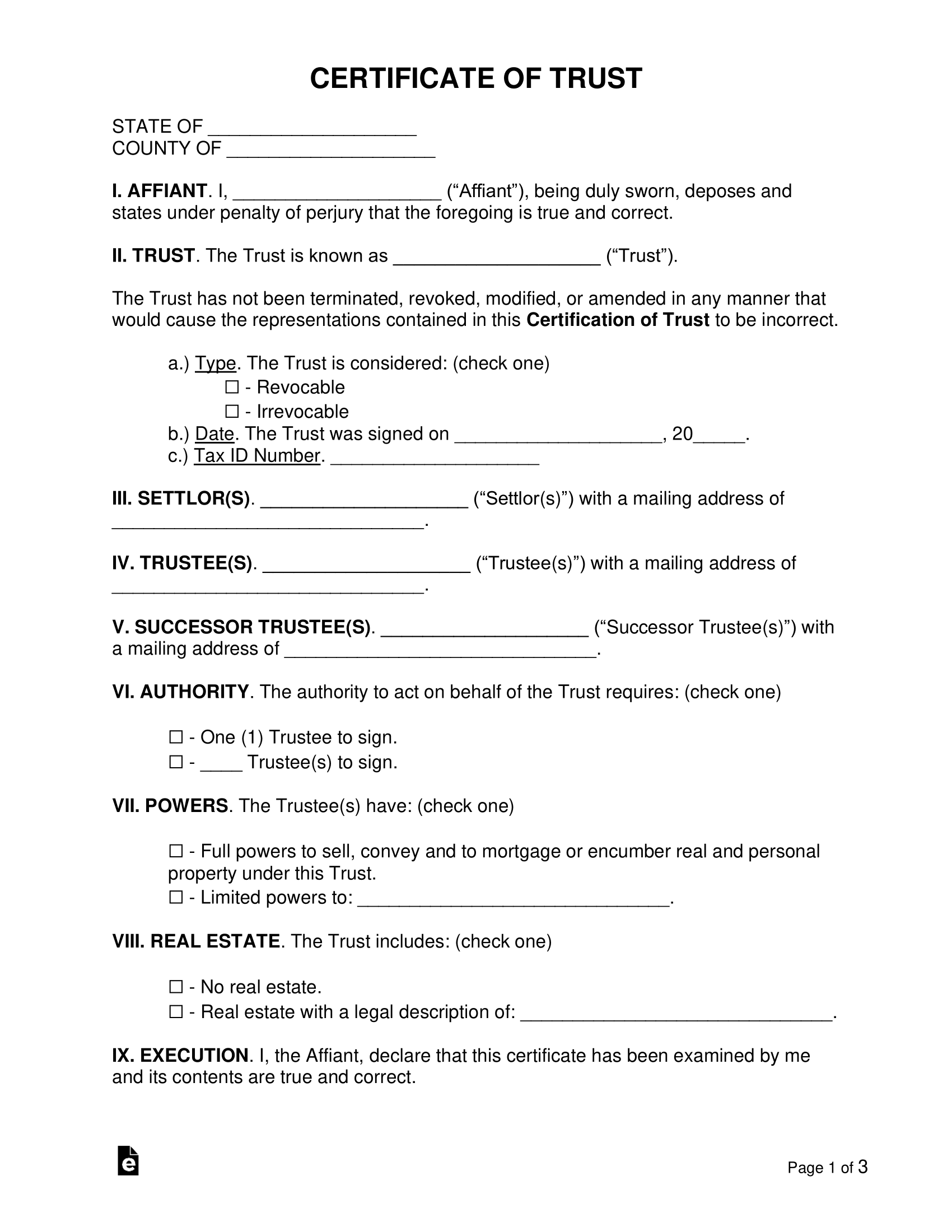
Official Certificate of Trust

Full Conversation


I downloaded a Certificate of Trust. It covers an irrevocable trust I set up in 1998. At that time, I used a CPA as trustee. In 2008, I made my two adult children the trustees. Do I sign the form as the affiant?

Lexi

Lexi, Chatbot

Is the original CPA still involved with the trust?

No. My two adult children are now the trustees. Who needs to obtain the notary acknowledgment — me or the two trustees?

Lexi

Lexi, Chatbot

Have there been any other changes to the trust since 2008?

No.

Seth

Seth

Under Minnesota law, the individuals who must execute a Certificate of Trust are the currently acting trustees, not the settlor. Minnesota has adopted the Uniform Trust Code, and Minn. Stat. § 501C.1013 specifically authorizes a trustee to provide a certificate of trust to confirm the existence of the trust and the trustee’s authority to act on its behalf. The statute contemplates execution by the trustee(s) and allows third parties to rely on the certificate without reviewing the full trust instrument.

Accordingly, your two adult children, as the current trustees, are the proper affiants. They must sign the Certificate of Trust and have their signatures notarized, as the document is used to establish who presently holds legal authority to bind the trust in transactions with banks, title companies, or other third parties.

As the original grantor/settlor, your signature is not required unless you retained powers to act as a trustee or co-trustee. Since you have confirmed that you did not retain trustee authority, including your signature would be unnecessary and could create confusion or raise questions for institutions relying on the certificate

That answers my question. Thanks.

Seth

Seth

You’re welcome. Enjoy the rest of your day.

Seth

Seth

7,784 satisfied customers

Seth
Welcome! Have a similar question?

12 lawyers online now

0:00

By messaging AskALawyer, you agree to our Terms and Privacy Policy.

Melissa R. Esq.
Melissa R. Esq.

Counsel

4.74 (2,012)

How can I structure my estate to avoid challenges?

16

4

Answered 5 days ago

Disclaimer


By messaging AskaLawyer.com, you agree to our Terms and have read our Privacy Policy.

The information provided on AskaLawyer.com is for general informational purposes only and does not constitute legal advice. While we strive to ensure the accuracy and timeliness of the information presented, we make no guarantees regarding its completeness or applicability to your specific circumstances.

Use of this website does not create an attorney-client relationship between you and AskaLawyer.com or any of its attorneys. Communications through this website, including any responses from attorneys, are not privileged or confidential. For advice tailored to your individual situation, we recommend consulting a licensed attorney in your jurisdiction.

AskaLawyer.com disclaims any liability for actions taken or not taken based on the content of this site. We are not responsible for any third-party content that may be accessed through this website. Reliance on any information provided herein is solely at your own risk.

Ask a Lawyer Logo
Ask a Lawyer Logo
Intake Questions
Step  of 3
Loading...

Lexi, Chatbot

How would you like your legal question to be answered?

Online

Legal AI

Using ChatGPT 4o

Loading...

How do you like to pay?

By proceeding with payment, you agree to our Terms and Privacy Policy. You authorize us to charge $ today and $ thereafter until canceled. You may cancel anytime in the My Account section to stop future charges.

Total Due:

After purchasing, your chat will begin with an attorney.

By proceeding with payment, you agree to our Terms and Privacy Policy. You authorize us to charge $ today and $ thereafter until canceled. You may cancel anytime in the My Account section to stop future charges.

Total Due:

After purchasing, your chat will begin with an attorney.

After connecting, your chat will begin with an attorney.

After choosing, your chat will continue with Legal AI.

It looks like you already have an account with Ask a Lawyer.

We have sent you a magic link to . Click the link in your email to sign in and continue your chat.

spin

Step of 6 •

You'll receive an email at as soon as the lawyer joins the conversation 🙏🏻😊

Over 90% of lawyers connect within 5 minutes. If you're not online at that moment, don't worry — the lawyer will reply to your message while you're away.

You're also welcome to stay in the chat while waiting to be connected 💬✨

Waiting for lawyer

0:00