[CO] Should a will reference a transfer-on-death deed for real property distribution and estate planning?

Benjamin
Benjamin

679 satisfied customers

View context
Solved

1. Is a TOD Deed Appropriate in Colorado?
Yes — in many simple estates, a Transfer on Death (TOD) deed is an efficient probate-avoidance tool for real property.

Under Colorado law, a properly executed and recorded TOD deed:

  • Transfers the condominium automatically at death
  • Avoids probate for that property
  • Gives the beneficiary no ownership rights during her lifetime
  • Remains fully revocable

The statute governing this is found in the Colorado Uniform TOD Act (C.R.S. § 15-15-401 et seq.).

So structurally, your idea is sound.

However, the more important issue is whether a TOD deed is the right mechanism given her goals.

2. The Structural Issue: Is the Friend a Beneficiary — or a Trustee?

From what you described, your sister does not intend to give the condo beneficially to her friend.

Instead, she wants the friend to:

  • Sell the condo
  • Pay debts
  • Make specific monetary gifts
  • Distribute the remainder to charities

That is not a simple gift. That is a fiduciary administration role.

A TOD deed, by default, gives the property to the named beneficiary outright.

If the deed simply names the friend individually, then legally:

  • The friend owns the condo outright at death
  • The friend has no automatic legal duty to carry out your sister’s distribution plan
  • The will cannot control that property (because TOD property passes outside probate)

That creates risk.

A TOD deed supersedes the will.

If the condo passes by TOD:

  • The will has no authority over that property
  • Instructions in the will about that condo are legally ineffective

So if you rely on the will to instruct the friend how to handle the condo, those instructions are likely unenforceable.

Should You Reference the TOD Deed in the Will?

Short Answer:
Yes — but only carefully, and not as a controlling mechanism.

If you use a TOD deed, the will should:

  • Acknowledge that certain assets pass outside probate
  • Clarify that the will does not control those assets
  • Avoid conflicting provisions

You do not want a clause that says:
"I leave my condominium to X…"

If there is a TOD deed already recorded, that clause would create confusion.

Instead, you can include language such as:

“I have executed a Transfer on Death Deed for my condominium located at [address]. That property shall pass according to the terms of that deed and shall not be part of my probate estate.”

This prevents conflict.

0

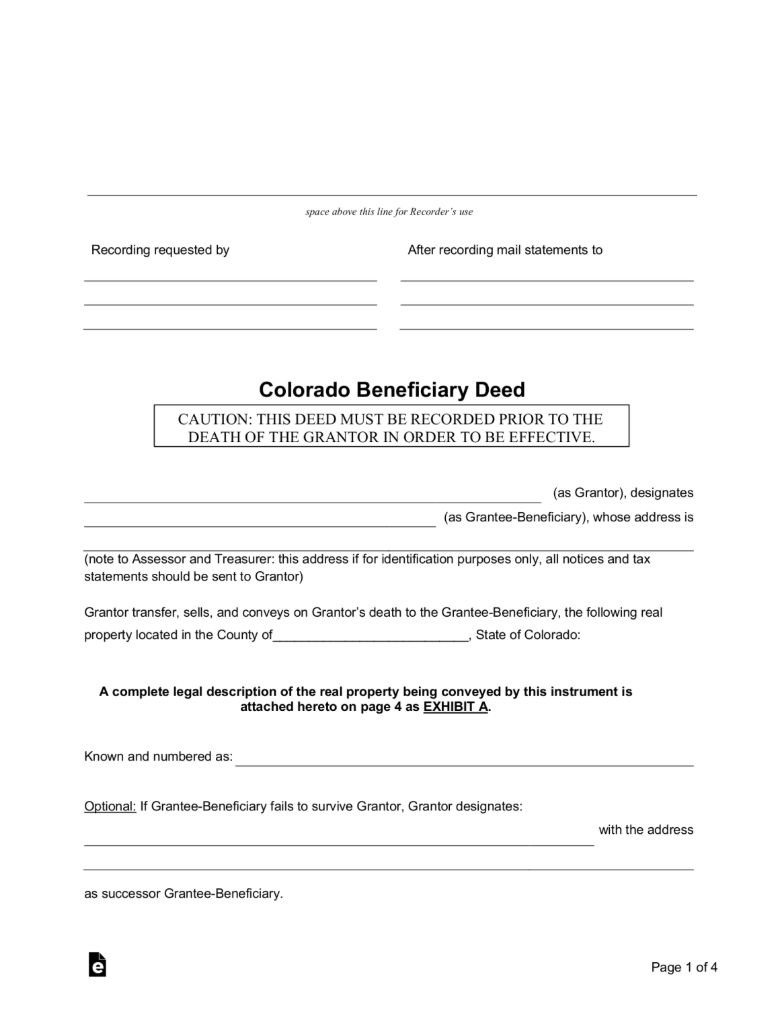
Colorado Beneficiary Deed

Full Conversation


Hello - I am helping my sister with her will. Her estate is fairly simple - she owns a condominium and after her death would like to transfer the property to a friend that will then sell it, pay off any debts, make a few specific gifts of money, and then give the remaining proceeds to one or two charitable organizations.

I recommended that she transfer the real property using a TOD deed. I want to know if this is the proper way to manage the estate and if we should reference in her will that the real property is being transferred using a TOD deed?

Lexi

Lexi, Chatbot

I understand that navigating estate planning can be complex, especially when it involves specific wishes for property and charitable gifts. Can you tell me if your sister has already drafted her will or is she starting from scratch?

We are starting from scratch and using the forms available on eForms.

Lexi

Lexi, Chatbot

Has your sister discussed her plans with the friend who will receive the condominium, and are they aware of their responsibilities regarding the sale and distribution of the proceeds?

Yes - her friend is a trusted person and understands the responsibilities -- but I believe the intention is to leave detailed instructions for her in writing also.

Benjamin

Benjamin

Hello, my name is Benjamin, and I have been a licensed attorney for over 19 years. I look forward to assisting you with your question.

I understand you're dealing with a situation where your sister wants to transfer her condominium to a friend using a TOD Deed, with the intention of selling it, paying off debts, making specific gifts, and donating the remaining proceeds to charities. Is that correct? What state are you in?

That is correct. We live in Colorado.

I think my question is - should we make reference to the TOD deed in the will document - or have the TOD deed and will completely separate?

Or does it make sense to note in a codicil that real property is being transferred via a TOD deed?

Benjamin

Benjamin

1. Is a TOD Deed Appropriate in Colorado?
Yes — in many simple estates, a Transfer on Death (TOD) deed is an efficient probate-avoidance tool for real property.

Under Colorado law, a properly executed and recorded TOD deed:

  • Transfers the condominium automatically at death
  • Avoids probate for that property
  • Gives the beneficiary no ownership rights during her lifetime
  • Remains fully revocable

The statute governing this is found in the Colorado Uniform TOD Act (C.R.S. § 15-15-401 et seq.).

So structurally, your idea is sound.

However, the more important issue is whether a TOD deed is the right mechanism given her goals.

2. The Structural Issue: Is the Friend a Beneficiary — or a Trustee?

From what you described, your sister does not intend to give the condo beneficially to her friend.

Instead, she wants the friend to:

  • Sell the condo
  • Pay debts
  • Make specific monetary gifts
  • Distribute the remainder to charities

That is not a simple gift. That is a fiduciary administration role.

A TOD deed, by default, gives the property to the named beneficiary outright.

If the deed simply names the friend individually, then legally:

  • The friend owns the condo outright at death
  • The friend has no automatic legal duty to carry out your sister’s distribution plan
  • The will cannot control that property (because TOD property passes outside probate)

That creates risk.

A TOD deed supersedes the will.

If the condo passes by TOD:

  • The will has no authority over that property
  • Instructions in the will about that condo are legally ineffective

So if you rely on the will to instruct the friend how to handle the condo, those instructions are likely unenforceable.

Should You Reference the TOD Deed in the Will?

Short Answer:
Yes — but only carefully, and not as a controlling mechanism.

If you use a TOD deed, the will should:

  • Acknowledge that certain assets pass outside probate
  • Clarify that the will does not control those assets
  • Avoid conflicting provisions

You do not want a clause that says:
"I leave my condominium to X…"

If there is a TOD deed already recorded, that clause would create confusion.

Instead, you can include language such as:

“I have executed a Transfer on Death Deed for my condominium located at [address]. That property shall pass according to the terms of that deed and shall not be part of my probate estate.”

This prevents conflict.

Okay - thank you - this is so helpful - one final question - it seems to make sense for her to have an agreement with her friend - in writing - regarding her wishes regarding the sale of the property and the proceeds - she trusts her friend completely to do as she directs but I noted to her what you have confirmed that her friend will own the property outright and there is no guaranty she will follow through with my sister's wishes and perhaps no legal recourse if she does not.

Benjamin

Benjamin

If your sister uses a Colorado TOD deed naming the friend individually, and then signs a separate “agreement” with that friend about how the proceeds should be handled, that agreement is very likely unenforceable after your sister’s death.

Once your sister dies:

  • The condo passes outside probate
  • The friend becomes the legal owner outright
  • Your sister is no longer alive to enforce any agreement

The key legal problem is this: A contract generally requires consideration and enforceability during the parties’ lifetimes.

After death:

  • Who enforces it?
  • The charities? They were not parties.
  • The estate? The condo never became part of the estate.
  • The personal representative? No authority over TOD property.

Even if you drafted a document saying:
“In consideration for receiving the condominium, you agree to sell it and distribute the proceeds…”

You still run into these issues:

  • Was there valid consideration?
  • Is it testamentary in nature?
  • Does it conflict with the TOD statute?
  • Does it create a constructive trust? (Hard to prove and expensive to litigate.)

Litigation would be complex and uncertain.

There are only two legally solid structures here:

A. Outright Gift (No Strings)
Friend owns it. Friend may morally follow wishes. No guaranteed enforcement.

B. Fiduciary Structure (Enforceable Duties)
Friend holds property as trustee. Written trust document defines:

  • Duty to sell
  • Duty to pay debts
  • Duty to distribute
  • Accounting obligations

Only structure B guarantees compliance.

Yes — you are correct:
If the condo is transferred outright by TOD deed, there is effectively no guaranteed legal recourse if the friend does not follow through.

A side letter or agreement is not a reliable enforcement mechanism.

The legally sound solution is a trust-based structure.

Okay - thank you. We will give this some thought.

Benjamin

Benjamin

Did that solve your issue? Please let me know if you have any further questions. I believe I have addressed your inquiry, so I will mark it as complete. Thank you and have a wonderful day!

Thanks - you have a great day also!

Benjamin

Benjamin

679 satisfied customers

Benjamin
Welcome! Have a similar question?

12 lawyers online now

0:00

By messaging AskALawyer, you agree to our Terms and Privacy Policy.

Disclaimer


By messaging AskaLawyer.com, you agree to our Terms and have read our Privacy Policy.

The information provided on AskaLawyer.com is for general informational purposes only and does not constitute legal advice. While we strive to ensure the accuracy and timeliness of the information presented, we make no guarantees regarding its completeness or applicability to your specific circumstances.

Use of this website does not create an attorney-client relationship between you and AskaLawyer.com or any of its attorneys. Communications through this website, including any responses from attorneys, are not privileged or confidential. For advice tailored to your individual situation, we recommend consulting a licensed attorney in your jurisdiction.

AskaLawyer.com disclaims any liability for actions taken or not taken based on the content of this site. We are not responsible for any third-party content that may be accessed through this website. Reliance on any information provided herein is solely at your own risk.

Ask a Lawyer Logo
Ask a Lawyer Logo
Intake Questions
Step  of 3
Loading...

Lexi, Chatbot

How would you like your legal question to be answered?

Online

Legal AI

Using ChatGPT 4o

Loading...

How do you like to pay?

By proceeding with payment, you agree to our Terms and Privacy Policy. You authorize us to charge $ today and $ thereafter until canceled. You may cancel anytime in the My Account section to stop future charges.

Total Due:

After purchasing, your chat will begin with an attorney.

By proceeding with payment, you agree to our Terms and Privacy Policy. You authorize us to charge $ today and $ thereafter until canceled. You may cancel anytime in the My Account section to stop future charges.

Total Due:

After purchasing, your chat will begin with an attorney.

After connecting, your chat will begin with an attorney.

After choosing, your chat will continue with Legal AI.

It looks like you already have an account with Ask a Lawyer.

We have sent you a magic link to . Click the link in your email to sign in and continue your chat.

spin

Step of 6 •

You'll receive an email at as soon as the lawyer joins the conversation 🙏🏻😊

Over 90% of lawyers connect within 5 minutes. If you're not online at that moment, don't worry — the lawyer will reply to your message while you're away.

You're also welcome to stay in the chat while waiting to be connected 💬✨

Waiting for lawyer

0:00