[PA] Can I file a small estate affidavit if my partner had no known heirs and I paid for funeral expenses out of pocket?

Angelo M
Angelo M

16,167 satisfied customers

View context
Solved

I'm sorry for your loss. In Pennsylvania, the issue you are running into is a common one, and it stems from how intestate succession works under Pennsylvania law. Even though you were a certified life partner, Pennsylvania does not treat a life partner the same as a spouse for inheritance purposes unless there is a will naming you as a beneficiary.

For the heirs section of the Pennsylvania small estate affidavit, you are required to list the heirs as defined by law, not based on relationship or fairness. Since your partner had no children, no surviving parents, and no siblings, the next category would normally be more remote relatives such as grandparents, aunts, uncles, or cousins. If you genuinely have no knowledge of any such heirs, you do not leave the section blank. Instead, you should state that no heirs are known after reasonable inquiry. Most Pennsylvania small estate affidavits allow or require language similar to the following:

"Decedent had no surviving spouse, children, parents, or siblings. After reasonable inquiry, no other heirs at law are known to the affiant. Affiant has no knowledge of any heirs entitled to inherit under Pennsylvania intestacy laws."

Be aware of an important practical point: because you are not an intestate heir, the court may scrutinize your affidavit more closely. In Philadelphia, the Register of Wills may require a brief written explanation of your relationship to the decedent, a statement describing what efforts were made to determine whether any heirs exist, and in some cases a disclaimer acknowledging that if an heir later appears, the funds may have to be returned.

Given that the asset is only slightly over $3,000, the court often allows the small estate process to move forward, but the funds technically remain subject to a future heir's claim. If an heir were ever discovered and proven, the money would belong to them rather than to you personally, unless there is a will or beneficiary designation naming you.

One final item to check carefully: confirm whether the investment account has a payable-on-death (POD) or transfer-on-death (TOD) beneficiary designation. If you are named there, the asset would pass outside probate entirely, and the small estate affidavit would not be necessary for that account.

0

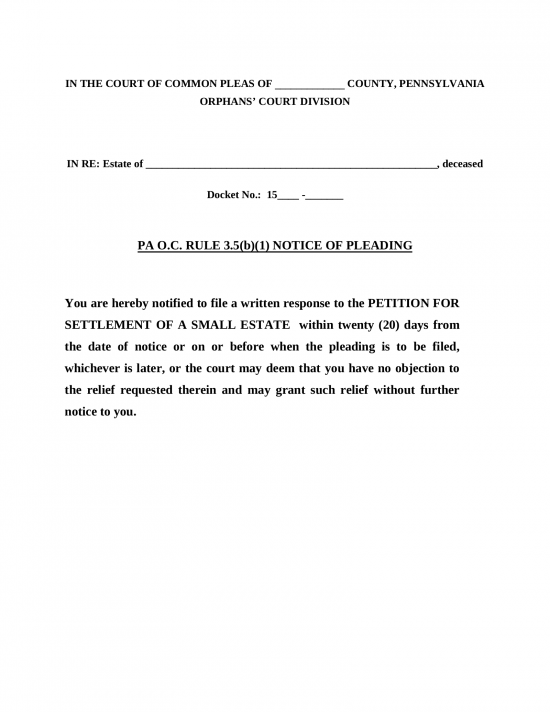
Pennsylvania Small Estate Affidavit Form
Full Conversation


I am trying to complete a small estate affidavit form for Pennsylvania for my certified life partner in Philadelphia. He had no children and was an only child and both parents are deceased. I have no knowledge of any heirs to contact. I opened the form but got stuck on the heirs section. The only remaining asset is just over $3,000 in an investment account.

Lexi

Lexi, Chatbot

I'm sorry to hear about your loss. It can be challenging to navigate these matters. Have you already started filling out the small estate affidavit form, or are you looking for guidance on how to begin? Do you have any documentation regarding your partner's assets or debts that might be relevant to the affidavit?

Angelo M

Angelo M

Greetings! I hope this message finds you well. I'm thrilled to have the opportunity to assist you with your situation and provide you with the support you need. Thank you for your patience, and I look forward to working with you.

Angelo M

Angelo M

I'm sorry for your loss. In Pennsylvania, the issue you are running into is a common one, and it stems from how intestate succession works under Pennsylvania law. Even though you were a certified life partner, Pennsylvania does not treat a life partner the same as a spouse for inheritance purposes unless there is a will naming you as a beneficiary.

For the heirs section of the Pennsylvania small estate affidavit, you are required to list the heirs as defined by law, not based on relationship or fairness. Since your partner had no children, no surviving parents, and no siblings, the next category would normally be more remote relatives such as grandparents, aunts, uncles, or cousins. If you genuinely have no knowledge of any such heirs, you do not leave the section blank. Instead, you should state that no heirs are known after reasonable inquiry. Most Pennsylvania small estate affidavits allow or require language similar to the following:

"Decedent had no surviving spouse, children, parents, or siblings. After reasonable inquiry, no other heirs at law are known to the affiant. Affiant has no knowledge of any heirs entitled to inherit under Pennsylvania intestacy laws."

Be aware of an important practical point: because you are not an intestate heir, the court may scrutinize your affidavit more closely. In Philadelphia, the Register of Wills may require a brief written explanation of your relationship to the decedent, a statement describing what efforts were made to determine whether any heirs exist, and in some cases a disclaimer acknowledging that if an heir later appears, the funds may have to be returned.

Given that the asset is only slightly over $3,000, the court often allows the small estate process to move forward, but the funds technically remain subject to a future heir's claim. If an heir were ever discovered and proven, the money would belong to them rather than to you personally, unless there is a will or beneficiary designation naming you.

One final item to check carefully: confirm whether the investment account has a payable-on-death (POD) or transfer-on-death (TOD) beneficiary designation. If you are named there, the asset would pass outside probate entirely, and the small estate affidavit would not be necessary for that account.

I am trying to determine whether it would be worth the effort to file if an heir is later determined. I do not want to spend money on fees to file and end up not getting anything out of it in the end. Do you have any idea about the fees associated with this type of filing?

Angelo M

Angelo M

Your concern is very reasonable, and you are asking the right question before spending money. In Pennsylvania, especially Philadelphia, the cost-benefit analysis matters a lot when the asset is only around $3,000.

On fees: Pennsylvania does not charge a filing fee just to prepare a small estate affidavit, but there are costs to actually access the money. In Philadelphia, you should expect a Register of Wills filing fee typically in the range of $50 to $100 depending on the document and whether certification is required, certified copies at usually $5 to $20 per copy with financial institutions almost always requiring at least one, and institution processing fees that vary widely by investment firm.

The biggest issue is inheritance tax. As a life partner rather than a spouse under Pennsylvania intestacy law, you are taxed at the 15% inheritance tax rate if you receive funds through the estate. On $3,000, that is about $450, payable before funds are released. Realistically, your out-of-pocket cost could land between $200 and $600 depending on how the institution handles it.

On the risk of an heir later appearing: if you file the affidavit and a lawful heir is later identified, that heir and not you would legally be entitled to the funds. You could be required to turn over the funds, and in theory could be exposed to liability if the affidavit is challenged. Practically speaking, that risk is low in small estates, but it is not zero.

Because you are not an intestate heir, the affidavit does not give you ownership rights. It only allows the estate to be collected and distributed according to law. That means you could spend money, time, and effort and still walk away with nothing if a relative later appears.

Before filing anything, I strongly recommend calling the investment company first and asking whether they require a small estate affidavit or Letters of Administration, what fees they charge, whether they will issue payment directly to you or only to the estate, and whether inheritance tax proof is required before release.

Since I used my own funds to pay for funeral expenses including cremation and a headstone, am I correct that those expenses would offset the inheritance tax? Or can I claim these funeral expenses against the estate, which was more than the cost of what remains in the estate? If so, how is it best to proceed?

Angelo M

Angelo M

Yes, you are thinking about this correctly, and Pennsylvania law does give you a meaningful way to address this.

Under Pennsylvania inheritance tax rules, funeral and burial expenses are deductible from the taxable estate before inheritance tax is calculated. This includes reasonable costs such as cremation, burial or interment, headstone or marker, funeral home charges, and related expenses. If you personally paid those expenses out of pocket, they are still treated as estate expenses and reduce the taxable value of the estate, even though reimbursement has not yet occurred.

In your situation, where the remaining estate asset is just over $3,000 and the funeral-related expenses you paid exceed that amount, the net taxable estate would be reduced to zero. That means there would be no inheritance tax due, because there is no remaining taxable value after deducting allowable funeral expenses.

The cleanest approach is to document everything. Keep receipts, invoices, and proof of payment for the cremation and headstone. When completing the small estate affidavit or any accompanying documentation, list the funeral expenses as estate obligations paid by you personally. In Philadelphia, the Register of Wills generally accepts this as a proper offset, even when the expenses exceed the remaining estate assets.

You are also legally entitled to reimbursement from the estate for funeral expenses, but reimbursement is capped by the assets actually available. Since the funeral expenses exceed the estate value, the estate would effectively be exhausted by those expenses, leaving no distributable balance to heirs and no inheritance tax exposure. This also significantly reduces the risk of a later heir claim, because there would be no remaining funds to claim.

Before filing, confirm with the investment company that they will release the funds based on a small estate affidavit reflecting funeral expense exhaustion, and ask whether they require proof of inheritance tax filing or a tax clearance receipt. Many institutions will release funds once shown that the estate has no net taxable value.

From a cost-benefit standpoint, this makes filing far more reasonable, because you are not paying inheritance tax on funds that are effectively reimbursement for expenses you already covered.

Angelo M

Angelo M

16,167 satisfied customers

Angelo M
Welcome! Have a similar question?

12 lawyers online now

0:00

By messaging AskALawyer, you agree to our Terms and Privacy Policy.

Queeneth E. Esq
Queeneth E. Esq

Commercial Contracts Attorney

4.61 (6,270)

[FL] Can I remove a violent relative from my late mother’s home?

9

2

Answered 3 weeks ago

Disclaimer


By messaging AskaLawyer.com, you agree to our Terms and have read our Privacy Policy.

The information provided on AskaLawyer.com is for general informational purposes only and does not constitute legal advice. While we strive to ensure the accuracy and timeliness of the information presented, we make no guarantees regarding its completeness or applicability to your specific circumstances.

Use of this website does not create an attorney-client relationship between you and AskaLawyer.com or any of its attorneys. Communications through this website, including any responses from attorneys, are not privileged or confidential. For advice tailored to your individual situation, we recommend consulting a licensed attorney in your jurisdiction.

AskaLawyer.com disclaims any liability for actions taken or not taken based on the content of this site. We are not responsible for any third-party content that may be accessed through this website. Reliance on any information provided herein is solely at your own risk.

Ask a Lawyer Logo
Ask a Lawyer Logo
Intake Questions
Step  of 3
Loading...

What's your legal question?

Lexi, Chatbot

How would you like your legal question to be answered?

Online

Legal AI

Using ChatGPT 4o

Loading...

How do you like to pay?

By proceeding with payment, you agree to our Terms and Privacy Policy. You authorize us to charge $ today and $ thereafter until canceled. You may cancel anytime in the My Account section to stop future charges.

Total Due:

After purchasing, your chat will begin with an attorney.

By proceeding with payment, you agree to our Terms and Privacy Policy. You authorize us to charge $ today and $ thereafter until canceled. You may cancel anytime in the My Account section to stop future charges.

Total Due:

After purchasing, your chat will begin with an attorney.

After connecting, your chat will begin with an attorney. After choosing, your chat will continue with Legal AI.

It looks like you already have an account with Ask a Lawyer.

We have sent you a magic link to . Click the link in your email to sign in and continue your chat.

spin

Step of 6 •

You'll receive an email at as soon as the lawyer joins the conversation 🙏🏻😊

Over 90% of lawyers connect within 5 minutes. If you're not online at that moment, don't worry — the lawyer will reply to your message while you're away.

You're also welcome to stay in the chat while waiting to be connected 💬✨

Waiting for lawyer

We couldn't send your message. Please try again.

Your lawyer will reply as soon as possible

If there’s a delay, please don’t worry. Your chat will stay open, and they’ll get back to you as soon as they can. There’s no rush on your end either. You’ll receive an email notification as soon as there’s a new message.

You've reached your AI chat limit

Upgrade your plan to continue chatting and get instant domain-specific answers.

0:00