Benjamin
Your husband cannot legally force you out of a jointly owned marital home unless and until a court orders it. What he is telling you about “his lawyer said you have to leave” is not legally accurate.
Why He Cannot Make You Leave
1. You are both on the deed.
Because both of you are on the deed, you have equal legal rights to occupy the home.
- Income level does not determine who stays
- VA disability income does not give him priority
- Neither spouse can unilaterally evict the other
Until a court says otherwise, you have the same right to live there as he does.
2. Virginia is an equitable distribution state.
Virginia divides property based on fairness, not “who makes more.”
Courts look at:
- Contributions to the marriage (financial and non-financial)
- Ability of each spouse to maintain housing
- Who can realistically afford the home
- Length of the marriage
- Fault grounds (if any)
There is no rule in Virginia that says the higher earner must leave.
3. You do NOT need to leave unless one of these happens:
- You voluntarily agree to move out
- A court issues an order (very rare early on unless there’s abuse)
- There is a protective order (not indicated here)
None of those exist right now.
Very Important Strategic Warning
Leaving the house voluntarily can hurt you later.
If you leave:
- He may argue you abandoned the marital residence
- He may try to establish status quo (him in the house, you out)
- It can complicate negotiations about who keeps or sells the home
- It puts you in the financial squeeze you’re already worried about
Virginia courts often favor maintaining the status quo, so leaving without an agreement or court order can weaken your position.
This is the reason they want you to leave probably, it supports their argument.
Virginia does not require one spouse to physically move out of the marital home in order to satisfy the 6-month (or 1-year) separation requirement.
You can be “legally separated” while living under the same roof if specific conditions are met.
Ownership of the deed does not control separation. Conduct does.
Under Virginia Code § 20-91(A)(9), separation means:
- An intent to end the marriage, and
- Cessation of marital cohabitation
It does not require:
- Separate residences
- One spouse leaving the home
- A court order enforcing separation
To qualify, you must show all of the following:
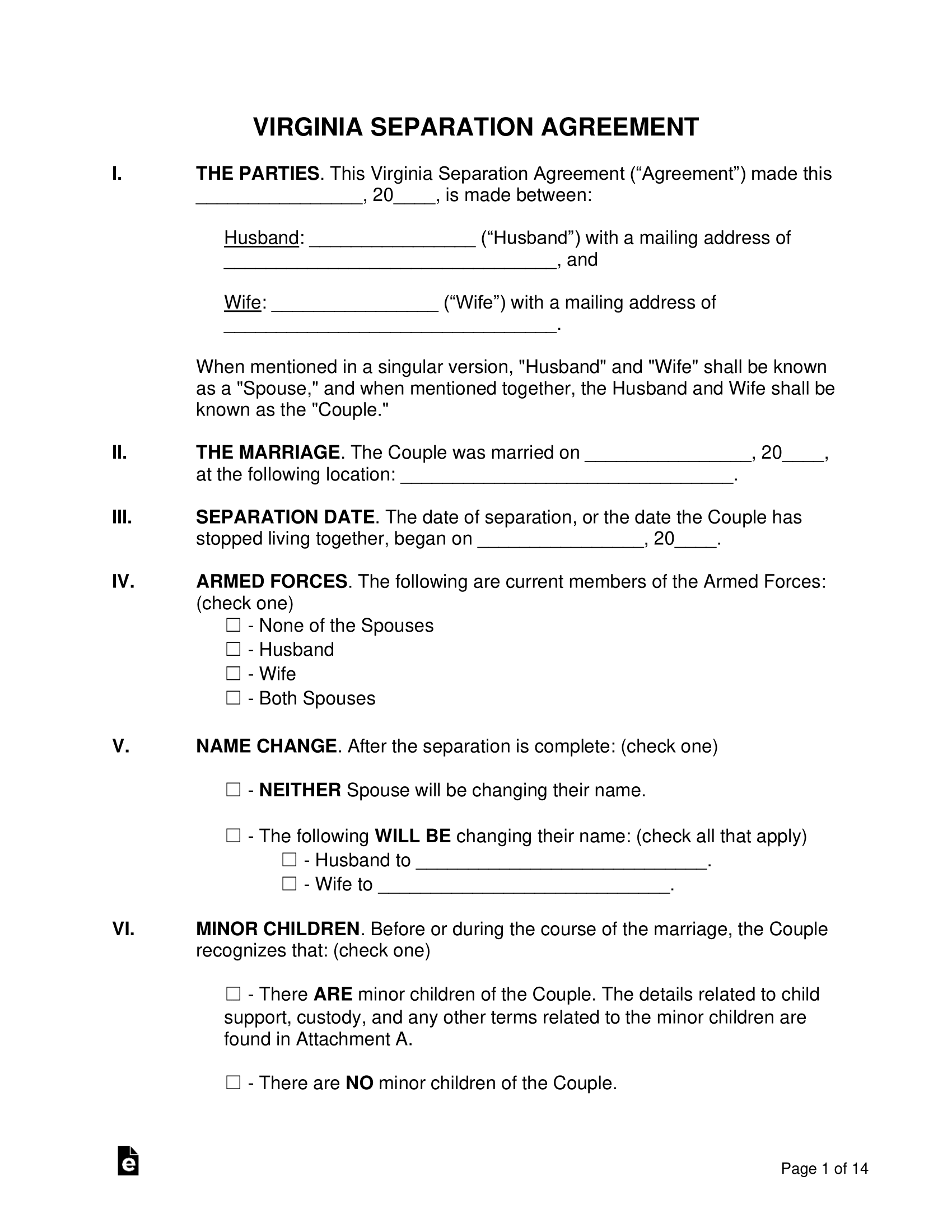
1. Clear intent to separate: At least one spouse clearly communicates the marriage is over. Example: written notice, text, email, or separation agreement draft. You’ve already done this by drafting a separation agreement.
2. No marital relationship: You must stop behaving as a married couple:
- No sexual relationship
- No shared bedroom
- No romantic conduct
- No joint social activities as a couple
Sleeping in separate rooms is strong evidence.
3. Separate lives inside the home: This is the part judges look at closely:
- Separate finances as much as possible
- Separate groceries and meals (or clearly divided food prep)
- Separate laundry
- Minimal interaction beyond logistics
- No holding yourselves out as spouses
You don’t have to be hostile — just clearly independent.
4. Corroboration (Enforcement mechanism)
This is how it’s “enforced”:
Virginia requires corroboration, meaning:
A third party (friend, family member, therapist, etc.) can testify or submit an affidavit stating:
- They know when separation began
- You were living separate lives
- The marriage was over
There is no divorce police checking your house. The court enforces separation retroactively, at the time of divorce.
6 Months vs. 1 Year
You qualify for 6 months if:
- No minor children
- You have a signed separation agreement
If either is missing → 1 year.
Living arrangements do not change this rule.