[PA] Can I use a 10-day notice to quit for a nonpaying month-to-month tenant?

TJ, Esq.
TJ, Esq.

17,778 satisfied customers

View context
Solved

This is helpful. So the lease expired August 31, 2024, and there's been no written renewal or extension since then. That means you're operating on an implied month-to-month tenancy, which is exactly what you said. (Act of Jul. 17, 2024, P.L. 944, No. 88) The fact that he has a house key giving him access to common areas doesn't change the eviction analysis here.

The lease language actually works in your favor. It clearly states he needed written authorization to continue after August 31, 2024. Since there was none, the tenancy converted to month-to-month on those same terms otherwise.

Now, regarding the roomer issue I mentioned: Pennsylvania does have different rules for “roomers” — someone renting a room in an owner-occupied home where the owner lives — but courts generally still apply standard landlord-tenant law to situations like yours, especially since there was a formal written lease to begin with. The key difference would be in notice requirements, but for nonpayment, a 10-day notice to quit is standard either way.

0

Pennsylvania 10-Day Notice to Quit Form | Non-Payment
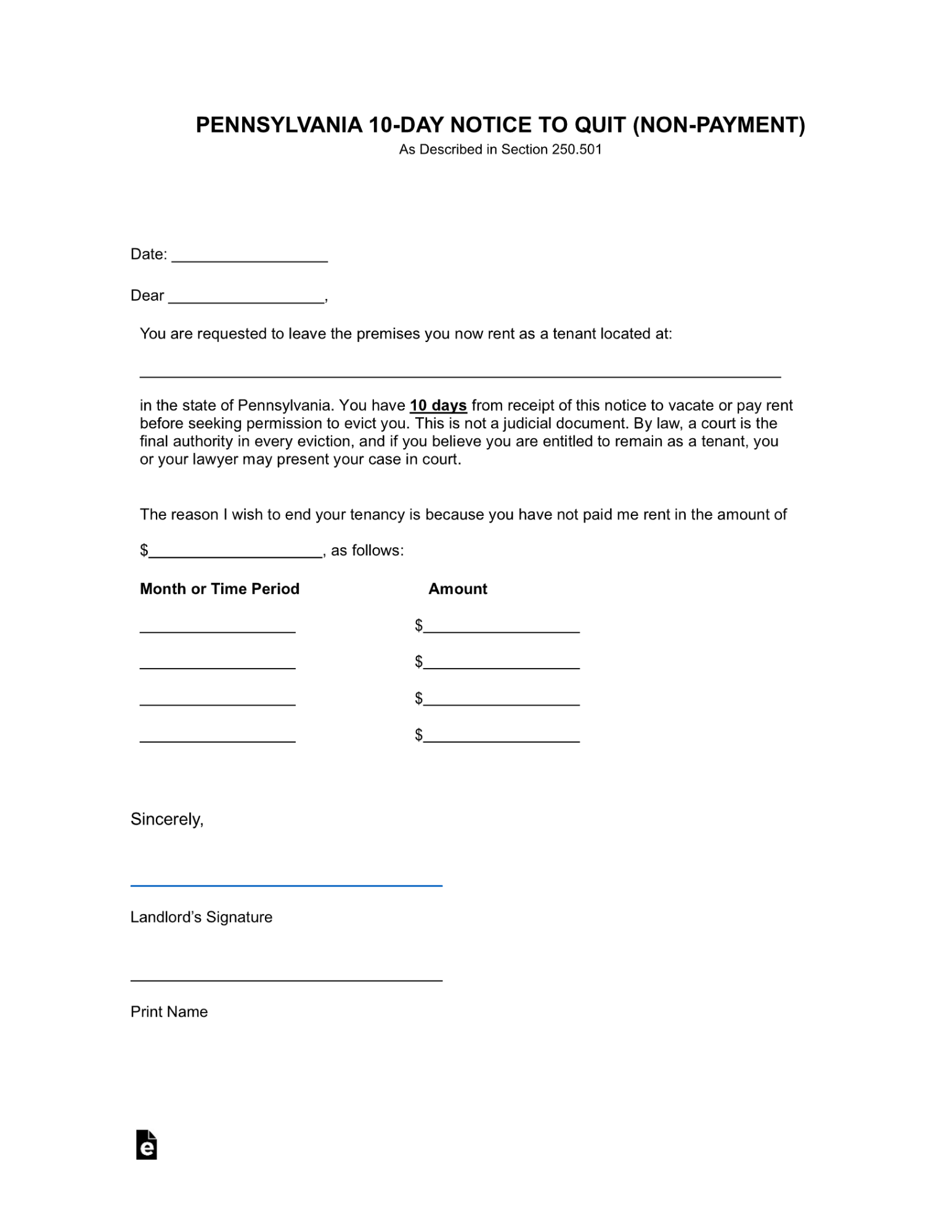
Full Conversation


I have a complex situation with a non-paying tenant. Can you review my 10-day notice to quit and make sure it will hold up?

Lexi

Lexi, Chatbot

I understand how challenging it can be to deal with a non-paying tenant. Can you tell me when you issued the 10-day notice to quit?

It has not been issued yet, but is for a PA tenant who is in an implied month-to-month agreement.

Lexi

Lexi, Chatbot

Have you had any previous communication or agreements with the tenant regarding the rent payment?

Nothing official, only text and in person.

TJ, Esq.

TJ, Esq.

Hello! My name is TJ and I'm an attorney. Thanks so much for the opportunity to assist you! I understand how important your legal question is, and I'm giving it my full attention. Just so you know, I only respond via chat. If you originally requested a phone call, your question was moved to the chat section because no attorneys were available for a call at that time. Either way, I'm certain I can help you! I'll share my initial thoughts shortly, and I may also ask for a few additional details. That information will help me understand your situation more clearly so I can offer a more complete and helpful answer.

VERY IMPORTANT INFORMATION (PLEASE READ): This is a Q&A platform for general information only. I can't represent you or form an attorney-client relationship. This also means there is no attorney-client privilege or confidentiality.

TJ, Esq.

TJ, Esq.

In Pennsylvania, you'll need to serve a 10-day notice to quit for nonpayment of rent on a month-to-month tenant. The notice must include specific language and be properly delivered. After 10 days pass without payment, you can file for eviction in court. The key is making sure the notice meets Pennsylvania's statutory requirements.

Is the tenant currently living in the unit, and has rent been overdue for how long? Thanks again for reaching out with your question.

The tenant lives in-unit, and I, the landlord, live in the same home. Rent has been overdue habitually, but up until recently the tenant was only ever a bit behind. As of now, he is behind all the way from December, and as of March 1, he will be $2,260 behind.

TJ, Esq.

TJ, Esq.

Since you live in the same home as the tenant, Pennsylvania treats this as an “owner-occupied” situation, which actually gives you some different options than a typical landlord-tenant relationship. The good news is you may have more flexibility here.

Given that the tenant has been consistently late and is now seriously behind, I'd like to understand the setup a bit better. When you say you live in the same home, do you mean the tenant rents a room in your house, or do they rent a separate unit like an apartment or basement area? And has the tenant made any recent communications about when they might pay the overdue rent?

The tenant lives in one room of my house but is allowed to use common areas. It is not a separate unit. The tenant has been largely non-responsive since the situation has gotten more contentious. His original lease was from August 2023 to September 2024, and we moved to an implied month-to-month basis. He was always a little late, but I tried to be kind. Only recently has he become seriously delinquent to the point where I want to make it a legal matter. Are you able to review my 10-day notice to quit as drafted on the eForms website?

TJ, Esq.

TJ, Esq.

Based on what you've described, you're in a strong position legally. The tenant had a written lease that expired, you've transitioned to month-to-month, and he's now seriously behind. A 10-day notice to quit for nonpayment is the right approach.

However, I want to flag something important about your situation. Because you live in the same home and the tenant is occupying a room with shared access to common areas, Pennsylvania law treats this differently than a typical landlord-tenant relationship. Specifically, you may fall under what's called a “roomer” situation, which has some different rules around notice periods and eviction procedures. This could actually work in your favor, but I need to make sure we're handling this correctly.

Before I review the language of your notice, I'd like to know: Does the tenant have a key to the common areas of the house, or do they access those areas only when you allow? And when the original lease was signed back in August 2023, did it specify anything about what would happen after the September 2024 expiration date?

Hi, there are no keys to common areas; they are just accessible through the home itself. He has a house key, and that alone allows him into the home and, by extension, any common area. Lease states:

VII. LEASE TERM. The term of this Agreement shall be a fixed-period arrangement beginning on September 1, 2023, and ending on August 31, 2024 (“Lease Term”). The Tenant(s) will be required to move out at the end of the Lease Term unless the Landlord and Tenant(s) authorize a renewal, extension, or separate agreement in writing.

TJ, Esq.

TJ, Esq.

This is helpful. So the lease expired August 31, 2024, and there's been no written renewal or extension since then. That means you're operating on an implied month-to-month tenancy, which is exactly what you said. (Act of Jul. 17, 2024, P.L. 944, No. 88) The fact that he has a house key giving him access to common areas doesn't change the eviction analysis here.

The lease language actually works in your favor. It clearly states he needed written authorization to continue after August 31, 2024. Since there was none, the tenancy converted to month-to-month on those same terms otherwise.

Now, regarding the roomer issue I mentioned: Pennsylvania does have different rules for “roomers” — someone renting a room in an owner-occupied home where the owner lives — but courts generally still apply standard landlord-tenant law to situations like yours, especially since there was a formal written lease to begin with. The key difference would be in notice requirements, but for nonpayment, a 10-day notice to quit is standard either way.

Yes I can. Before I do, here are some concerns I have that I want to make sure are okay. I used eForms standard template which means the language at times does not always seem applicable. For example, it asked me the date of the lease agreement but my original expired. Should I just put down the first day after the lease ended?

Second, it asked me the PAST DUE rent dates. Here, I put Dec 1, 2025 because I am still owed $160 from December, and as an end date I put 31 March, 2026 because he will owe for March as of March 1, which will be the 10th day of the notice. I did not know whether I should exclude March as the notice will start tomorrow, before March is technically due? Finally, I want to make sure my method of delivery is adequate. If I do not see him face-to-face, I intend to video tape the full document, then attach it to his room's door, and slip another copy underneath.

TJ, Esq.

TJ, Esq.

On the lease date: The eForms template is asking for the original lease date since that's when the tenancy began. Put September 1, 2023 — the start date from your lease. The fact that it expired doesn't change when the agreement was entered into. Courts will understand the context.

On the past due rent dates: You've got this right. December 1, 2025 through March 31, 2026 is correct. You're owed for all of December, January, February, and March since March 1 will be the 10th day when he's obligated to have paid. Including March is proper because the debt will have accrued by then.

On delivery: Here's where I need to flag a real problem. Pennsylvania law requires the notice to be served in one of specific ways: personal delivery to the tenant, delivery to an authorized person at the premises, delivery at their workplace, or posting in a conspicuous place. A video recording of you posting the document doesn't satisfy Pennsylvania's statutory requirements. Posting it on the door and slipping a copy underneath could work IF you can prove it was conspicuous posting and properly done.

The safest approach is personal delivery if you can manage it. If not, posting on the door alone without the video is acceptable as long as it's in a very visible spot. But you'll need to fill out the affidavit of service accurately reflecting how you actually served it.

Can you advise lastly on “conspicuous and proper”? I planned on adding a cover sheet that just had “Joe” written on it to protect the tenant’s privacy, but otherwise to literally tape it to the door, while recording. What else should I do to cover myself in the event that the tenant is not home when I try to serve? He’s been very intentionally avoidant since this whole thing got contentious.

TJ, Esq.

TJ, Esq.

Now on the conspicuous posting issue, you're on the right track but let me clarify what “conspicuous” means in Pennsylvania.

Conspicuous means it's placed where someone would reasonably see it when coming to the door or entering the premises. Taping it directly to the front door at eye level is ideal. The cover sheet with just “Joe” on it is fine and actually smart for privacy. Recording yourself doing this is fine too, though it's not required by law. What matters legally is the affidavit you fill out afterward, where you'll swear under penalty of perjury that you posted it conspicuously.

Here's what I'd do to protect yourself if he's avoiding you: First, take photos or video showing the notice on the door with a timestamp. Second, if you tape it there and he doesn't answer, don't take it down. Leave it up. Third, on your affidavit of service, check the box for “POSTED AT THE RENTAL PREMISES” and describe exactly where you posted it — for example, “taped to the front door at eye level.” Fourth, note the date and time you posted it. Fifth, if possible, have a witness present when you post it, or at minimum, a neighbor who can confirm they saw it there later.

The fact that he's been avoidant actually works in your favor here. Posting service is specifically allowed by law for situations where tenants are avoiding personal service. You're following the rules correctly.

Once you've posted it, keep your evidence — photos, video, affidavit — safe. You'll need that if this goes to court.

Does that make sense on how to handle the posting?

Yes sir, I think I'm good from here! May we keep this chat open in case I run into another question tomorrow?

TJ, Esq.

TJ, Esq.

Yes, of course!

Oooh, one more! Did you mean the house’s front door or the room’s front door? My plan was his room’s front door so as not to embarrass him.

TJ, Esq.

TJ, Esq.

I appreciate that you're being considerate, but legally speaking, you need to post it on the house's front door or another main entrance to the property. Here's why: the notice is directed at him as a tenant of the rental premises, which is the whole house at that address. Posting it only on his room door could give him an argument later that he didn't receive proper notice, especially since he's been avoidant.

Courts look at whether notice was posted in a place where the tenant would reasonably see it when accessing the property. His room door doesn't meet that standard because it's not a common entry point to the rental premises itself.

I know you want to handle this tactfully, but at this point in the process, with him being seriously behind and intentionally avoiding communication, a notice posted on the house's front door is the appropriate legal method. It protects you by ensuring he can't later claim he never saw it. Plus, he already knows the situation is contentious, so posting notice on the main door won't surprise him.

Tape it to the front door at eye level, photograph it with a timestamp, document everything, and fill out your affidavit accurately. That combination will hold up in court if you need it to.

Excellent, I will. One more question. I read that the day served does not count toward the 10 days. Does that mean I must wait until tomorrow, 2/19, for the 10th day to be 3/1?

TJ, Esq.

TJ, Esq.

Exactly right. You've got the math correct. In Pennsylvania, the day the notice is served doesn't count toward the 10 day period. So if you serve it tomorrow, February 19, day one of the 10 day period starts on February 20. That means the 10th day would be March 1.

That timing actually works perfectly for you since March 1 is when the March rent becomes due anyway. So by serving tomorrow, the tenant will have until March 1 to pay the full $2,260, which covers everything through March.

Make sure when you fill out your affidavit of service that you note the date as February 19, 2026. That's your service date. Do you have any other questions about what happens after the 10 days pass if he doesn't pay or vacate?

My understanding is I need to go find the Magisterial District Judge and raise a complaint? Can you maybe paint me a simplified picture?

TJ, Esq.

TJ, Esq.

Yes, you've got the basic idea right. Here's the simplified picture of what comes next if he doesn't pay or vacate by March 1.

After March 1 passes without payment or him moving out, you'd file a complaint for eviction, called a “forcible detainer” complaint in Pennsylvania, with your local Magisterial District Judge. You'll need to find the right district judge for your area based on where the property is located. The complaint is fairly straightforward to file, and there's a filing fee, usually around $75 to $150 depending on your district.

Once you file, the judge will schedule a hearing, usually within 7 to 10 days. You'll go to that hearing, present your evidence — the notice, proof of service, proof that he didn't pay — and the judge will decide. If the judge rules in your favor, they'll issue an eviction order. The tenant then has a few days to appeal or move out. If he doesn't leave voluntarily, you can have a constable physically remove him and his belongings.

The whole process from filing to actual removal typically takes 2 to 4 weeks if the tenant doesn't fight it.

The key thing is you need to keep all your documentation: the original lease, the notice you serve tomorrow, photos or video of posting, your affidavit of service filled out completely and accurately, and any records of the rent amounts owed.

It does! I really hope it doesn’t get to that. If the tenant reacts violently or otherwise damages property in spite, does the process change in any way? I don’t expect this, but I just want to be maximally prepped.

TJ, Esq.

TJ, Esq.

That's a smart precaution to think through. If the tenant reacts violently or damages property, that actually opens up additional legal options for you, but it doesn't change the eviction process itself. The eviction will proceed the same way regardless.

Here's what's important: If he becomes violent or threatens you, that's a criminal matter. You can call 911 and report it to local police. That's separate from the eviction. If he damages property in the house beyond normal wear and tear, you can sue him for those damages in small claims court or include those damages claims in your eviction case.

The key thing is to document everything. If there's any violence or property damage, take photos, get a police report filed, and keep records of the costs to repair anything. All of that can be brought up in the eviction hearing and can strengthen your case, but more importantly, it protects you legally and ensures there's a record if you need it.

One practical tip: When you post the notice tomorrow, consider having someone with you, just as a witness and for your own safety. That's not a legal requirement, but it's smart given that he's been hostile and avoidant.

The eviction process itself will move forward on its normal timeline. Any violence or damage is a separate issue that law enforcement would handle.

Feeling prepped, thank you!

TJ, Esq.

TJ, Esq.

You’re very welcome, and I’m happy I could help!

Does my tenant get a copy of the affidavit of service? Or do I just hang on to it?

And also, if I end up serving to the front door, do I just fill out the time for when I do that? I.e., if I taped it to the door at 11:08 AM, I write in 11:08 AM? And what I think is my final question… I don’t have a copier, so if my tenant does get a copy of the affidavit of service, is it fine just to make sure the information is identical, since I can’t literally make an identical copy?

TJ, Esq.

TJ, Esq.

Good questions. Let me hit these one by one.

On the affidavit: You keep the original. The tenant doesn't automatically get a copy of the affidavit of service. However, when you file the eviction complaint with the Magisterial District Judge later, that becomes a court document and both sides get copies. So he'll see it then. For now, just keep it safe with your other records.

On the time: Yes, exactly. If you taped it to the door at 11:08 AM, write in 11:08 AM on the affidavit. Be as specific as you can. The form asks for the date and time, so fill in what actually happened.

On copies: You don't need an identical photocopy. What matters is that you have ONE signed original affidavit that you keep. When you later file with the court, you'll provide that original or a certified copy to the judge. For your own records, you can absolutely make a plain copy, even by hand or typing up the same information, to keep as a backup. Courts don't require identical photocopies of affidavits. They care about the original signed document.

The key is: sign and date the original affidavit when you actually post the notice. Keep that original safe. You'll bring it with you if this goes to the eviction hearing.

Sorry, I keep thinking of next questions. For the legal proceedings, if I am found to be in compliance and granted the eviction, can I request court costs in addition to the rent? And would this consult be admissible if I could prove payment and relevance? Sorry, not admissible, I meant claimable.

TJ, Esq.

TJ, Esq.

Yes to both. If you win the eviction case, Pennsylvania allows you to recover court costs — filing fees, constable fees, etc. You can ask the judge for those at the hearing.

As for this chat, no, it wouldn't be claimable as damages. Court costs mean the actual expenses you paid to the court and constable. Attorney fees and consultation costs are generally not recoverable in eviction cases unless your lease specifically says otherwise. Check your original lease to see if it has a clause allowing you to recover attorney fees if there's a dispute, but typically those aren't awarded in eviction proceedings.

You can recover the actual rent owed plus court costs. That's it.

Yes, it does, thank you!

TJ, Esq.

TJ, Esq.

You are welcome! :)

TJ, Esq.

TJ, Esq.

17,778 satisfied customers

TJ, Esq.
Welcome! Have a similar question?

12 lawyers online now

0:00

By messaging AskALawyer, you agree to our Terms and Privacy Policy.

Disclaimer


By messaging AskaLawyer.com, you agree to our Terms and have read our Privacy Policy.

The information provided on AskaLawyer.com is for general informational purposes only and does not constitute legal advice. While we strive to ensure the accuracy and timeliness of the information presented, we make no guarantees regarding its completeness or applicability to your specific circumstances.

Use of this website does not create an attorney-client relationship between you and AskaLawyer.com or any of its attorneys. Communications through this website, including any responses from attorneys, are not privileged or confidential. For advice tailored to your individual situation, we recommend consulting a licensed attorney in your jurisdiction.

AskaLawyer.com disclaims any liability for actions taken or not taken based on the content of this site. We are not responsible for any third-party content that may be accessed through this website. Reliance on any information provided herein is solely at your own risk.

Ask a Lawyer Logo
Ask a Lawyer Logo
Intake Questions
Step  of 3
Loading...

What's your legal question?

Lexi, Chatbot

How would you like your legal question to be answered?

Online

Legal AI

Using ChatGPT 4o

Loading...

How do you like to pay?

By proceeding with payment, you agree to our Terms and Privacy Policy. You authorize us to charge $ today and $ thereafter until canceled. You may cancel anytime in the My Account section to stop future charges.

Total Due:

After purchasing, your chat will begin with an attorney.

By proceeding with payment, you agree to our Terms and Privacy Policy. You authorize us to charge $ today and $ thereafter until canceled. You may cancel anytime in the My Account section to stop future charges.

Total Due:

After purchasing, your chat will begin with an attorney.

After connecting, your chat will begin with an attorney. After choosing, your chat will continue with Legal AI.

It looks like you already have an account with Ask a Lawyer.

We have sent you a magic link to . Click the link in your email to sign in and continue your chat.

spin

Step of 6 •

You'll receive an email at as soon as the lawyer joins the conversation 🙏🏻😊

Over 90% of lawyers connect within 5 minutes. If you're not online at that moment, don't worry — the lawyer will reply to your message while you're away.

You're also welcome to stay in the chat while waiting to be connected 💬✨

Waiting for lawyer

We couldn't send your message. Please try again.

Your lawyer will reply as soon as possible

If there’s a delay, please don’t worry. Your chat will stay open, and they’ll get back to you as soon as they can. There’s no rush on your end either. You’ll receive an email notification as soon as there’s a new message.

You've reached your AI chat limit

Upgrade your plan to continue chatting and get instant domain-specific answers.

0:00