TJ, Esq.
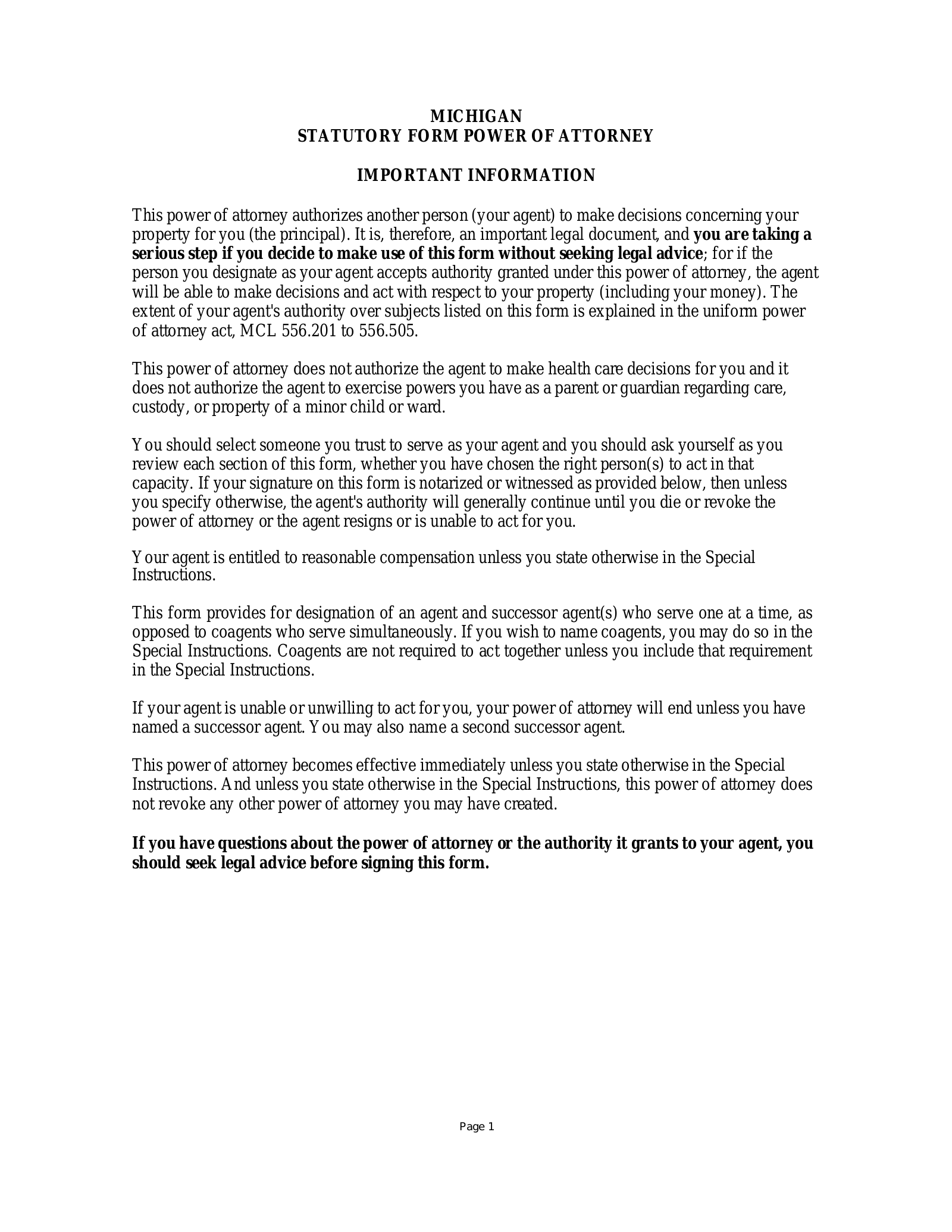
Resigning your POA protects you. You're right to want to resign. Once you formally resign in writing, you're no longer responsible for your mom's finances or healthcare decisions, and anything that happens after your resignation date is not your liability. If the grandson misses her medication doses or makes poor financial decisions, that's on him and your mom, not on you. You can't be held liable for decisions you're not making. This lines up with how Michigan law defines when an agent's authority actually ends: under the termination provisions of Michigan's Uniform Power of Attorney Act (MI Comp L § 556.210), an agent's authority terminates once the agent resigns, and any acts taken after that point are simply outside the scope of your role.
How to resign properly. In Michigan, you don't need court approval to resign from a POA. You can do this by sending a written resignation letter to your mom. Keep it simple: state that you're resigning effective immediately (or give a date a few days out if you want to wrap things up), and send it to her. It's smart to also send a copy to your brother and keep one for yourself. You might also want to notify her bank and any healthcare providers that have you listed, so they know the POA is no longer valid. This creates a clear paper trail that protects you. Michigan's power of attorney statute actually spells out how an agent gives notice of resignation (MI Comp L § 556.218), including who else needs to be notified if your mom were ever found incapacitated, such as a court-appointed guardian or conservator, or, if none exists, a caregiver or adult protective services.
What about transferring to your brother. You can't directly transfer a POA to someone else in Michigan. However, your mom could sign a new POA naming your brother instead of you. This would require her to have the mental capacity to understand what she's doing. Given her Alzheimer's diagnosis, this is where things get complicated. If she's still able to understand the document and what it means, she can sign a new one, but if her cognitive decline has progressed, a court might question whether she had capacity to sign it. Your brother being in Arizona also makes this harder practically.
If your brother won't or can't take it on. If your brother declines, or if your mom doesn't have capacity to sign a new POA, then yes, your mom would be on her own. The grandson would have no legal authority to make decisions unless your mom gives it to him in writing. He could still live with her and influence her, but he wouldn't have the legal power that a POA gives. If your mom's condition worsens and she can't manage her own affairs, someone (possibly you, your brother, or the grandson) could petition the court for a guardianship or conservatorship, but that's a separate process and wouldn't happen unless someone files for it. Michigan's probate code lays out exactly how that works: any interested person may petition a probate court for a finding of incapacity and the appointment of a guardian (MI Comp L § 700.5303), and the court can only grant it if there's clear and convincing evidence that the person is incapacitated and that a guardian is necessary (MI Comp L § 700.5306a) for her continuing care.
The money question. You're not legally obligated to fund her bills. Supporting an adult parent is not a legal duty in Michigan. You've been doing it out of kindness, but there's no law requiring you to continue. Stopping financial support won't put you in a legal bind. That said, I get that it's emotionally complicated when your mom depends on it and the grandson's presence depends on her having money, but enabling this situation isn't helping anyone, and it's costing you.
The bigger picture. What you're describing is a vulnerable adult, your mom with cognitive decline, being isolated and potentially exploited by someone (the grandson) who controls access to her and her resources. APS couldn't intervene because your mom refused help, but if you stop funding this arrangement, it may force a reckoning. Your mom might have to make different choices, or the grandson might leave because there's no money to support him. That sounds harsh, but sometimes that's what needs to happen for things to change.
Your next steps. Talk to your brother about whether he'd take on a POA role. If he won't, you can still resign knowing you've done what you could. Draft a simple resignation letter, send it to your mom, and keep copies. Notify her bank and doctors, then step back and let your mom and the grandson figure out their own situation.

 Solved
 Create Document


 11
11
 4
4