[KY] What are a co-owner’s rights when asked to sign a quitclaim deed to the other owner?

Richard
Richard

76,546 satisfied customers

View context
Solved

Here's a structured approach to your situation:

  1. Understand Your Rights: As a co-owner, you have equal rights to the property. This means you should have been involved in any decisions regarding the sale of the house. If your name is still on the title, you have a legal claim to the property and any proceeds from its sale.
  2. Evaluate the Quitclaim Deed: Signing a quitclaim deed would mean giving up your ownership rights. Before considering this, ensure you understand the full implications, including any financial loss or gain. It's crucial to consult with a real estate attorney to evaluate whether this is in your best interest.
  3. Address the Contribution Claim: Without a written agreement, your co-owner's claim for contributions may be difficult to enforce. However, it's important to review the itemized list he provided and assess whether any of the claims are valid or if you have any counterclaims. You might want to negotiate a settlement that reflects your understanding of the agreement.
  4. Mortgage and Title Issues: Since your name was removed from the mortgage without your consent, you should investigate this further. Contact the mortgage company to clarify your status and ensure there are no outstanding liabilities on your part.
  5. Legal Action and Mediation: If negotiations with your co-owner fail, consider seeking mediation or legal action. A real estate attorney can help you explore options like filing a partition action under KRS 389A.030, which allows any co-owner to ask the circuit court to order the property sold and the proceeds divided. If the court finds the property can be physically divided without impairing its value, division proceeds under KRS 381.135.
  6. Next Steps: Gather any evidence you have of your agreement, even if it's just notes or emails. Document all communications with your co-owner and the mortgage company. This will be useful if you need to take legal action.

0

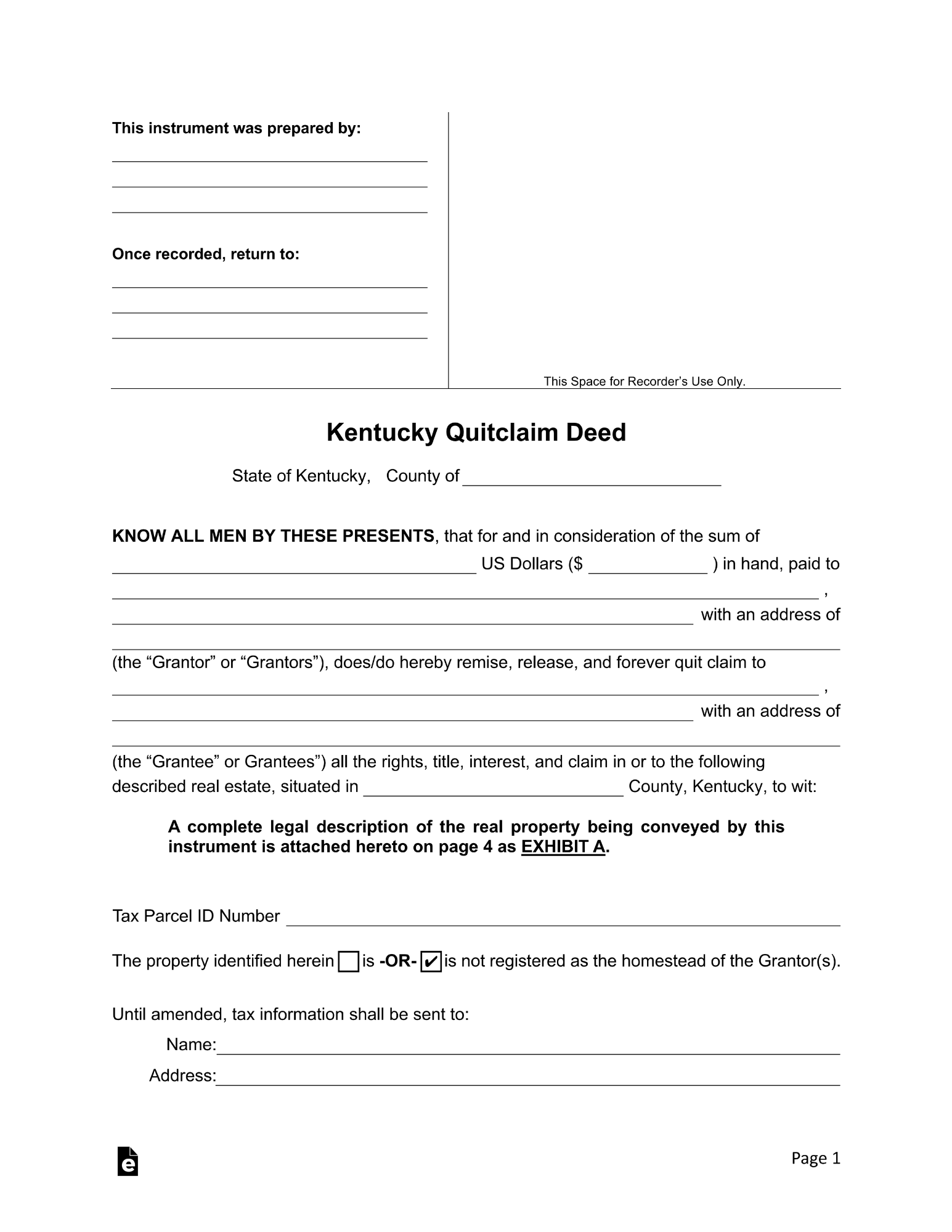
Kentucky Quit Claim Deed

Full Conversation


I am on the title of a home with a co-owner. He wants me to sign a quitclaim deed. I would like a better understanding of my rights and seek to make the best financial decision for myself.

Lexi

Lexi, Chatbot

I understand that navigating co-ownership and quitclaim deeds can be challenging. Have you discussed your concerns with the co-owner regarding the quitclaim deed?

No. I told him I would be seeking legal counsel prior to signing any documentation.

Lexi

Lexi, Chatbot

Are there any specific rights or financial implications you are particularly worried about in this situation?

Yes. Significant.

Lexi

Lexi, Chatbot

Is there anything else the Real Estate Lawyer should know before I connect you? Rest assured they'll be able to help with your rights and financial decision.

No.

Richard

Richard

Hello. My name is Richard and I have been a licensed attorney for over 25 years and hope to be of assistance. Please be advised that this website is for information purposes only and I cannot formally represent customers of this website or perform actual legal services on your behalf. I understand you're co-owning a home and your co-owner wants you to sign a quitclaim deed. Could you please share more details about any specific concerns or steps you've taken regarding this situation?

In 2020, I purchased a home with my romantic partner in Kentucky. We were not married. We are both named on the title/deed and the mortgage note. During our homeownership, we ended the relationship but remained living together and friendly. In July 2022, I started medical school in another city in Kentucky and thus moved out of the house.

To my understanding and memory, we had an agreement that I would pay the sewer and water bills monthly so I could claim the house as my permanent residence, but I was not responsible for the mortgage or other costs of the house. We were not in a spot to be able to sell at the time of my acceptance into medical school, so we agreed to wait to sell the house and split the profit 50/50. Unfortunately, none of this was in writing, but we did have discussion about it and that is to the best of my knowledge what happened.

I would intermittently go and stay a night or weekend at the house since July 2022. The last time I was at the house was March 30, 2025. When I have asked my friend/co-owner to visit since then, he has said "no" or "that does not work for me." So I have not had access to the house since March 30, 2025.

Of note, he has had at least one friend live with him during the time I have been gone for at least a few months. I do have reason to believe that someone has also lived at the house with him (without discussing with me prior) since August 2025.

Also of note, our mortgage loan was sold to a different company in December 2022. To my knowledge, I was not listed with the company it was sold to. The loan was also taken off of my credit report in December 2022; however, I don't know if there was an official release.

In August 2025, the co-owner ended his friendship with me. I was in a tough spot financially and reached out to him about selling the house later that month. He intermittently replied to my messages in August and September. Unfortunately, I was not in a place financially to pursue any legal action and we no longer communicated.

On April 13, 2026, I received a message that he had been working with an attorney and was sending a "quitclaim deed." I responded later in April that I wanted to speak to an attorney prior to giving up my part of the house.

He is now stating that if I don't respond within the week, he is going to file a contribution claim against me for around $40,000. Additionally, I have since learned that he has sought a realtor and listed the house for sale and it is pending sale, all of which was done without discussing it with me.

My goals: understand what my rights are in home ownership, and understand what would be the most financial benefit to me. I am happy to provide his most recent email with the contribution claim if that is helpful.

Richard

Richard

Thanks for sharing all those details. It sounds like a complex situation, and I'm here to help you navigate it.

First, could you clarify if there was any written agreement or documentation regarding your arrangement to pay the sewer and water bills in exchange for claiming the house as your permanent residence?

Also, do you have any documentation or evidence of the discussions or agreements you had with your co-owner about splitting the profits from the sale of the house?

Lastly, have you received any formal communication from the mortgage company regarding your status on the loan or any changes since the loan was sold to a different company?

These details will help me understand your rights and options better.

I have not been able to find any written agreement or documentation regarding the sewer and water bills.

No discussions were documented about splitting the profits of the house.

I have not received any formal documentation from the mortgage company. When it was sold, my name was no longer listed on the bill. All mail was directed to him. I did not and do not have access to the online account of the mortgage.

Richard

Richard

Based on your situation, there are several legal arguments and considerations in property co-ownership that could potentially support your case:

  1. Co-Ownership Rights: As a co-owner, you have equal rights to the property unless otherwise specified in a written agreement. This means you have a say in decisions regarding the property, including its sale.
  2. Quitclaim Deed: This is a legal instrument that transfers any ownership interest you have in the property to another person. It does not guarantee that the property is free of liens or other encumbrances. Signing a quitclaim deed would mean relinquishing your ownership rights.
  3. Contribution Claims: Your co-owner's threat to file a contribution claim suggests he may seek reimbursement for expenses he believes you should have shared. However, without a written agreement, proving such claims can be challenging.
  4. Mortgage and Title: If your name was removed from the mortgage without your consent, it could raise legal issues, especially if you are still on the title. This discrepancy might affect your rights and responsibilities.
  5. Sale of Property: Listing the property for sale without your consent could be a breach of your co-ownership rights. Typically, both parties must agree to sell a jointly owned property.

Let me know if you have any questions or clarifications. If not, I'll move forward with guidance.

He sent an email with an itemized list of contribution claims. Do you need access to that? And is that something you can help me respond to?

Richard

Richard

I don't need to see the email directly, but I can certainly help you understand how to respond to it.

Richard

Richard

Here's a structured approach to your situation:

  1. Understand Your Rights: As a co-owner, you have equal rights to the property. This means you should have been involved in any decisions regarding the sale of the house. If your name is still on the title, you have a legal claim to the property and any proceeds from its sale.
  2. Evaluate the Quitclaim Deed: Signing a quitclaim deed would mean giving up your ownership rights. Before considering this, ensure you understand the full implications, including any financial loss or gain. It's crucial to consult with a real estate attorney to evaluate whether this is in your best interest.
  3. Address the Contribution Claim: Without a written agreement, your co-owner's claim for contributions may be difficult to enforce. However, it's important to review the itemized list he provided and assess whether any of the claims are valid or if you have any counterclaims. You might want to negotiate a settlement that reflects your understanding of the agreement.
  4. Mortgage and Title Issues: Since your name was removed from the mortgage without your consent, you should investigate this further. Contact the mortgage company to clarify your status and ensure there are no outstanding liabilities on your part.
  5. Legal Action and Mediation: If negotiations with your co-owner fail, consider seeking mediation or legal action. A real estate attorney can help you explore options like filing a partition action under KRS 389A.030, which allows any co-owner to ask the circuit court to order the property sold and the proceeds divided. If the court finds the property can be physically divided without impairing its value, division proceeds under KRS 381.135.
  6. Next Steps: Gather any evidence you have of your agreement, even if it's just notes or emails. Document all communications with your co-owner and the mortgage company. This will be useful if you need to take legal action.

Can you help in negotiating a settlement?

Here is what he sent to me:

Here's where things stand:

Down payment gap. When we closed in 2020, I put in $8,260.55 and you put in $1,575.85. A 50/50 split would have been $4,918.20 each. You came up $3,342.35 short of an equal contribution.

Mortgage payments since you moved out. Since May 2022, 48 monthly payments, I've paid every mortgage payment alone. At roughly $1,225 per month, your half of those 48 payments would be $29,400. You remain jointly liable on the original mortgage note throughout that period, which means under Kentucky co-obligor law I have a contribution claim against you for that amount.

Wall repairs and painting. I paid $4,100 in repairs and repainting to fix the deteriorating plaster walls and chipping paint. Your 50% share: $2,050.

Newly discovered sewage line collapse. I just learned the main sewage line has collapsed and excavation work must begin shortly at a cost of $9,500. (Attached is the quote for known repairs, final costs likely to be larger, and an image of the collapsed section.) Your 50% share: minimum $4,750, and this is why I can no longer offer $5,000 for signing of the quitclaim, along with the ongoing quitclaim prep costs.

Additional pending repairs (costs not calculated yet) which need to be addressed are the rotted and damaged fence sections (images attached), collapsed sidewalk sections which need to be raised and/or completely replaced ($1,000 to $2,000 expected, images attached), damaged gutters, damaged house siding that needs to be reset, repairs to the collapsing front cement stairs, etc.

Total you owe me to date: $39,542.35.

That means you owe me more than $8,000 over a 50% home equity value under Kentucky equitable partition, as there is just under $55,000 in total equity in the event of a complete sale (estimated appraisal $210,500) and even less with a refinance. Every additional month I carry the property alone, that gap grows by another $625 or so on top of maintenance costs.

I have no interest in suing you to recover this. It would be expensive, time consuming, public, and stressful for both of us, and I don't believe that serves anyone.

What I'm asking now is simple. Please sign the corrected quitclaim deed and walk away clean so I can utilize the equity to cover repairs or sale without constantly requiring your signature and without impacting your credit. In exchange, I will:

Waive my entire contribution claim against you ($39,542.35+).
Pay all attorney, recording, and notarization costs with my attorney for the prep (as I have).
Remove your name from the mortgage notes as soon as possible, ending any future note exposure for you.
Provide you a written mutual release confirming we're done, ensuring no future claims can be held against you, for peace of mind.

That's the absolute best I can offer now. A complete release from a debt obligation that's already larger than anything you'd recover by holding out, and a clean ending.

Richard

Richard

Just a quick heads-up, I'm happy to share general legal info, but this conversation doesn't create an attorney-client relationship or count as formal legal representation. It's important to consult with a local attorney who can provide specific advice and help you negotiate a settlement based on your unique situation. Let me know if there's anything else I can help with!

What kind of attorney would best be suited to help negotiate a settlement?

Richard

Richard

For your situation, a real estate attorney would be best suited to help negotiate a settlement. They specialize in property law and can provide guidance on co-ownership issues, contribution claims, and quitclaim deeds.

I hope I was able to help resolve your issue! If you have any other questions, feel free to ask.

Don't hesitate to reach out whenever you need assistance!

Richard

Richard

76,546 satisfied customers

Richard
Welcome! Have a similar question?

12 lawyers online now

0:00

By messaging AskALawyer, you agree to our Terms and Privacy Policy.

Disclaimer


By messaging AskaLawyer.com, you agree to our Terms and have read our Privacy Policy.

The information provided on AskaLawyer.com is for general informational purposes only and does not constitute legal advice. While we strive to ensure the accuracy and timeliness of the information presented, we make no guarantees regarding its completeness or applicability to your specific circumstances.

Use of this website does not create an attorney-client relationship between you and AskaLawyer.com or any of its attorneys. Communications through this website, including any responses from attorneys, are not privileged or confidential. For advice tailored to your individual situation, we recommend consulting a licensed attorney in your jurisdiction.

AskaLawyer.com disclaims any liability for actions taken or not taken based on the content of this site. We are not responsible for any third-party content that may be accessed through this website. Reliance on any information provided herein is solely at your own risk.

Ask a Lawyer Logo
Ask a Lawyer Logo
Intake Questions
Step  of 3
Loading...

What's your legal question?

Lexi, Chatbot

How would you like your legal question to be answered?

Online

Loading...

How do you like to pay?

By proceeding with payment, you agree to our Terms and Privacy Policy. You authorize us to charge $ today and $ thereafter until canceled. You may cancel anytime in the My Account section to stop future charges.

Total Due:

After purchasing, your chat will begin with an attorney.

By proceeding with payment, you agree to our Terms and Privacy Policy. You authorize us to charge $ today and $ thereafter until canceled. You may cancel anytime in the My Account section to stop future charges.

Total Due:

After purchasing, your chat will begin with an attorney.

After connecting, your chat will begin with an attorney. After choosing, your chat will continue with Legal AI.

It looks like you already have an account with Ask a Lawyer.

We have sent you a magic link to . Click the link in your email to sign in and continue your chat.

spin

Step of 6 •

You'll receive an email at as soon as the lawyer joins the conversation 🙏🏻😊

Over 90% of lawyers connect within 5 minutes. If you're not online at that moment, don't worry — the lawyer will reply to your message while you're away.

You're also welcome to stay in the chat while waiting to be connected 💬✨

Waiting for lawyer

We couldn't send your message. Please try again.

Your lawyer will reply as soon as possible

If there’s a delay, please don’t worry. Your chat will stay open, and they’ll get back to you as soon as they can. There’s no rush on your end either. You’ll receive an email notification as soon as there’s a new message.

You've reached your AI chat limit

Upgrade your plan to continue chatting and get instant domain-specific answers.

0:00