
[CA] How does a business bankruptcy affect a personally guaranteed commercial lease?

Jon
Jon

556 satisfied customers

View context
Solved

When a California Professional Corporation runs into financial trouble, the key issue is the difference between business liability and personal liability. The corporation is a separate legal entity, which generally protects the owner personally, but a personal guarantee, like the one the spouse signed on the lease, can override that protection.

Under California Corporations Code § 13400 et seq. (the Moscone-Knox Professional Corporation Act), a Professional Corporation provides limited liability. That means the $295,000 in loans, lines of credit, and credit cards typically stays with the business, not the owner personally, as long as no personal guarantees were signed and corporate formalities have been followed. (Note: California courts can disregard this protection under the "alter ego" doctrine where formalities aren't observed; see Sonora Diamond Corp. v. Superior Court, 83 Cal. App. 4th 523 for the standard courts apply.)

The lease is the main risk. If the corporation files for bankruptcy and rejects the lease, 11 U.S.C. § 502(b)(6) limits what the landlord can recover. Instead of the full remaining rent, the claim is capped at the greater of one year of rent or 15% of the remaining lease term (up to three years), plus any unpaid rent at filing.

Courts in the Ninth Circuit have, in some cases, applied this same cap to personal guarantors, which could significantly reduce the spouse's exposure.

If there's no bankruptcy and the lease is simply broken, California Civil Code § 1951.2 applies. The landlord must make reasonable efforts to re-rent the space, and any rent they receive, or could have received, reduces what the guarantor owes under the guarantee.

As for options, Chapter 11 (including Subchapter V for small businesses) allows the company to keep operating while restructuring debt. Chapter 7, by contrast, liquidates the corporation and effectively ends business debts that weren't personally guaranteed.

Another alternative is an Assignment for the Benefit of Creditors, which is faster and more private than bankruptcy but doesn't stop lawsuits or provide the federal lease cap under 11 U.S.C. § 502(b)(6).

In practical terms, the business debts are usually low personal risk, while the lease guarantee is the real exposure. Because of that, it often makes sense to approach the landlord early and try to negotiate a lump-sum settlement that falls somewhere between the bankruptcy cap and the full remaining rent.

0

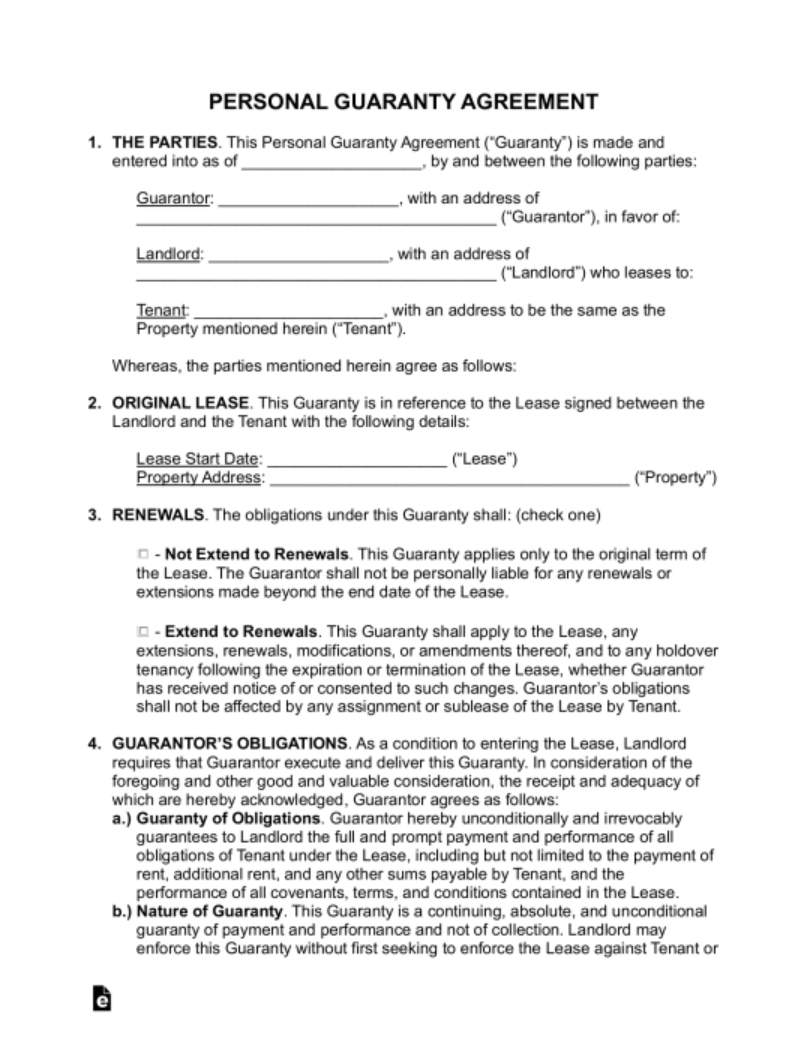
Personal Guaranty Addendum (to a Lease Agreement)
Full Conversation


i'm looking for bankruptcy question for personal and business

Lexi

Lexi, Chatbot

I understand that navigating bankruptcy for both personal and business matters can be overwhelming. Are you currently facing any specific financial challenges with your personal or business debts?

yes, with the business

Lexi

Lexi, Chatbot

Have you already filed for bankruptcy, or are you in the process of considering it?

No, but I am concerned that we may need to

Lexi

Lexi, Chatbot

Is there anything else the Bankruptcy Lawyer should know before I connect you? Rest assured they'll be able to help with your business bankruptcy.

no

Jon

Jon

Hello, and thank you for reaching out! I'm Jon, a licensed attorney with over 13 years of experience, here to help. I understand legal matters can feel overwhelming, but you're in good hands. My goal is to explain things clearly and guide you toward the best possible solution for your situation. Just a quick note: our conversation is for general legal information only and does not create an attorney-client relationship.

ok

Jon

Jon

Can you please tell me which state your business is located in?

California

Jon

Jon

Got it, thanks. What type of business entity do you have (for example, sole proprietorship, LLC, corporation, etc.)?

Professional Corporation

Jon

Jon

And are your business debts personally guaranteed by you or any other owners?

Yes, our lease (we are in year 5 of 10) is personal guaranteed by my wife. our business debts are not personally guaranteed

Jon

Jon

Got it. Approximately how much total debt does your professional corporation currently have? And are you currently facing any lawsuits, collection actions, or threats of legal action from creditors?

total debt excluding the liability of the lease totals $295,000. That combines our business loan, line of credit, and $40k on a credit card

Jon

Jon

Understood! I believe I have all the information I need. Is there anything else you'd like to add before I start working on your answer? If not, I'll get started right away.

Well, my question is kind of general at first. My concern is that our business will not be able to pay all bills at some point in this year. It may not happen. We may be ok, but I want to get an idea of what things look like if things do not go well

Jon

Jon

Got it! I just need a few minutes to put together a complete response for you. It shouldn't take longer than about 4 to 5 minutes, and I want to make sure it's clear and comprehensive. Thanks so much for waiting, I really appreciate your patience.

Jon

Jon

When a California Professional Corporation runs into financial trouble, the key issue is the difference between business liability and personal liability. The corporation is a separate legal entity, which generally protects the owner personally, but a personal guarantee, like the one the spouse signed on the lease, can override that protection.

Under California Corporations Code § 13400 et seq. (the Moscone-Knox Professional Corporation Act), a Professional Corporation provides limited liability. That means the $295,000 in loans, lines of credit, and credit cards typically stays with the business, not the owner personally, as long as no personal guarantees were signed and corporate formalities have been followed. (Note: California courts can disregard this protection under the "alter ego" doctrine where formalities aren't observed; see Sonora Diamond Corp. v. Superior Court, 83 Cal. App. 4th 523 for the standard courts apply.)

The lease is the main risk. If the corporation files for bankruptcy and rejects the lease, 11 U.S.C. § 502(b)(6) limits what the landlord can recover. Instead of the full remaining rent, the claim is capped at the greater of one year of rent or 15% of the remaining lease term (up to three years), plus any unpaid rent at filing.

Courts in the Ninth Circuit have, in some cases, applied this same cap to personal guarantors, which could significantly reduce the spouse's exposure.

If there's no bankruptcy and the lease is simply broken, California Civil Code § 1951.2 applies. The landlord must make reasonable efforts to re-rent the space, and any rent they receive, or could have received, reduces what the guarantor owes under the guarantee.

As for options, Chapter 11 (including Subchapter V for small businesses) allows the company to keep operating while restructuring debt. Chapter 7, by contrast, liquidates the corporation and effectively ends business debts that weren't personally guaranteed.

Another alternative is an Assignment for the Benefit of Creditors, which is faster and more private than bankruptcy but doesn't stop lawsuits or provide the federal lease cap under 11 U.S.C. § 502(b)(6).

In practical terms, the business debts are usually low personal risk, while the lease guarantee is the real exposure. Because of that, it often makes sense to approach the landlord early and try to negotiate a lump-sum settlement that falls somewhere between the bankruptcy cap and the full remaining rent.

We do not have enough money to pay the lump sum for the 1 year of rent, or 15% of remaining rent on the lease term. What would our options be? That amount would be about $108,000.

Jon

Jon

If you cannot afford a lump-sum payment for the lease guarantee, your options shift toward structured negotiations or statutory protections. Under California Civil Code § 1951.2, a landlord is legally required to mitigate damages by attempting to re-lease the space, which means the guarantor's personal liability is reduced by any rent a new tenant pays. You could propose a surrender agreement where you vacate the property early in exchange for a settlement paid in monthly installments over several years. Utilizing a Subchapter V Chapter 11 filing would also allow the business to spread the capped landlord claim over a three-to-five-year repayment plan rather than paying it all at once. If negotiations fail, the time required for a landlord to obtain a court judgment in California often provides a window to settle for a lower amount as their legal fees mount and a new tenant is eventually found. In a worst-case scenario where the debt cannot be settled or paid over time, a personal bankruptcy filing for the guarantor would legally discharge the entire lease obligation.

I am worried about the loss of assets a personal bankruptcy would cost us. Presumably we'd both have to file, correct? I want to know about our house, cars, retirement accounts, etc. Let's put together a hypothetical. Let's say we have a home worth $570,000 with $290,000 remaining on the mortgage. The husband has a teacher pension he pays into and the wife (the guarantee signer) has about $300,000 in a retirement account. We have 2 cars. What does bankruptcy look like in that scenario?

Jon

Jon

California bankruptcy exemptions likely protect your primary assets from being seized to pay creditors. Since your home equity of $280,000 falls below the state's generous homestead exemption, which starts at $300,000, your house is secure. Retirement assets, including the teacher pension and the retirement account, are almost entirely exempt under state and federal law regardless of their value. While vehicle exemptions are more modest, standard cars are typically shielded using a combination of dedicated motor vehicle and wildcard exemptions. Because only the spouse signed the lease guarantee, that spouse could file for individual bankruptcy to discharge that obligation while protecting joint assets. In this scenario, you would likely retain your home, vehicles, and savings while legally eliminating the personal liability for the business lease. For a detailed analysis of your specific numbers, I recommend consulting with a local bankruptcy attorney.

Jon

Jon

556 satisfied customers

Jon
Welcome! Have a similar question?

12 lawyers online now

0:00

By messaging AskALawyer, you agree to our Terms and Privacy Policy.

Disclaimer


By messaging AskaLawyer.com, you agree to our Terms and have read our Privacy Policy.

The information provided on AskaLawyer.com is for general informational purposes only and does not constitute legal advice. While we strive to ensure the accuracy and timeliness of the information presented, we make no guarantees regarding its completeness or applicability to your specific circumstances.

Use of this website does not create an attorney-client relationship between you and AskaLawyer.com or any of its attorneys. Communications through this website, including any responses from attorneys, are not privileged or confidential. For advice tailored to your individual situation, we recommend consulting a licensed attorney in your jurisdiction.

AskaLawyer.com disclaims any liability for actions taken or not taken based on the content of this site. We are not responsible for any third-party content that may be accessed through this website. Reliance on any information provided herein is solely at your own risk.

Ask a Lawyer Logo
Ask a Lawyer Logo
Intake Questions
Step  of 3
Loading...

What's your legal question?

Lexi, Chatbot

How would you like your legal question to be answered?

Online

Loading...

How do you like to pay?

By proceeding with payment, you agree to our Terms and Privacy Policy. You authorize us to charge $ today and $ thereafter until canceled. You may cancel anytime in the My Account section to stop future charges.

Total Due:

After purchasing, your chat will begin with an attorney.

By proceeding with payment, you agree to our Terms and Privacy Policy. You authorize us to charge $ today and $ thereafter until canceled. You may cancel anytime in the My Account section to stop future charges.

Total Due:

After purchasing, your chat will begin with an attorney.

After connecting, your chat will begin with an attorney. After choosing, your chat will continue with Legal AI.

It looks like you already have an account with Ask a Lawyer.

We have sent you a magic link to . Click the link in your email to sign in and continue your chat.

spin

Step of 6 •

You'll receive an email at as soon as the lawyer joins the conversation 🙏🏻😊

Over 90% of lawyers connect within 5 minutes. If you're not online at that moment, don't worry — the lawyer will reply to your message while you're away.

You're also welcome to stay in the chat while waiting to be connected 💬✨

Waiting for lawyer

We couldn't send your message. Please try again.

Your lawyer will reply as soon as possible

If there’s a delay, please don’t worry. Your chat will stay open, and they’ll get back to you as soon as they can. There’s no rush on your end either. You’ll receive an email notification as soon as there’s a new message.

You've reached your AI chat limit

Upgrade your plan to continue chatting and get instant domain-specific answers.

0:00