[TX] Can you use general work experience at a competitor without violating a confidentiality agreement?

TJ, Esq.
TJ, Esq.

23,986 satisfied customers

View context
Solved

THE CORE LEGAL ISSUE

Your situation breaks down into a few distinct legal questions, and the good news is that on each one, you're on the right side of the line. The agreement you signed in 2019 is enforceable under Texas law, but only to the extent it's reasonable in scope and protects legitimate business interests (see Texas Business and Commerce Code ยง 15.50). Courts won't enforce provisions that try to prevent you from using general skills and knowledge you've developed over years of work.

GENERAL PROFESSIONAL EXPERIENCE VS. CONFIDENTIAL INFORMATION

This is the biggest concern you raised, and it's worth understanding clearly. Texas courts have consistently held that employees can use and apply general professional knowledge, skills, and experience gained during employment, even when they work for a competitor. What you can't do is use or disclose trade secrets, proprietary processes, client lists, financial information, or other information the company specifically protected as confidential (see the Texas Uniform Trade Secrets Act, Texas Civil Practice and Remedies Code Chapter 134A).

Based on what you've described, your operational experience, understanding of workflow pain points, and knowledge of how the company's system works fall into the "general professional knowledge" category. You're not taking proprietary code, internal processes unique to your former employer, or confidential business strategies. You're taking what you learned by doing the work. That's legally protected, and you can use it in your new role.

The fact that you'll be helping your new employer build their own approach rather than replicating your former employer's specific systems actually strengthens your position even more. You're applying your experience to create something new, not copying something proprietary.

WHAT ABOUT THE BROAD CONFIDENTIALITY LANGUAGE?

The agreement defines confidential information broadly, and that's intentional on the employer's part. But here's what matters: even with broad language, Texas courts won't enforce provisions that are so vague or overreaching that they effectively prevent you from working in your industry or using general knowledge. The definition you described, while broad, still contemplates actual confidential information like financial data, client lists, and internal documents. General operational knowledge and workflow understanding don't fit that definition, even under broad language.

THE PERSONAL DEVICE ISSUE

This is where you need to be proactive. The personal device language in the agreement is designed to protect the employer if company information was stored on your personal equipment. It doesn't prevent you from using your experience, but it does create a potential problem if company files or confidential information remain on your device after you leave.

Here's what you should do: Before you sign the resignation acknowledgment, go through your personal computer and delete any company-related files, emails, documents, or information. Be thorough. Check your downloads folder, documents, email archives, cloud storage, and any other places where company materials might be stored. Keep a record of what you deleted and when, just in case questions come up later. This protects you because it shows you took the agreement seriously and didn't retain confidential information.

Once you've cleaned your device, you can sign the resignation paperwork with confidence. You've complied with the spirit of the agreement, and you're not retaining anything proprietary.

THE 24-MONTH NON-SOLICITATION CLAUSE

This one is pretty straightforward. You can't directly solicit your former employer's employees to leave and work for you or your new company. That's enforceable under Texas law. But you're not planning to do that, so it's not really a concern for you. If former colleagues reach out to you after you've left, that's different, and you can talk to them. You just can't be the one initiating contact for the purpose of recruiting them away.

THE 12-MONTH NOTIFICATION REQUIREMENT

This is the weakest part of the agreement. Requiring you to notify the company of future employment in the industry for 12 months is unusual and arguably overreaching. Some Texas courts have found ongoing reporting requirements like this unreasonable because they go beyond protecting legitimate business interests and start looking like they're trying to control your career. That said, it's probably not worth pushing back on hard during your exit unless you want to create friction. You're complying with the spirit of it by being transparent about your transition to another brokerage. If they ask, you can tell them where you're going. But you're not legally obligated to provide ongoing updates throughout the year.

SIGNING THE RESIGNATION ACKNOWLEDGMENT

Signing the acknowledgment doesn't create new legal obligations beyond what you already agreed to in 2019. It just confirms you received the agreement again and understand your obligations as you leave. It's not a new contract. So from that standpoint, signing it doesn't increase your risk.

YOUR BOTTOM LINE

Your risk level is low. You're leaving professionally, you're not taking confidential information, you're not soliciting employees, and you're using general professional knowledge that you're legally allowed to use. Clean your personal devices before you leave, sign the resignation paperwork, and move forward with confidence. You're handling this the right way.

0

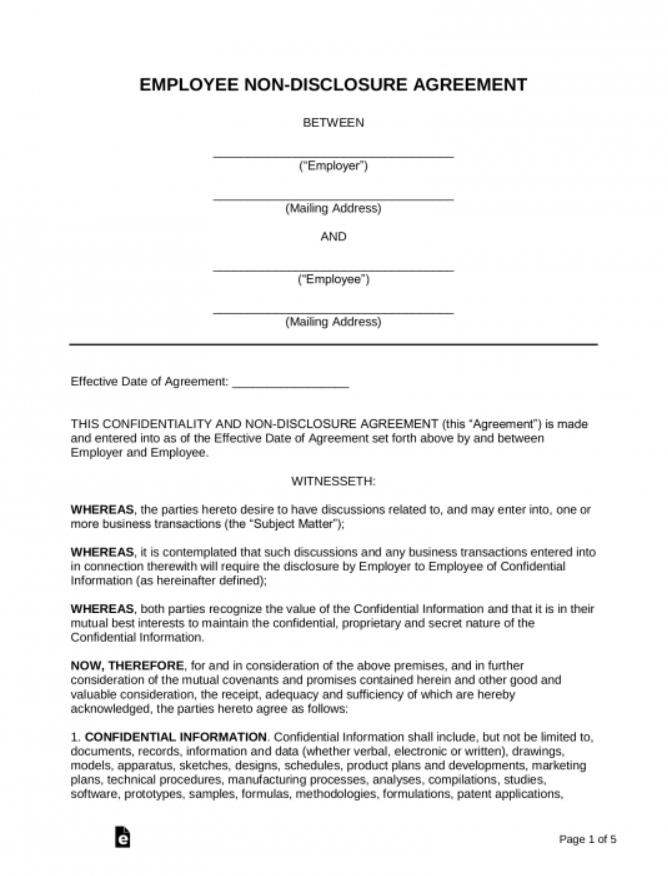
Employee Non-Disclosure Agreement (NDA)

Full Conversation


Hi, I'm located in Texas and recently resigned from a real estate brokerage/accounting operations role after about 6 years with the company. I'm transitioning to another brokerage company in a similar accounting/operations position. As part of my resignation paperwork, my employer attached a Confidentiality, Non-Disclosure, and Non-Solicitation Agreement that I originally signed when I was hired in 2019. The agreement includes:

  • confidentiality obligations that survive employment
  • a 24-month non-solicitation clause
  • language requiring notification of future employment in the industry for 12 months
  • broad language regarding company access to personal devices/services if company information was ever stored there

My concern is that the new company specifically values my experience and operational knowledge from working within my current employer's ecosystem and transaction/accounting processes. I am not taking documents, client lists, proprietary files, or confidential data, but my experience with these systems is a major reason I was recruited.

I want to understand:

  • whether signing the resignation acknowledgment creates any new legal obligations beyond what I already signed in 2019
  • whether accepting employment with another brokerage in a similar operational/accounting role could realistically violate this agreement
  • how enforceable these clauses typically are under Texas law
  • whether there are any sections I should specifically push back on before signing

I'm leaving professionally, returning company property, and not soliciting employees or taking confidential information. I mainly want to make sure I am protecting myself before signing the separation paperwork.

Lexi

Lexi, Chatbot

I understand your concerns about the implications of the Confidentiality, Non-Disclosure, and Non-Solicitation Agreement. Have you had a chance to review the specific terms of the agreement in detail since your resignation?

I reviewed the agreement in detail after my resignation because I'm transitioning to another brokerage company in a similar accounting/operations role and wanted to better understand my obligations.

My main concerns are:

  • the broad confidentiality language
  • the 24-month non-solicitation clause
  • the requirement to notify the company of future industry employment for 12 months
  • the language regarding personal devices/services if company information was ever stored there

I'm not taking any confidential documents, client lists, proprietary files, or internal data. However, the new company specifically values my experience and operational knowledge from working within my current employer's ecosystem, transaction management, and accounting/compliance workflows.

I want to understand where the line is between protected confidential/proprietary information and general professional experience and operational knowledge gained through years of work.

I also want to understand whether signing the resignation acknowledgment itself creates any new legal exposure beyond the agreement I originally signed in 2019.

Lexi

Lexi, Chatbot

Have you discussed your situation with your new employer to see if they have any concerns regarding your transition?

Not in detail yet. The new employer is aware that I currently work within my employer's ecosystem and that my experience with transaction/accounting operations is a major reason they were interested in me for the role.

However, I have not discussed the specific agreement terms with them yet because I wanted to first understand my own legal obligations and whether there are any actual concerns I should raise before starting.

To be clear, I have no intention of bringing over confidential information, internal documents, client lists, or proprietary data. My understanding is that the value I bring is my operational experience, understanding of process pain points, and knowledge gained from working in this environment over the last several years.

Lexi

Lexi, Chatbot

Is there anything else the Employment Lawyer should know before I connect you? Rest assured they'll be able to help with your non-solicitation clause.

No.

TJ, Esq.

TJ, Esq.

Hello! I'm an attorney with over 20 years of experience. Thanks so much for the opportunity to assist you!

TJ, Esq.

TJ, Esq.

Based on what you're describing, signing the resignation acknowledgment likely just confirms you received and understand the original 2019 agreement rather than creating new obligations. The real question is whether your general operational knowledge and experience violates the non-solicitation clause, and that's a gray area. Texas courts generally enforce these agreements if they're reasonable in scope and duration, but using your experience and skills isn't the same as soliciting employees or using confidential information. The 24-month non-solicitation clause is pretty standard and likely enforceable, though the requirement to notify them of future employment for 12 months is unusual and might be harder to enforce depending on how it's worded.

Before you sign the resignation paperwork, are there specific provisions in the agreement that feel overly broad to you? And does the agreement define what counts as "confidential information," or does it use really vague language?

Thank you for walking me through this. I appreciate you being so thoughtful about handling this the right way.

Thank you, that's actually very helpful and lines up with what I was hoping the distinction would be.

My biggest concern is definitely the broad confidentiality language and some of the wording around access to personal devices/services if company information was ever stored there. The requirement to notify the company of future industry employment for 12 months also felt unusually broad to me.

The agreement defines confidential information very broadly and includes things like business operations, employee information, vendor relationships, financial information, future plans, and internal processes. My concern is mainly around where the line exists between protected confidential information and general operational experience and knowledge gained over 6 years in this environment.

For example, the new role values my understanding of transaction/accounting workflows, operational pain points during acquisitions, and my familiarity with my employer's ecosystem overall. I want to make sure that using my professional experience and industry knowledge in a new role would not realistically be viewed as misuse of confidential information.

I have no intention of taking documents, databases, internal files, client information, or proprietary materials with me, and I am leaving professionally and cooperatively. I mainly want to make sure I fully understand my risk level before signing the resignation acknowledgment.

TJ, Esq.

TJ, Esq.

I'm glad that helped. Here's the thing about the distinction you're making, and it's a good one: Texas courts have consistently held that an employee can't be prevented from using general skills, knowledge, and experience gained during employment, even under a non-compete or non-solicitation agreement. The line between protected confidential information and general professional knowledge is real, and it matters.

What you're describing, your understanding of transaction workflows, operational pain points, and familiarity with the company's platform as a system, falls pretty clearly on the "general knowledge" side of that line. You're not taking the company's proprietary processes or internal documents. You're taking what's in your head from doing the work. That's legally protected.

The broad definition of confidential information in the agreement is something to note, but courts in Texas won't enforce overly vague language that tries to restrict general industry knowledge. The personal devices language is pretty standard and mainly protects them if company data was stored there, but it doesn't prevent you from using your experience.

The 12-month notification requirement is unusual and probably the weakest provision in the agreement from an enforceability standpoint, depending on how it's worded. Some courts have found those kinds of ongoing reporting requirements unreasonable.

Your risk level here is pretty low if you're doing what you've described. You're not in violation just by accepting the new role and using your professional experience.

When you transition to the new company, do you anticipate they'll ask you to help them replicate specific internal processes or systems from your former employer, or will you mostly be building your own approach to their operations?

Thank you for trusting me with this. I really appreciate it.

FRIENDLY REMINDER: If there's ever a delay in my response, please don't worry. I'll be back with you as soon as I can. Thanks again for your patience!

I don't anticipate that they would ask me to replicate my employer's internal systems or proprietary processes directly. My understanding is that the value I bring is more around my operational experience, understanding of workflow pain points, and my ability to help improve and organize processes based on what I've learned over the years.

I expect I'll mostly be helping build and improve their own approach to operations rather than attempting to recreate anything proprietary from my current employer.

Also, regarding the personal device portion of the agreement, there were periods where I used my personal computer temporarily for normal day-to-day work while my company-issued equipment was unavailable. Because of that, there may still be company-related files or information stored locally on my device. I have no intention of retaining or using any of that information going forward and fully intend to remove and delete any company-related materials from my personal devices before transitioning out.

TJ, Esq.

TJ, Esq.

Good to know. That actually puts you in a really solid position here, and I want to walk you through why and what you should do before you sign that resignation paperwork.

TJ, Esq.

TJ, Esq.

THE CORE LEGAL ISSUE

Your situation breaks down into a few distinct legal questions, and the good news is that on each one, you're on the right side of the line. The agreement you signed in 2019 is enforceable under Texas law, but only to the extent it's reasonable in scope and protects legitimate business interests (see Texas Business and Commerce Code ยง 15.50). Courts won't enforce provisions that try to prevent you from using general skills and knowledge you've developed over years of work.

GENERAL PROFESSIONAL EXPERIENCE VS. CONFIDENTIAL INFORMATION

This is the biggest concern you raised, and it's worth understanding clearly. Texas courts have consistently held that employees can use and apply general professional knowledge, skills, and experience gained during employment, even when they work for a competitor. What you can't do is use or disclose trade secrets, proprietary processes, client lists, financial information, or other information the company specifically protected as confidential (see the Texas Uniform Trade Secrets Act, Texas Civil Practice and Remedies Code Chapter 134A).

Based on what you've described, your operational experience, understanding of workflow pain points, and knowledge of how the company's system works fall into the "general professional knowledge" category. You're not taking proprietary code, internal processes unique to your former employer, or confidential business strategies. You're taking what you learned by doing the work. That's legally protected, and you can use it in your new role.

The fact that you'll be helping your new employer build their own approach rather than replicating your former employer's specific systems actually strengthens your position even more. You're applying your experience to create something new, not copying something proprietary.

WHAT ABOUT THE BROAD CONFIDENTIALITY LANGUAGE?

The agreement defines confidential information broadly, and that's intentional on the employer's part. But here's what matters: even with broad language, Texas courts won't enforce provisions that are so vague or overreaching that they effectively prevent you from working in your industry or using general knowledge. The definition you described, while broad, still contemplates actual confidential information like financial data, client lists, and internal documents. General operational knowledge and workflow understanding don't fit that definition, even under broad language.

THE PERSONAL DEVICE ISSUE

This is where you need to be proactive. The personal device language in the agreement is designed to protect the employer if company information was stored on your personal equipment. It doesn't prevent you from using your experience, but it does create a potential problem if company files or confidential information remain on your device after you leave.

Here's what you should do: Before you sign the resignation acknowledgment, go through your personal computer and delete any company-related files, emails, documents, or information. Be thorough. Check your downloads folder, documents, email archives, cloud storage, and any other places where company materials might be stored. Keep a record of what you deleted and when, just in case questions come up later. This protects you because it shows you took the agreement seriously and didn't retain confidential information.

Once you've cleaned your device, you can sign the resignation paperwork with confidence. You've complied with the spirit of the agreement, and you're not retaining anything proprietary.

THE 24-MONTH NON-SOLICITATION CLAUSE

This one is pretty straightforward. You can't directly solicit your former employer's employees to leave and work for you or your new company. That's enforceable under Texas law. But you're not planning to do that, so it's not really a concern for you. If former colleagues reach out to you after you've left, that's different, and you can talk to them. You just can't be the one initiating contact for the purpose of recruiting them away.

THE 12-MONTH NOTIFICATION REQUIREMENT

This is the weakest part of the agreement. Requiring you to notify the company of future employment in the industry for 12 months is unusual and arguably overreaching. Some Texas courts have found ongoing reporting requirements like this unreasonable because they go beyond protecting legitimate business interests and start looking like they're trying to control your career. That said, it's probably not worth pushing back on hard during your exit unless you want to create friction. You're complying with the spirit of it by being transparent about your transition to another brokerage. If they ask, you can tell them where you're going. But you're not legally obligated to provide ongoing updates throughout the year.

SIGNING THE RESIGNATION ACKNOWLEDGMENT

Signing the acknowledgment doesn't create new legal obligations beyond what you already agreed to in 2019. It just confirms you received the agreement again and understand your obligations as you leave. It's not a new contract. So from that standpoint, signing it doesn't increase your risk.

YOUR BOTTOM LINE

Your risk level is low. You're leaving professionally, you're not taking confidential information, you're not soliciting employees, and you're using general professional knowledge that you're legally allowed to use. Clean your personal devices before you leave, sign the resignation paperwork, and move forward with confidence. You're handling this the right way.

TJ, Esq.

TJ, Esq.

Does that answer your main concerns about the agreement and your transition? Is there anything else about the specific language or your obligations that you'd like me to clarify?

Thank you again, this has honestly helped put my mind at ease a lot.

I think my last remaining questions are more around practical guidance since I am transitioning to another brokerage company that could be viewed as a competitor.

Based on everything we discussed, is there any reason you would advise against signing the resignation acknowledgment as written?

Also, during my first 6 to 12 months at the new company, are there any specific actions or situations you would advise me to avoid entirely given the agreement I signed?

One thing I'm still trying to better understand is where the line exists in a real-world work environment between general operational experience and industry knowledge versus confidential or proprietary information.

For example, if I'm asked questions in my new role related to transaction/accounting workflows, operational pain points, or how certain processes worked within my former employer's ecosystem, how should I think about determining what would cross into proprietary/confidential territory versus what would simply be considered normal professional experience?

I want to make sure I handle this transition correctly and avoid putting myself in a position where something could later be interpreted the wrong way.

TJ, Esq.

TJ, Esq.

I'd sign the resignation acknowledgment as written. There's no reason to push back on it, and doing so might create unnecessary friction on your way out.

For practical guidance during your transition, here's what I'd keep in mind. You can absolutely discuss general operational workflows, pain points you observed, and how systems like your former employer's platform function in a real-world environment. That's industry knowledge. Where you draw the line is this: don't share specific internal processes that your former employer created or customized, don't reference confidential financial data or client information, and don't describe proprietary systems or methodologies that were unique to that company.

A good rule of thumb is to ask yourself whether the information you're sharing is something that could be learned by someone working in the real estate accounting space generally, or whether it's something specific to your former employer's operations. If it's the former, you're fine. If it's the latter, skip it. You can always say, "I approached it differently at my last place, but I want to learn how you do things here," rather than detailing exactly how your former employer did it.

You're thinking about this the right way, and that instinct to be careful is going to serve you well. Is there anything else you'd like to discuss about this, or do you feel like you have what you need to move forward?

Thank you for all your help. I appreciate your help and what [name redacted] has created here. I think I'm sleeping easy tonight, and I know what to do!

TJ, Esq.

TJ, Esq.

You're very welcome! I'm really glad I could help you feel confident about this transition. You're handling it the right way, and you've got a clear path forward. Best of luck with the new role, and come back anytime you need guidance on anything.

TJ, Esq.

TJ, Esq.

23,986 satisfied customers

TJ, Esq.
Welcome! Have a similar question?

12 lawyers online now

0:00

By messaging AskALawyer, you agree to our Terms and Privacy Policy.

Disclaimer


By messaging AskaLawyer.com, you agree to ourย Terms and have read ourย Privacy Policy.

The information provided on AskaLawyer.com is for general informational purposes only and does not constitute legal advice. While we strive to ensure the accuracy and timeliness of the information presented, we make no guarantees regarding its completeness or applicability to your specific circumstances.

Use of this website does not create an attorney-client relationship between you and AskaLawyer.com or any of its attorneys. Communications through this website, including any responses from attorneys, are not privileged or confidential. For advice tailored to your individual situation, we recommend consulting a licensed attorney in your jurisdiction.

AskaLawyer.com disclaims any liability for actions taken or not taken based on the content of this site. We are not responsible for any third-party content that may be accessed through this website. Reliance on any information provided herein is solely at your own risk.

Ask a Lawyer Logo
Ask a Lawyer Logo
Intake Questions
Step  of 3
Loading...

What's your legal question?

Lexi, Chatbot

How would you like your legal question to be answered?

Online

Loading...

How do you like to pay?

By proceeding with payment, you agree to our Terms and Privacy Policy. You authorize us to charge $ today and $ thereafter until canceled. You may cancel anytime in the My Account section to stop future charges.

Total Due:

After purchasing, your chat will begin with an attorney.

By proceeding with payment, you agree to our Terms and Privacy Policy. You authorize us to charge $ today and $ thereafter until canceled. You may cancel anytime in the My Account section to stop future charges.

Total Due:

After purchasing, your chat will begin with an attorney.

After connecting, your chat will begin with an attorney. After choosing, your chat will continue with Legal AI.

It looks like you already have an account with Ask a Lawyer.

We have sent you a magic link to . Click the link in your email to sign in and continue your chat.

spin

Step of 6 โ€ข

You'll receive an email at as soon as the lawyer joins the conversation ๐Ÿ™๐Ÿป๐Ÿ˜Š

Over 90% of lawyers connect within 5 minutes. If you're not online at that moment, don't worry โ€” the lawyer will reply to your message while you're away.

You're also welcome to stay in the chat while waiting to be connected ๐Ÿ’ฌโœจ

Waiting for lawyer

We couldn't send your message. Please try again.

Your lawyer will reply as soon as possible

If there’s a delay, please don’t worry. Your chat will stay open, and they’ll get back to you as soon as they can. There’s no rush on your end either. You’ll receive an email notification as soon as there’s a new message.

You've reached your AI chat limit

Upgrade your plan to continue chatting and get instant domain-specific answers.

0:00