[CA] Does a tenant need to give 60 days’ notice to remove a subtenant who has lived in the house for over a year?

TJ, Esq.
TJ, Esq.

17,778 satisfied customers

View context
Solved

Here is how this works. California Civil Code Section 1946.1 says that if a tenant, or in your case a subtenant, has lived in a unit for twelve months or longer, the landlord, or in your situation the tenant acting as a landlord to the subtenant, must give sixty days written notice to end the tenancy. This is a hard requirement, and you cannot skip it or use a shorter notice period. (CA Civ Code § 1946.1)

The notice has to be in writing and needs to clearly state that the subtenant’s tenancy will end on a specific date that is at least sixty days away. You should deliver it in a way that creates proof of delivery, either hand deliver it and have the subtenant sign a receipt, send it by certified mail with return receipt requested, or use a process server. Keep a copy for yourself.

Once the sixty-day period ends, if the subtenant still has not moved out, you will need to file an unlawful detainer, eviction, case in court. This is where things get more formal, and the court process will handle the rest. But you cannot skip the sixty-day notice, the court will not allow the eviction to proceed without it. (CA Civ Pro Code § 1161)

Here are the steps to move forward.

  1. Draft a written sixty-day notice to quit that includes the subtenant’s name, the property address, the current date, and the specific move-out date, at least sixty days from when notice is given.
  2. Serve the notice on the subtenant using certified mail with return receipt, or hand delivery with a signed receipt. Keep copies of everything.
  3. Document the date you served the notice and keep all proof of service.
  4. If the subtenant does not move out by the end of the sixty days, consult with an eviction attorney about filing the unlawful detainer case in court.
  5. The sixty-day requirement exists to give tenants adequate time to find new housing, and courts take it seriously. Following this process correctly from the start will help protect you if you end up in court and will make the process move more smoothly.

0

California Lease Termination Letter | 60-Day Notice
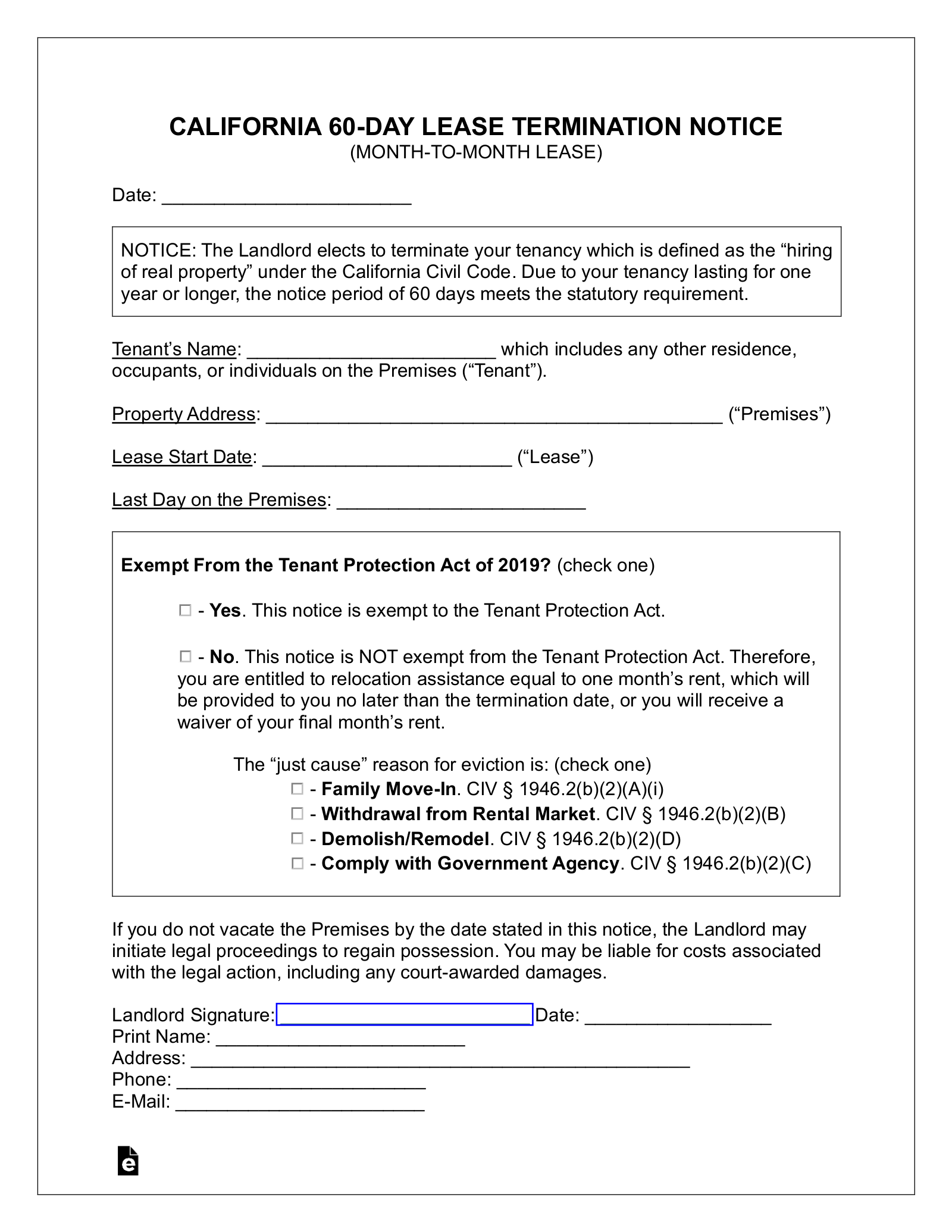
Full Conversation


Chat.

Lexi

Lexi, Chatbot

I understand that you may be feeling overwhelmed with your situation. Can you please describe the specific legal issue you are facing?

I need to remove a subtenant as the tenant in Orange, California.

Lexi

Lexi, Chatbot

Have you already taken any steps or actions regarding this issue?

No.

Lexi

Lexi, Chatbot

Is there anything else the Lawyer should know before I connect you? Rest assured they'll be able to help with your subtenant removal.

No.

TJ, Esq.

TJ, Esq.

Hello! My name is TJ and I’m an attorney. Thanks so much for the opportunity to assist you! I understand how important your legal question is, and I’m giving it my full attention. I’ll share my initial thoughts shortly, and I may also ask for a few additional details. That information will help me understand your situation more clearly so I can offer a more complete and helpful answer.

VERY IMPORTANT INFORMATION: If you don’t hear from me right away, please know I will always get back to you. I may be researching, preparing your answer, or occasionally dealing with a technical issue, so there can be a short wait between messages. However, your message will stay right where it is, and you’ll be notified as soon as I reply.

Sounds good. Thank you!

TJ, Esq.

TJ, Esq.

Hi there! In California, a landlord can remove a subtenant by serving a notice to quit. The process depends on whether the subtenant has a lease agreement with the tenant, not the landlord, and how long they've lived there. Generally, you need to give proper notice and follow eviction procedures if they won't leave voluntarily.

Does the subtenant have a written agreement with your tenant, or is it informal? And roughly how long has the subtenant been living in the unit? Thanks again for reaching out with your question.

I am the tenant and I am serving the notice to the subtenant. The subtenant has been there for over a year.

TJ, Esq.

TJ, Esq.

Got it — you're the tenant removing the subtenant, not the landlord. That's an important distinction.

In California, since the subtenant has been there over a year, they likely have tenant rights even though they're renting from you rather than the landlord. You'll need to serve a 30-day notice to quit, and if they don't leave, you'd need to file an eviction, called an unlawful detainer, in court. You can't just force them out yourself.

Does the subtenant have a written lease or rental agreement with you, or was it just a verbal arrangement?

Would a 60-day notice not be required since the subtenant has been there over a year?

TJ, Esq.

TJ, Esq.

Hey, glad you caught that. You are absolutely right to question that. California law does require a sixty-day notice to quit for tenants who have occupied a property for a year or more. Since your subtenant has been there over a year, the sixty-day notice applies, not the thirty-day notice I mentioned. I apologize for that error.

TJ, Esq.

TJ, Esq.

Here is how this works. California Civil Code Section 1946.1 says that if a tenant, or in your case a subtenant, has lived in a unit for twelve months or longer, the landlord, or in your situation the tenant acting as a landlord to the subtenant, must give sixty days written notice to end the tenancy. This is a hard requirement, and you cannot skip it or use a shorter notice period. (CA Civ Code § 1946.1)

The notice has to be in writing and needs to clearly state that the subtenant’s tenancy will end on a specific date that is at least sixty days away. You should deliver it in a way that creates proof of delivery, either hand deliver it and have the subtenant sign a receipt, send it by certified mail with return receipt requested, or use a process server. Keep a copy for yourself.

Once the sixty-day period ends, if the subtenant still has not moved out, you will need to file an unlawful detainer, eviction, case in court. This is where things get more formal, and the court process will handle the rest. But you cannot skip the sixty-day notice, the court will not allow the eviction to proceed without it. (CA Civ Pro Code § 1161)

Here are the steps to move forward.

  1. Draft a written sixty-day notice to quit that includes the subtenant’s name, the property address, the current date, and the specific move-out date, at least sixty days from when notice is given.
  2. Serve the notice on the subtenant using certified mail with return receipt, or hand delivery with a signed receipt. Keep copies of everything.
  3. Document the date you served the notice and keep all proof of service.
  4. If the subtenant does not move out by the end of the sixty days, consult with an eviction attorney about filing the unlawful detainer case in court.
  5. The sixty-day requirement exists to give tenants adequate time to find new housing, and courts take it seriously. Following this process correctly from the start will help protect you if you end up in court and will make the process move more smoothly.
TJ, Esq.

TJ, Esq.

Did I completely answer your question about the sixty-day notice requirement? Do you need any clarification on how to serve the notice or what comes next if they do not leave after the sixty days?

Thanks again for using this service, I appreciate the opportunity to help you work through this.

TJ, Esq.

TJ, Esq.

17,778 satisfied customers

TJ, Esq.
Welcome! Have a similar question?

12 lawyers online now

0:00

By messaging AskALawyer, you agree to our Terms and Privacy Policy.

Disclaimer


By messaging AskaLawyer.com, you agree to our Terms and have read our Privacy Policy.

The information provided on AskaLawyer.com is for general informational purposes only and does not constitute legal advice. While we strive to ensure the accuracy and timeliness of the information presented, we make no guarantees regarding its completeness or applicability to your specific circumstances.

Use of this website does not create an attorney-client relationship between you and AskaLawyer.com or any of its attorneys. Communications through this website, including any responses from attorneys, are not privileged or confidential. For advice tailored to your individual situation, we recommend consulting a licensed attorney in your jurisdiction.

AskaLawyer.com disclaims any liability for actions taken or not taken based on the content of this site. We are not responsible for any third-party content that may be accessed through this website. Reliance on any information provided herein is solely at your own risk.

Ask a Lawyer Logo
Ask a Lawyer Logo
Intake Questions
Step  of 3
Loading...

Lexi, Chatbot

How would you like your legal question to be answered?

Online

Legal AI

Using ChatGPT 4o

Loading...

How do you like to pay?

By proceeding with payment, you agree to our Terms and Privacy Policy. You authorize us to charge $ today and $ thereafter until canceled. You may cancel anytime in the My Account section to stop future charges.

Total Due:

After purchasing, your chat will begin with an attorney.

By proceeding with payment, you agree to our Terms and Privacy Policy. You authorize us to charge $ today and $ thereafter until canceled. You may cancel anytime in the My Account section to stop future charges.

Total Due:

After purchasing, your chat will begin with an attorney.

After connecting, your chat will begin with an attorney.

After choosing, your chat will continue with Legal AI.

It looks like you already have an account with Ask a Lawyer.

We have sent you a magic link to . Click the link in your email to sign in and continue your chat.

spin

Step of 6 •

You'll receive an email at as soon as the lawyer joins the conversation 🙏🏻😊

Over 90% of lawyers connect within 5 minutes. If you're not online at that moment, don't worry — the lawyer will reply to your message while you're away.

You're also welcome to stay in the chat while waiting to be connected 💬✨

Waiting for lawyer

0:00